


Leaks or revelations are often more compelling because of what they don’t reveal. Through Operation Paperclip, the U.S. organized a monumental transfer of black technology by actively recruiting Nazi criminals for employment by U.S. intelligence. Author H. P. Albarelli excavates the part that was missing from the recently-outed official report: the U.S. pointedly chose fervent Nazi scientists with experience in chemical, biological and radioactive warfare to become the architects of the CIA’s darkest military experiments with human guinea pigs, reminiscent of Nazi Germany.
Voltaire Network |
CIA Denial of Coddling Nazis Far From the Truth - Part 2
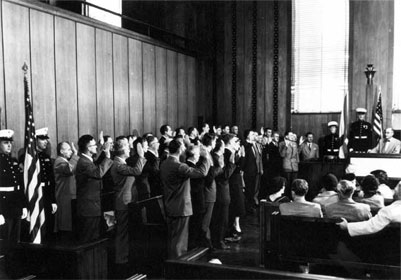
On 11 November 1954, thirty-nine of the German-born scientists who entered the United States through Project Paperclip were sworn in as U.S. citizens. Military Intelligence "cleansed" the files of Nazi references. By 1955, more than 760 German scientists had been granted citizenship in the U.S. and given prominent positions in the American scientific community. Many had been longtime members of the Nazi party and the Gestapo, had conducted experiments on humans at concentration camps, had used slave labor, and had committed other war crimes.
Marvin Washington Brooks had been terribly ill for nearly three months.
A year prior in early-1952, he had been diagnosed with cancer and had been admitted as “a patient for treatment” to the University of Texas Medical School’s M.D. Anderson Hospital. Brooks had served as an infantryman in the Army during World War II. He had received a Purple Heart for being wounded during the Battle of the Bulge. Not long after he was admitted to the M.D. Anderson Hospital, Brooks began to receive weekly treatment from a team of physicians led by an older doctor with a heavy German accent and three distinctive scars across his face. Brooks was told the treatment could significantly affect his cancer in positive ways. But Brooks had become increasingly ill, with constant vomiting, weight and hair loss, and patchy skin with large areas appearing as if severely sunburned. Within about six months of the weekly treatment, Brooks was in constant pain. He died the first month of 1955, two days before what would have turned 47 years old. Brooks was never informed that he was one of 263 cancer patients who were secretly being experimented upon with “whole body irradiation.” Brooks, nor his wife or family, had ever been consulted about the experiments. Nor had Brooks, or anyone else, given the hospital permission to experiment on him. Nobody ever told Brooks, or anyone in his family, that the German physician who saw him weekly was Dr. Herbert Bruno Gerstner, a former Nazi doctor who had been secretly brought to the United States in 1949.
On November 17, 2010 the CIA’s Director of Public Affairs, George Little, wrote a short letter to the editor of the New York Times. Little, on behalf of the agency, protested a just published Times article that detailed CIA “interactions with former Nazi officials in the early years of the post World War II era.” Mr. Little wrote, “We would like to make clear that the agency at no time had a policy or a program to protect Nazi war criminals, or to help them escape justice for their actions during the war.”
The article provoking the CIA’s ire had appeared on the front page of the Times’ Sunday, November 14 edition. Written by reporter Eric Lichtblau, it was entitled “Nazi’s Were Given ’Safe Haven’ in U.S., Report Says”. The article focused on a 600-page “secret report” that had been produced by the U.S. Justice Department. The report, which Justice Department officials had suppressed from public release for years, details the American government’s importation into the U.S., following the end of World War II, of countless numbers of Nazis.
Written in a dry, bureaucratic style, the report recounts a number of examples of well-known Nazis to whom both the CIA and Department of State had provided both shelter and employment to, including Adolph Eichman, Otto Von Bolschwing, Dr. Josef Mengele, and Arthur Rudolph. To the purposes of this article, it is important to underscore here that the long-concealed report makes no mention whatsoever of the many Nazi scientists who specialized in chemical, biological and radioactive warfare and who were secretly relocated in the United States between the years 1946 and 1958.
For many readers, especially those unfamiliar with Project Paperclip, the New York Times article was stunning news. For those who were knowledgeable of the Pentagon’s and CIA’s long-overlooked aggressive efforts at recruiting and utilizing Nazi scientists the article was mostly old news, but its publication along with its accusatory finger pointing at the intelligence agency was encouraging.
While the intent here is not to cast aspersions on Mr. Little— who most likely has little knowledge about the subject in question, and was only issuing protestations at the behest of someone well above him, perhaps DCI Leon Panetta— it is to take strong exception with the CIA’s denial, and to offer ample evidence, taken from the agency’s own files among other government resources, that the denial is blatantly erroneous.
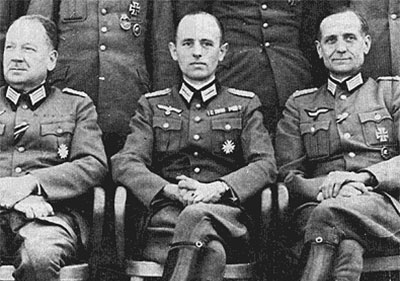
"Operation Paperclip" transferred to the U.S. over 1,600 Nazi scientists, largely escaping the Nuremberg trials. Men who were classified as ’ardent Nazis’ were chosen - just weeks after Hitler’s defeat - to become ’respectable’ U.S. citizens, some of whom are allegedly still working in places like Brookhaven labs, Cold Spring Harbor and Plum Island. Photo: Gen. Reinhard Gehlen (middle) and his SS united were hired, and swiftly became agents of the CIA when they revealed their massive records on the Soviet Union to the US.
Genesis: Project Paperclip
Briefly, America’s initial involvement with chasing down and recruiting Nazi scientists began near concurrently with the Nuremberg Trials. To repeat the words of Clarence G. Lasby, one of the very first historians to take serious note of Project Paperclip: “History is often improvisation; it was so with the evolution of Project Paperclip. The project came to life in the aspirations of those who looked upon the German wartime developments as ‘technically sweet’, to use the phrase with which Robert Oppenheimer described the excitement over the construction of an H-bomb.”
Even before the war had ended, U.S. military, intelligence, and political leaders in Washington, D.C. wanted to do all that they could to capture and recruit Nazi scientists with coveted expertise, knowledge, and experience for employment by the United States government. With the war’s end the race was on. Operation Paperclip was the title of the first such program operated by the Office of Strategic Services (OSS), precursor to the CIA. Chief among the OSS objectives in capturing Nazi scientists was preventing the targeted individuals from falling into the hands of the Soviets or the U.K., both of which had launched their own programs to sweep up Nazis researchers. Over the past half-century the label “Paperclip” has come to encompass many other U.S. lead programs, many sharing the same broad objectives as Project Paperclip, operated at the same time, and administered by the Army, Navy, Air Force, State Department, and CIA. Without doubt the specter of Project Paperclip has strongly permeated the American psyche, especially through the sub-text of the entertainment industry. Apt examples are: both the book and the recently released film Shutter Island; the classic films Marathon Man; Boys From Brazil; Dr. Strangelove; The Right Stuff; The Good Sheperd; and countless television shows and fiction and non-fiction titles.
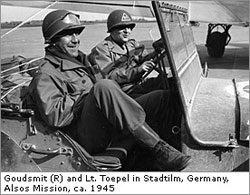
The earliest aggressive attempt at seizing Nazi scientists was a special team of U.S. soldiers called the Alsos Mission, led by U.S. army officer Boris T. Pash and civilian scientist Samuel Goudsmit. The Alsos Mission searched across Europe for targeted Nazis, most of who fell into the broad categories of nuclear, rocketry, and chemical/biological warfare researchers with highly coveted credentials, quite literally pulling a number of less-than-willing scientists from places of hiding in cupboards, dank cellars, medieval castles, and byzantine caves chuck filled with cartons of concealed documents.
Bio-Chemical Warfare Experiments & Nazis
Abhorrent human experiments by Nazi scientists were conducted on large numbers of people by the German Nazi regime in its concentration camps during World War II.
Much overlooked in the large numbers of German scientists secreted into the United States were a sizable number of former Nazi chemists and biochemists brought into the country along with their families. Many of these scientists had been intensely involved in the conduct of human experiments for the Nazis, including horrific activities conducted under the auspices of the dreaded SS and its ultra-secret Ahnenerbe Institutes at several concentration camps.
Illustrative of the thinking and fervor with which the United States pursued Nazi bio-chemical researchers are sections of a 1946 report on targeted German scientists. It reads: “Dr. Reetz is deemed an outstanding scientist in the field of chemical warfare agents, especially in synthesizing of new war chemicals. While employed with the German Chemical Warfare Laboratories (NWA) at Spandau, he is known to have synthesized more than one hundred war gas compounds. Dr. Reetz is also known to be thoroughly conversant in the chemistry of nerve gases, such as Sarin, Somar, and Tabun, and with the irritant gas Excelsior as developed in the German Chemical Warfare Laboratories at Spandau and Raubkammer…. Dr. Schrader conducted research on the synthesis of Tabun, Sarin, and Soman… Dr. Von Juergen Klenk was manager of the Sarin plant at Seewerk. Because of his knowledge of this chemical warfare agent he should be interrogated by organic chemist and chemical engineers on the U.S. Chemical Warfare Service…Dr. Gross Eberhard has also worked with Sarin, Tabun, and Soman, as to toxicity and treatment of symptoms… specialists from Camp Detrick should be assigned to the interrogation of all of these doctors…. Also high on the list is Dr. Hoffmann who worked in the Gatow chemical laboratories.”
“Dr. Hoffmann” was German scientist Dr. Friedrich “Fritz” Hoffmann, who came to America in 1947 through the Paperclip pipeline. During the war, Hoffmann had been based in Frankfurt and Gatow, a district of Berlin, where he conducted a myriad of chemical experiments for the Third Reich. Reportedly, Hoffmann, a large, gregarious man, who spoke English fairly well, was opposed to the Nazi ideology but evidence of this appears slim. After the war, the British counterpart Paperclip project, Operation Matchbox, had recruited him. He worked developing synthesized poison gases at Porton Down, but he did not like living in England and failed to get along with British researchers.
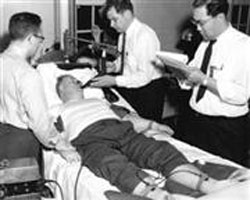
Sarin-gas breathing experiments at the Edgewood Arsenal facility. During the 1960s thousands of Army enlisted men served as "volunteers" for the secret testing of chemical and incapacitating agents. The actual historical record, however, has until now remained disturbingly incomplete.
In the U.S., Hoffmann was initially posted at Camp Detrick and Edgewood Arsenal, where he continued his work with refining lethal sarin and tabun gases for warfare objectives, utilizing a specially built gas chamber, put together along with Edgewood Arsenal research chief Dr. Seymour Silver, within which countless animals were destroyed, and at least 25 alleged ‘volunteer’ American servicemen were experimented upon. Reports that several servicemen died in these experiments have persisted for decades, but the Pentagon refuses to release any documents concerning the experiments.
In early 1952, the CIA, in conjunction with researchers at Camp Detrick and Edgewood Arsenal, including relocated Nazis Hoffmann, and Dr. Karl Tauboeck, who had researched truth serums and nerve gases for the Nazi SS, undertook construction of yet another special chamber that could be used “in oxygen deprivation experiments” similar to those conducted by the Germans on concentration camp inmates. Reads an April 11, 1952 CIA memorandum: “[Oxygen deprivation] affects the higher brain centers, resembling alcoholic inebriation. Some subjects [in experiments conducted thus far] became exhilarated, talkative, or quarrelsome, with emotional outbursts or fixed ideas. Some complained of headache or numbness. Voluntary coordination and attention are impaired… burns and bruises are not noticed.”
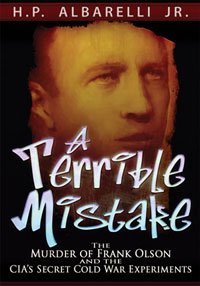
A Terrible Mistake, by J. P. Albarelli, junior
Hoffmann also worked on organophosphate insecticides while at Camp Detrick and helped develop protective clothing for researchers there, a project that brought him into occasional contact with U.S. Army researchers Drs. Frank R. Olson and Harold A. Abramson.
Eventually, in the mid-1950s, Hoffmann joined the staff of a specially created CIA front-organization called Chemrophyl Associates. The company, which had Drs. Sidney Gottlieb, Robert Lashbrook, and Ray Treichler of the CIA’s Chemical Branch as its primary corporate officers, was headquartered in a Washington, D.C. post office box and had a desk at the CIA’s Technical Services Section (TSS), then located on the National Mall near the Reflecting Pool. Chemrophyl soon evolved into another CIA front called the Amazon Natural Drug Company.
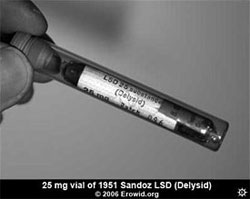
At about the same time, Hoffmann ordered a hefty supply of LSD-25 [eight cartons of LSD ampoules] from the Sandoz Chemical Company in Basle, Switzerland. Hoffmann would also rendezvous with pioneer mycologist Gordon Wasson and University of Delaware professor and covert CIA consultant James Moore in Mexico. Hoffmann would also meet several times with officials of Sandoz Chemical company, including Albert Hofmann and Dr. W.A. Stohl, Jr. and would on at least two occasions also meet with Dr. Henry K. Beecher, a noted Harvard University professor, who in turn had also met often with Sandoz officials Hofmann and Stohl, as well as with the covert operative who had secretly worked since 1946 for U.S. Army intelligence in the Sandoz laboratories.
Former CIA Chemical Branch chief Dr. Sidney Gottlieb spoke of the Moore and Sandoz agency connections in 1998: “Moore was perhaps not the best choice but he was a friend of a friend… and, of course, we were well aware that the military, people with the Army, had been well ahead of us in the way of hallucinogens, especially LSD… Operatives, as well as informants, had been inside the Sandoz laboratories for years and information from insiders was being relayed to Edgewood [Arsenal] on a weekly basis sometimes, but still we went ahead with our own subprojects, some of which peripherally involved Hoffmann.”
Hoffmann would also see to it that hundreds of rhesus monkeys from Latin and South America were shipped by the CIA’s front-company to Fort Detrick’s Special Operations Division, Frederick, Maryland, where the primates would be fed a steady diet of psychotropic drugs in efforts to study various stages of induced “psychotic behavior.” These experiments would quickly evolve into human experiments conducted among U.S. service personnel at Edgewood Arsenal, Maryland and several federal prisons. Said one former Detrick researcher, “I don’t know which was more frightening, one of the monkeys pumped-up on a cocktail of psychedelics or one of the drugged, out-of-control inmates at Atlanta’s federal penitentiary.”
Other front organizations maintained by the CIA’s Security Research Services that involved Hoffmann, and other former Nazis transported to the U.S., included a front-organization called the Morwede Company, which maintained a small office on New York Ave. NW in Washington, D.C. The Morwede Company worked closely with the CIA-created Human Ecology Fund in the late 1950s and 1960s and focused some of its activities on matters that clearly fall into the esoteric realm.
In the late 1950s, Dr. Hoffmann’s work for the CIA and Fort Detrick also evolved into intensive research regarding the development of lethal chemical agents to be used as weapons in Vietnam. One of these weapons initially became known as Agent White, then Agent Blue, and eventually and infamously as Agent Orange, a so-called herbicide, or defoliant, that wreaked havoc with the health of countless American soldiers and veterans. Agent Orange, which contains deadly Dioxin (unsafe at any level of use), was authorized (along with Agent White) for use in Vietnam in November
1961, with the stated objective of “improving road and waterway visibility and clear camp perimeters” so that “greater numbers of enemy troops could be killed.”
Earlier in 1959, and perhaps even before that, Dr. Friedrich Hoffmann, working for the Army Chemical Corps and CIA, had been dispatched to Europe to scan the chemical-biological landscape there for “potential warfare agents.” Hoffmann met with a wide array of military and corporate officials in Europe all of whom overwhelmingly supported the use (and sale) of chemical warfare agents such as Agent Orange-type compounds, which were then in the very early stages of development by U.S. military researchers. While in Europe, Hoffmann also, ironically through a series of meetings with German and U.K. scientists, became aware of what he later termed “startling information about the toxicity of Dioxin” including the fact that the chemical had been strongly linked to “severe and sometimes fatal liver damage.” Through these contacts Hoffmann became aware of industrial incidents and accidents during which “trace amounts of dioxin in a wood preservative had caused several deaths from liver failure among [exposed] workers.” When Hoffmann returned to the U.S. he promptly wrote a report to his superiors within which he revealed his findings about Dioxin, but his report apparently was ignored. The subsequent widespread damage and destruction done by years of Agent Orange use in Vietnam is amply documented and is still very much with us today.
Radiation Experiments and Paperclip Nazis
Project Paperclip brought Dr. Herbert Bruno Gerstner from Germany to the United States in 1949. Following processing and orientation in New York City at the now gone Alamac Hotel, Gerstner, a small, slim man with three long scars across his left cheek, was sent in 1950 to Texas where he began his work at the Air Force’s School of Aviation medicine in San Antonio. Prior to coming to America, Gerstner had spent much of his professional career in Leipzig, Germany. There he worked for the University of Leipzig. Some readers may recall that the University employed a number of physicians who were quite prominent in the Nazi’s euthanasia program aimed at the mentally ill, including large numbers of children.
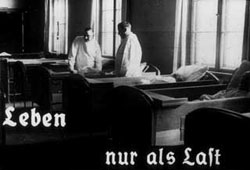
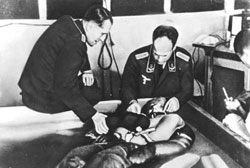
This photo originates from a film produced by the Reich Propaganda Ministry. It shows two doctors in a ward in an unidentified asylum. The existence of the patients in the ward is described as "life only as a burden." Such propaganda images were intended to develop public sympathy for the Euthanasia Program.
Gerstner interned at the Leipzig’s University Medical Policlinic, where he worked as a scientific assistant in the University’s Physiology Institute directed by Dr. Martin Gildemeister. Gildemeister was an authority on the effects of electricity on people struck by lightning and on victims of accidental electrocution, as well as a widely regarded researcher of electromagnetic fields. Gerstner considered Gildemeister his mentor and the two men were close professionally and on a social basis. Following Gildemeister’s death in 1943, Gerstner vigorously continued his mentor’s research. It is suspected that in the mid-1930s Gerstner had extensive contact with German psychiatrist Dr. Frederick Panse. Panse was the inventor of the “Panse method” or “Pansen”, an extreme form of shock therapy that one U.S. government report dubbed as “pure unadulterated sadism.” Dr. Pansen became a psychiatric consultant for the German military under the Third Reich. In 1935, he became a founder and director of the Rhenish Provincial Institute for Psychiatric and Neurological Genetics. In 1937, he was a much sought after lecturer on racial hygiene. In 1940, be became a lead consultant for Hitler’s T4 euthanasia program. Under the program, Panse advocated for the extermination of those with “incurable mental illness” and he was praised for “expertly guiding” hundreds of people into the gas chambers, after he made them “drunk with elation” through the administration of a number of drugs.
All the while Panse was developing his skills at guiding the mentally ill toward their murders, Dr. Herbert Gerstner worked diligently on studying the effects of electricity on the human body. As early as 1935, Dr. Gerstner began collaborating with Dr. Siegfried Koeppen, a close associate of Dr. Panse. Koeppen worked closely with Professor Julius Hallervoden, who under the T4 euthanasia program dissected the brains of hundreds of people killed because they were found “undesirable to society.” Together Gerstner and Koeppen conducted a series of experiments on untold numbers of human subjects designed to compare the wounds inflicted upon human skin from burns and electrocution. The scant files that remain on these experiments indicate that the two researchers had ample supplies of “fresh human skin” that is believed to have come in part from the “feeble minded” children exterminated by the T4 program. Remarkably, when Gerstner was first interviewed by Project Paperclip officials, before being sent to the U.S., he admitted to using human subjects in his experiments, explaining that from 1937 through to 1939 he used subjects that were “cancer patients” and “old people and young people who were sick.”
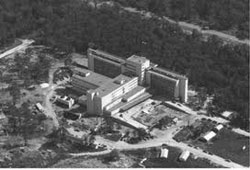
University of Texas Medical School’s M.D. Anderson Hospital in 1953.
When Gerstner was recruited by Paperclip officials for work in San Antonio at the M.D. Anderson Hospital for Cancer Research his research in Nazi Germany made him a perfect match for the objectives of the Air Force and CIA, both of which were most interested in learning all that they could about how many flights a pilot of a nuclear-powered aircraft might take without harmful radiation exposure, as well as how to treat radiation and electrical burns on human flesh. Dr. Gerstner’s Texas cancer patients never for a moment suspected that their treatment at the hands of Gerstner and his associates was not in their best interest or aimed at curing their illness. Even when they became deathly sick with constant vomiting, dehydration, skin lesions, and rapid weight loss, Gerstner’s patients did not suspect that they were being administered an extreme amount of X-ray dosages that would eventually kill them.
[End of Part 1 of a three-part article.]
Other articles of interest are:
– The U.S. ruling class’ bargains with the Reich, by Vladimir Simonov, Voltaire Network, 3 May 2005.
– «Operation Paperclip» : des V2 à la Lune, by Thierry Meyssan, Réseau Voltaire, 24 August 2004.
– Les Bush et Auschwitz, une longue histoire, by Thierry Meyssan, Réseau Voltaire, 3 June 2003.


 Articles by this author
 Send a message
United States of America


Linda Thomas-Greenfield, Madame Veto has blood on her hands

Jared Kushner’s cruel shenanigans with Gaza’s beaches

Bombs and Humanitarian Aid from the USA in Gaza

State of the Union Address
continue


Stay In Touch
Follow us on social networks
Subscribe to weekly newsletter