


In the context of the financial crisis which is jolting European Union states in much the same way that it crippled Southern countries for several decades, the Committee for the Abolition of Third World Debt (CADTM) has presented eight alternative proposals. Some of the ideas stem from a particular view of society, while others are based on CADTM’s experience in Third World countries. All, without exception, deserve to be examined.
Voltaire Network |
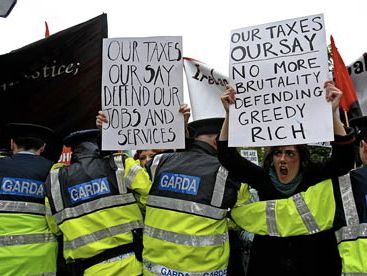
The crisis has shaken the European Union to its very foundations. Public debt is suffocating several countries that have been badly hit by the financial markets. With the governments currently in office, and the European Commission (EC), European Central Bank (ECB), and IMF all aiding and abetting, the financial institutions responsible for the crisis are making lots of money while speculating on government debt. Meanwhile, business owners are taking advantage of the situation to launch an offensive against the social and economic rights of the majority.
The reduction of public deficits must be brought about not through cuts in spending for social programs, but through an increase in tax revenue as a result of efficient measures against tax evasion, more taxation on capital, financial transactions, personal wealth, and higher incomes. To reduce public deficits, cuts should be made in arms spending, as well as other expenditures that are socially obnoxious and detrimental to the environment. It is by contrast essential to increase spending on social programs, if only to compensate for the consequences of the economic depression. Beyond this protective position, the current crisis should be seen as an opportunity to break away from the capitalist mindset and achieve a radical change in society. The new logic to be developed must turn away from productivism, take the environment into account, remove all forms of oppression (based on race, gender or other arbitrary criteria), and support universal access to common goods.
To achieve this goal we must build an anti-crisis front both locally and at the European level so as to bring together enough energy to create a balance of power that is favorable to the implementation of radical solutions focusing on social justice and concern for the environment. As early as August 2010, the CADTM drafted eight alternative proposals to the crisis in Europe. [1] The main point is the need to cancel the illegitimate part of the public debt. To this end, the CADTM recommends setting up an audit under citizen control, which should be combined, in some cases, with a unilateral and sovereign suspension of repayment. The aim of the audit is to cancel the illegitimate part of the public debt and to strongly reduce the remainder.
A radical reduction of public debt is necessary but not sufficient in order to get EU countries out of the crisis. It has to be complemented with significant measures in various areas.
1. Auditing public debt to cancel the illegitimate part
A significant part of the public debt in EU countries is illegitimate since it results from a deliberate policy by governments that have decided to systematically favor the moneyed classes to the detriment of other members of society. Tax reductions on higher incomes, personal wealth, and the profits of private corporations have led public authorities to increase the public debt so as to compensate for the drop in government revenues. They have also raised the tax burden on low income households, that is, on the majority of the population. Moreover, the 2007-2008 bail out of the private the financial institutions responsible for the crisis has meant huge spending of public money and a rapid rise of public debt. The decrease in revenues because of the crisis triggered by private financial institutions had to be financed once again by massive borrowing. Such a context clearly shows the illegitimacy of a significant part of the public debt. In a number of countries blackmailed by the financial markets we must add other obvious sources of illegitimacy. From 2008 onward, public money has been borrowed from private banks (and other private financial institutions), which have used the money they get at very low rates from central banks to speculate and compel governments to raise the amounts they pay them. In countries such as Greece, Hungary, Latvia, Romania, and Ireland, IMF loans were granted on conditions that run against the population’s economic and social interests. Worse yet, these conditions again favor banks and other financial institutions. They must therefore be regarded as illegitimate. Finally, in some cases governments have gone against the will of the people: for instance, while in February 2011 a large majority of the Irish voted against parties that had granted gifts to bankers and accepted the conditions imposed by the European Commission and the IMF, the new government coalition has led the same policies as the previous ones. More generally, in many countries the legislative branch of government has gotten marginalized by policies enforced by the executive branch after agreements with the European Commission and the IMF. The executive submits the agreement to Parliament who then has to take it or leave it. In some cases, debates without votes are organized on major issues. The tendency of the executive branch to turn parliament into a rubberstamping assembly is getting stronger.
In such a troublesome situation, knowing as we do that several countries will soon have to face a defaulting scenario for want of cash, and that repaying illegitimate debt is by definition inacceptable, we have to speak out loud and clear in favor of the cancellation of illegitimate debt. The cost of the cancellation must be borne by private financial institutions, i.e. those that are responsible for the crisis.
Countries such as Greece, Ireland, Portugal, and ones in Eastern Europe (or outside the EU, such as Iceland), i.e. countries that are being blackmailed by speculators, the IMF and other bodies such as the European Commission, ought to call for a unilateral moratorium on repayment of the public debt. The proposal is gaining popular support in countries that are most badly hit by the crisis. In Dublin at the end of November 2010, in a telephone survey of some 500 people, 57% of the Irish in the poll favored defaulting rather than receiving emergency aid from the IMF and the EU. "Default! say the people", was the headline of the Sunday Independent, the island’s main weekly. [2] The CADTM argues that such a unilateral moratorium must be combined with the auditing of public loans (with citizen participation). The auditing should give the government and public opinion the necessary evidence and arguments to cancel/repudiate the part of the debt that has been found to be illegitimate. International law and the various national laws offer a legal basis for such a unilateral sovereign act of cancellation/repudiation.
Its experience working on the debt question in the South incites the CADTM to warn defaulting countries against insufficient measures such as merely suspending repayment, which can prove counterproductive. What is required is a moratorium without accrual of interest on over-due loans.
In other countries such as France, the UK or Germany, it may not be imperative to call for a unilateral moratorium during the auditing period. Yet an audit has to be carried out in order to determine the scope of the cancellation/repudiation called for. Should the international economic environment deteriorate further, a suspension of payment may be on the agenda even for countries that thought they could not be blackmailed by private creditors.
Citizen participation is an imperative condition to guarantee that an audit is objective and transparent. The auditing committee must include the various public bodies concerned, experts in auditing public finances, economists, jurists, constitutionalists, and representatives of social movements. This will make it possible to decide on the various responsibilities involved in the indebtedness process and to demand accountability of those responsible, whether at a national or international level. Should the current government not agree to debt auditing, a citizens auditing committee must be set up, without the government’s participation.
In all cases, it is legitimate for private institutions and high-income individuals, who hold debt securities, to bear the burden of the cancellation of illegitimate sovereign debt, since they are largely responsible for the crisis, and have also profited from it. This is merely a fair return to more social justice. It is important to create a register of security holders in order to compensate those who have low or middle-range incomes.
If the audit brings up evidence of crimes related to illegitimate debt, their perpetrators must be heavily sentenced to pay compensation and serve prison terms as befits the severity of their transgressions. Public bodies that have contracted illegitimate loans must be held accountable.
As for legitimate debt, creditors should be forced to try and reduce the principal and the interest rates, and to postpone maturity. Here again, positive discrimination in favor of small holders of public debt securities should insure that they get paid. Moreover, the amount in the state budget set aside for refunding the debt must be capped depending on the economic conditions, public bodies’ ability to repay, and the irreducible nature of spending on social programs. We must take inspiration from what was done for Germany after WWII. The 1953 London agreement on German external debt (which among other measures reduced the principal of the debt by 62%) stipulated that the debt service / annual export income ratio could not exceed 5%. [3] We could define a similar ratio: the amount dedicated to repaying the debt cannot exceed 5% of the State’s revenues. We must also define a legal framework so as to avoid a repetition of the crisis that started in 2007-2008, including the prohibition of socializing private debts, an obligation to organize a permanent audit of public debt policies, with citizen participation, the non applicability of statutory limitations to crimes related to illegitimate debt, invalidity of illegitimate debt, and so on.
2. Stop austerity plans, they are unfair and are only making the crisis worse
Governments of European countries have chosen to comply with IMF demands and impose strict austerity policies on their populations, with slashed public spending, including massive layoffs of civil servants and frozen or even reduced salaries for them, reduced access to some vital public services and to social protection, later retirement age. Conversely public corporations have demanded – and received – an increase in their prices, while the cost for getting access to health care and education has risen. Using particularly unfair higher indirect taxes such as sales tax (VAT) is more and more frequent. Public corporations in the sectors open to competition have been massively privatized. The austerity policies implemented have been pushed to levels not seen since World War II. The consequences of the crisis have thus been made much worse by the alleged remedies, the main aim of which is to protect the interests of capital holders. In a nutshell, champagne for the bankers, and peanuts for the workers, pensioners, and unemployed!
But the people are less and less ready to bear the injustice of such reforms, which signify large scale social regression. Those who are being forced to contribute the most to enable governments to pay back creditors are wage earners, the unemployed and low-income households. Meanwhile, women are the most severely affected, since the current organization of patriarchal society and the economy is such that they bear the brunt of the disastrous consequences of make-shift, part-time, and under-paid jobs. They are also directly affected by the deterioration of public social services. Our struggle to impose another mindset must go hand in hand with a struggle for the total respect of women’s rights.
3. Establish real European fiscal justice and a fair redistribution of wealth.
Ban transactions with legal and tax havens. Fight against the massive fiscal fraud being committed by the largest and most prosperous corporations.
Since 1980, the rates of direct taxation on the highest incomes and largest corporations have continuously fallen in the European Union. Between 2000 and 2008, the highest personal income tax rate fell by 7 percent, while the highest corporate tax rate dropped by 8.5 percent. These hundreds of billions of euros in tax breaks have been largely dished out to speculators and the richest members of society, who have seen their wealth continue to accumulate.
Major fiscal reform aiming for social justice must be implemented (decreasing the revenues and personal wealth of the richest so that the rest of the planet can have more), and adopted throughout Europe in order to prevent fiscal dumping. [4] The goal is to increase public revenues, in particular via a progressive tax on the revenues of the wealthiest individuals (the marginal rate for those in the highest tax bracket must be raised to 90% [5]), a tax on personal wealth above a certain amount, and a corporate tax. This increase in revenues must be accompanied by a rapid decrease in the price of every day goods and services, such as basic food items, water, electricity, heating, public transport, and school supplies, which can be accomplished via a substantial and targeted decrease in the sales tax (VAT) applied to these vital goods and services. The fiscal policy adopted should also encourage the protection of the environment by applying a dissuasive tax penalizing companies that pollute.
The EU must adopt a tax on financial transactions, particularly on foreign exchange markets, so as to increase government revenues.
Despite their lofty intentions, the G20 countries have repeatedly refused to deal with legal and tax havens. A simple measure to fight against these tax havens (which drain vital resources needed for the development of people in Northern as well as Southern countries) would consist in adopting a law officially banning all individuals and companies located in a country from making any kind of transaction transiting through a tax haven, with a fine that would be equivalent to the amount of the forbidden transaction. Ultimately, these financial cesspools must be eliminated, along with the criminal activities, corruption, and white-collar suit and tie delinquency occurring there.
Fiscal fraud drains a considerable amount of resources from the local community and adversely affects employment. Substantial public resources must be allocated to government finance services so they can combat this kind of fraud effectively. The results of their activities must be made public, and the guilty parties must be severely punished.
4. Rein in the financial markets by creating a register of securities holders, and forbidding short sales and speculation in various domains. Create a public European rating agency.
Worldwide speculation represents several times the amount of wealth produced on the planet. The highly complex nature of this financial engineering makes it totally uncontrollable. The mechanisms it puts into play undermine the real economy. Opaque financial transactions are the rule. To be taxed at the source, the creditors must be first identified. Financial market dictatorships must come to an end! Speculation must also be forbidden in many arenas. Speculation on government bonds, currencies, and food should also be forbidden. [6] Short sales must also be banned [7] and Credit Default Swaps strictly regulated. Over-the-counter derivatives markets must be closed, because they are veritable black holes, not subject to any regulation or surveillance.
Rating agencies must also be seriously reformed and strictly regulated. Far from being instruments for making objective scientific estimations, they have become basic devices structuring neoliberal globalization and have already triggered social catastrophes several times. When a country’s rating is lowered, the interest rates on the loans made to it are increased, which explains why the economic situation in the country concerned further deteriorates. The complacent behavior of speculators greatly exacerbates the difficulties encountered, which will adversely affect common citizens. The submissive attitudes of these rating agencies in their dealings with the North American financial sector, has turned them into a major actor on the international scene, and their responsibility in triggering and worsening crises has not been highlighted enough by the media. The economic stability of European countries has been placed in the hands of these rating agencies with no safeguards, no serious means of controlling them provided by governmental authorities. The only way to get out of this impasse is by creating a public rating agency.
5. Transfer the banks to the public sector with citizen control.
After decades of financial excesses and privatizations, it is high time to transfer the banking sector to the public domain. Governments must recover their capacity to control and frame economic and financial activity. They must also have the instruments needed to make investments and finance public spending by minimizing the need to borrow from private and/or foreign institutions. Banks must be expropriated with no compensation for their owners, and transferred to the public sector where they would be placed under citizen control.
In some cases, the expropriation of private banks would represent a cost for the State because of the debts they have accumulated. This cost would have to be paid for by the banks’ major shareholders. The private corporations, which are shareholders of the banks and often led them to the financial abyss in the first place, while making juicy profits, hold part of their wealth in other sectors of the economy. A levy must be placed on the wealth of these shareholders, so as to avoid making the general public pay for the bank losses. The Irish example is emblematic: the way in which the Irish Allied Bank was nationalized is totally unacceptable, and we must draw appropriate lessons from this very bad example.
6. Re-nationalize the numerous companies and services privatized since 1980.
During past thirty years many public corporations and public services have been privatized. From banks to the heavy industry sector as well as the postal service and telecommunications, energy, and transport, governments worldwide have handed over entire blocks of the economy to the private sector, losing in the bargain any capacity to regulate the economy. These public goods, which are the fruit of collective work, must be returned to the public domain. The idea would be to create new public corporations and to adapt public services to the needs of the people, in particular to respond to climate change issues, with for example the creation of a public service for insulating buildings.
7. Drastically reduce the amount of time people work to create jobs and increase wages and pensions
Redistributing wealth in a different way is the best response to the crisis. The share of the wealth produced going to employees has significantly decreased for decades, while the creditors and businesses have increased their profits and as a consequence engaged in more financial speculation. Increasing wages, not only increases people’s well-being, it also makes more means available for social protection and pensions.
By decreasing the amount of time people work without decreasing wages, and by creating new jobs, workers will see an improvement in their quality of life and jobs will be given to those who are looking for one. Drastically decreasing the amount of time people work also offers the possibility of putting into place another pace of life, a different way of living in society that turns its back on the excesses of consumer society. The time saved for leisure activities could be translated into an increased participation of people in their community’s political life, more inter-personal solidarity, and also used for volunteer and artistic activities.
8. For a new, democratic European Union based on solidarity.
Several provisions in the treaties of the European Union, the Euro Zone, and the ECB must be abrogated, such as articles 63 and 125 of the Treaty of Lisbon prohibiting all control of movements of capital and all aid to a State in difficulty. The Stability and Growth Pact must also be abandoned. Furthermore, the present treaties must be replaced by new ones in the framework of a real democratic constitutive process to come up with a people’s solidarity pact for jobs and the environment.
Monetary policy must be completely revised as must the status and practices of the Central European Bank. The inability of the political authorities to oblige the ECB to mint money is a severe handicap. By placing the ECB above the governments and thus the people, the European Union made the disastrous choice of placing human interests below financial interests instead of the contrary.
With many social movements denouncing its statutes as being too rigid and utterly inappropriate, the ECB was forced to change its policy in the midst of the crisis and to modify the role that it had been given. Unfortunately, it agreed to do so for the wrong reasons. It did not mean to take the interests of the people into account, but to preserve those of the creditors. This attitude clearly illustrates that the cards need to be reshuffled and another hand dealt. The ECB must be able to finance States directly when their concern is to reach social and environmental targets that fully meet the fundamental needs of their populations.
Today, extremely diverse economic activities, from investing in the construction of a hospital to a project of pure speculation, are financed in a similar way. The political authorities must at least consider imposing very different costs for each kind of borrowing: low rates should be reserved for investments that are socially just and economically sustainable, while applying very high rates, even prohibitive when the situation demands, for speculative operations which could also be purely and simply prohibited in certain domains (see above).
With a Europe based on solidarity and cooperation it should be possible to get away from the competitive ethos which tends to cause a lowering of standards. The neo-liberal mindset has led to a crisis and has proven to be a failure. It has dragged down social indicators resulting in less social protection, fewer jobs, and fewer public services. The few who have profited from the crisis have done so by trampling on the rights of the others, the majority. The culprits have won; the victims are forced to pay! This logic, which underlies all the founding texts of the European Union, with the Stability and Growth Pact leading the field, has to be demolished. It has lost all credibility. Another Europe, based on cooperation between States and solidarity between peoples, must become the primary objective. To this end, budgetary and fiscal policies must be coordinated, but not standardized, for there are huge disparities between the European economies. Only coordinating them can bring about a solution which will enable everyone to go forward. Far-reaching policies on the European scale, including massive public investment for job creation in essential public services, from local services to sustainable energy, from the battle against climate change to basic social sectors, must be enforced.
The CADTM maintains that this new democratized Europe must strive to establish non negotiable principles. It must uphold and improve social and fiscal justice, make choices that will raise the standard of living of its inhabitants, engage in arms reduction and a radical decrease in military spending (including withdrawing European troops from Afghanistan and leaving NATO), choose sustainable energies so as to avoid nuclear power, and refuse genetically modified organisms (GMO). Furthermore, Europe must resolutely put an end to its "besieged fortress" policy regarding candidates for immigration, so that it can become a partner trusted for its fairness and true solidarity towards the peoples of the South.
Translated by Charles La Via, Christine Pagnoulle and Vicki Briault
[1] See Debt, a boon for creditors, a tragedy for the people !, CADTM.org, 31 January 2010. This article updates and develops these proposals.
[2] Default! Say the people: Irish negotiators raised defaulting but ’Europe went completely mad’, by Jody Corcoran, Independent.ie, 28 November 2010.
[3] See Éric Toussaint, The World Bank: a Critical Primer, Pluto Press, London (2008), Chapter 4.
[4] For instance in Ireland, where tax on corporate profit in only 12.5.
[5] This 90% rate was imposed on the rich in the United States in the 1930s under Franklin Roosevelt’s presidency.
[6] See Éric Toussaint “Getting to the root causes of the food crisis”, CADTM, 21 November 2008.
[7] Short sales allow traders to speculate on the price of a stock, which they expect will drop, via transactions in which they buy then immediately sell stock they did not own when they ‘shorted’ it. German authorities have forbidden these dubious transactions, whereas French authorities and ones from other countries are opposed to this German ban.


 Articles by this author
 Send a message


Stay In Touch
Follow us on social networks
Subscribe to weekly newsletter