


While a debate is underway in France on the benefits of colonisation and
responsibility of Arabs in the digression of their societies, the former Algerian
president Ahmed Ben Bella recalls several historical truths: the illegitimacy of one
people dominating over another - that took place formerly in Algeria and today in
Palestine; the global reality, and not an Arab one, of colonisation and the struggle
for national liberty; Western interference by overthrowing nationalist governments
and revolutionaries in countries in the south of the world; and maintaining the
aftermath of colonisation. He emphasizes that today, it’s the Christian Evangelical
fundamentalists who export violence.
Voltaire Network |
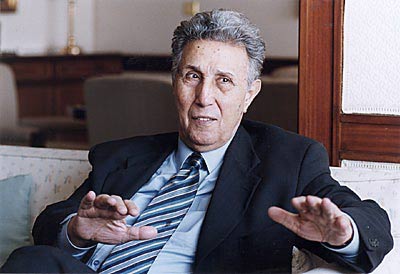
Ahmed Ben Bella
Ahmed Ben Bella is one of the great figures of Arab nationalism. He was one of the
nine members of the Committee of Algerian Revolutionaries that gave birth to the
National Liberation Front (NLF). Arrested by the French occupiers in 1952, he
managed to escape. Once again arrested in 1956, along with seven colleagues, he was
detained in the la Santé prison until 1962. After the signing of the Evian Accord,
he became the first elected president of independent Algeria. On the domestic front,
he initiated a Socialist policy characterised by a vast program of Agrarian reform.
On the international front, he brought his country into the UN and engaged in the
movement of non-aligned countries. His influence grew in the struggle against
imperialism, driven by the great powers that supported his military coup d’etat.
From 1965 to 1980 he was placed under surveillance. Since then, he has held the
position of his country’s interior affairs minister, yet he continues to play an
international role, in particular as president of the International Campaign against
the attack in Iraq. Central actor of historical dissidence, he responds to questions
from Silvia Cattori for Voltaire Network.
Silvia Cattori: When you are not travelling, do you reside in Switzerland?
Ahmed Ben Bella: No, I live in Algeria, but I often come to Switzerland. I had lived
here for ten years, after my quarrels with the Algerian military powers. In Algeria,
I’m bombarded by journalists. So, when I need to take a little rest and step back
from what happens there, I come here where I have a small apartment. You know, I’m
ninety years old!
S.C.: You have the air of a young man! Do you know, Mr. Ben Bella, that you have
imprinted a very positive image in the hearts of people throughout the world?
A.B.B.: (Laughs) My life has been a bit special, this is true. I participated in the
liberation of my country. I was one of the organisers of its struggle for
liberation. I likewise actively participated in all the struggles for liberation.
S.C.: Your origin is Arab-Moroccan. What ties have you kept with your rural roots?
A.B.B.: Yes, I am Algerian of Moroccan origin through my parents, but all my life is
Algeria. I was born there. I am the son of poor peasants who came at a very young
age to live in Algeria. I only recently saw the place where they were born, near the
city of Marrakech.
S.C.: In coming to you, I have the impression of coming into contact with the people
and causes for which you have fought all your life. It’s very moving to talk about
your fight to create a more humane, more just world. Are you not the incarnation of
all this?
A.B.B.: Yes, my life is a life of combat; I can say that this has never stopped for a
single instant. It is a combat that started for me at the age of 16. I’m 90 years
old now, and my motivation hasn’t changed; it’s the same fervour that drives me.
S.C.: In 1962, you reached the highest goals of independent Algeria. All hopes were
open. From colonised Algeria to its liberation, from the international political
scene to the fight for alter-globalisation, you paid a high price for your
dissidence.
A.B.B.: Yes, I paid much in my fight for justice and liberty of people. But clearly,
I did what I felt to be a duty, an obligation. So, for me the choice was not
difficult. When I was engaged in the struggle for my country, I was very young. My
horizons were open. I quickly realised that the problems go beyond Algeria, that
colonisation affected many people, that three-quarters of the countries in the world
have been colonised in one way or another. Algeria was thus, for the French, a
department overseas; it was the France located on the other side of the
Mediterranean. The French colonisation of Algeria lasted a long time: 132 years. I
participated in that fight right in Algeria.
Immediately after independence, I was
associated with all those who, in the world, themselves undertook the struggle to
liberate their own country. It was thus this phase in the fight for national liberty
that I participated completely. In Tunisia, in Morocco, in Vietnam, Algeria has
become somewhat like the "mother of freedom struggles"; to support them was thus for
us a sacred mark. When someone came to ask us for help, it was sacred. We did not
even think twice. We helped them, even if we had only meagre means; we offered them
arms, a little bit of money, and in occasion, men.
S.C.: In 1965, it was not the French who imprisoned you; it was your brothers in
arms. Today, what do you feel towards those who had so brutally barred the road?
A.B.B.: I don’t feel contempt, I don’t feel hate. I think that they participated in
something that was not very proper and was very pitiful, not only for the Algerian
people, but also for the other people who counted on our support. My fight to bring
better conditions of life to Algerians thus plunged into great poverty, and my fight
to help other still colonised people to recover their freedom bothered certain
authorities. From their point of view, I had gone too far. I had to disappear. That
is to say, if the Algerian army had not overthrown me, others would have done so. I
had to disappear, because I had become too much of a nuisance. I accommodated
practically all of the liberation movements, including those of Latin America.
S.C.: Were you already in contact with Fidel Castro?
A.B.B.: Yes, Che [Guevara] had come to Algiers bringing me the message from Fidel
Castro whom I had encountered two times. He asked us to support the struggles that
were developing in South America, as Cuba couldn’t do anything; it had been under
the control of the United States that occupied Guantánamo Bay. Therefore nothing
could leave Cuba, not even a box of matches, without the United States knowing about
it. I didn’t hesitate for a second. It’s from Algeria, and with the participation of
Che, who stayed with us six months, that the state major of the liberation army of
South America was created. I can say now: all the combatants who participated in the
fight for freedom in South America came to Algeria; it’s from there that all those
who fought left. We trained them, we arranged for the weapons to reach them, we
created networks.
S.C.: In what year did Che Guevara come to Algeria?
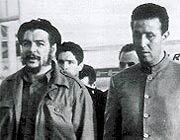
Ahmed Ben Bella with Ernesto Che Guevara
Alger, 1963
A.B.B.: Che came in 1963, shortly after I had come to power. With my government, we
engaged in bringing our help to fights for national freedom. At that precise moment,
several countries were still colonised or had barely overcome colonisation. This was
the case in practically all of Africa. We supported them. Mr. Mandela and Mr.
Amilcar Cabral themselves came to Algeria. It’s me who coached them; afterwards they
returned to lead the fight for freedom in their countries. For other movements,
which were not involved in a military fight and who needed only political support,
such as Mali, we helped in other ways.
S.C.: Who precisely dismissed you in 1965? The Algerian army or the foreign forces?
A.B.B.: I am certain that, indirectly, there was the intervention of foreign
authorities. Elsewhere we have seen the same mechanisms working. Everywhere that the
struggle for national freedom has triumphed, once the authorities agreed, there were
military coups d’etat that overthrew their leaders. That is the result time and time
again. In two years, there were 22 military coups d’etat, essentially in Africa and
the third world. The coup d’etat of Algiers, in 1965, is what opened the path.
Algeria was therefore only the beginning of something that was in development: this
is why I say that it’s the global capitalist system that finally reacted against us.
S.C.: Are you a Marxist?
A.B.B.: I am not a Marxist, but I place myself resolutely at the left. I am a Muslim
Arab, in my actions oriented very to the left, in my convictions. That is why, even
if I don’t share the Marxist doctrine, I always found myself on the side of all the
leftist movements in the world and Socialist countries like Cuba, China, the USSR,
that have led the anti-colonialist and anti-imperialist fights. It’s with them that
we have constituted a liberation front and brought our logistic support to armies to
help their countries come out of colonialism and establish a national internal
regime. This was the phase of eliminating colonialism. Colonialism is an idea born
in the West that drives Western countries - like France, Italy, Belgium, Great
Britain - to occupy countries outside of Europe. Colonialism is known in its
primitive form, that is to say, by the permanent settling of repressive foreign
powers, with an army, services, policies. This phase has known cruel colonial
occupations which have lasted 300 years in Indonesia.
S.C.: After this phase, were you not active in the movement of non-aligned countries?
A.B.B.: There are no more non-aligned countries. This movement had been created by
men of very high position such as Nehru, Mao Tse-tung, Nasser and other great names;
in an era where above all there was the risk of an atomic war. It was the
confrontation between the USSR and the United States. We were on the verge of a
nuclear war. The non-aligned countries played an important role in preventing it.
This movement lasted a certain number of years. But the system finished for the
better.
S.C.: Afterwards, did you not play an important role in the development of the
alter-globalisation movement?
A.B.B.: The global system presiding over everything, as we have said, invented
another form of domination: « globalisation. » "Globalisation" is a very nice word
in itself. A word which can unite, can bring brotherhood among people. But, the word
"globalisation" such as it is conceived, is a word that brings just the worst. With
this word there has been brought the globalisation of misery, death, hunger: 35
million people die of malnutrition every year. Yes, that would be a very nice word,
if we had globalised for the better, brought well being for all. But, it’s the
contrary. It’s a perverse globalisation; it globalises the bad, it globalises death,
it globalises poverty.
S.C.: Does globalisation only have perverted effects?
A.B.B.: The only advantage that we have taken from it is that we are nowadays better
informed than before. Nobody can ignore the fact anymore that the system leads to an
extension of dissatisfaction. Wealth has been created, but it is an artificial
wealth. These are the multinationals, like General Motors and Nestlé; these are the
big industrial groups that weigh, on the monetary scale, much more than big
countries like Egypt. If we base it on their gains, General Motors, for example, is
four times richer than Egypt, which is a country of 70 million inhabitants, the
country of the Pharaohs, an extraordinary country, the most educated Arab country!
That gives you an image of what « globalisation » means. In a nutshell, it is why I
fought the system that favours groups that represent, on the monetary scale, much
more than a large country and generates so much inequality. And this is the reason
why we must, the rest of us, seek a better understanding of problems which have been
wilfully complicated, but which are ultimately an expression of one single thing:
the establishment of an inhumane system.
S.C.: Despite the clearly expressed will, in 2003, by three-quarters of the people on
the planet, the progressive movements did not succeed in preventing war. Do you not
sometimes have the feeling that those who are in the direction of movements lacked a
course; or frankly followed a false path for through not having been able to
identify the true motivations of the adversary?
A.B.B.: I myself, speaking as a man of the south, note that something has changed in
the north, which is a very important point to raise. What changed exactly in this
so-called advanced region of the north: that we have made a war, we have colonised,
that we have done terrible things, and that there is today an opinion that is
expressed, that there are young people who say "enough." This indicates that this
perverse global system does not strike only the south but also the north. In the
past, we spoke of poverty, misery only in the south. Now there is a lot of misery, a
lot of bad that creates victims in the north as well. This has become manifest: the
global system was not made to serve the good of all, but to serve multinational
companies.
Thus, deep from within this north, which we have so fought against, there is now a
movement, there is an entire generation of youth who want to act, who go out onto
the streets, who protest, even if the leftists did not know to give the key to the
solution to these young people who want change. This has always occurred: all
movements begin in this manner. The liberation movement which I led in Algeria, the
organization that I created to fight the French army, was at first a small movement
of nothing at all. We were but some tens of people throughout Algeria, a territory
that is five times the size of France.
S.C.: What have they gained, these generations of young people who have put so much
hope in Attac, for example, who proposed to "reform globalisation"? But must it have
not been necessary to refuse this same principal and adopt more radical measures,
faced with the radical nature of the system that calls itself liberal?
A.B.B.: Those who are leftists, once in power, are not different from other parties.
In that which concerns Algeria, we have tried to work with the French left. But we
did not know about the worse power exerted by the French Socialist party. The worst
of things that came to us was with the Socialists. No previous political power had
fought us as hard as the Socialist Guy Mollet. I am telling you the precise facts. I
am speaking of what I know. I was at the head of the FLN when the government of Guy
Mollet - after having understood that France couldn’t maintain itself in Algeria -
contacted Gamal Abdel Nasser so that he could ask us if we were ready to discuss
with them. I always planned this; that one day he was going to have to sit together
at a bargaining table with us and define the best way that Algeria could become
completely independent. It was the goal that we sought: to again become free, to not
live anymore under the stick of an oppressive system. I said yes, that I was ready
to negotiate, on the condition that they, the French, would ask for it. It was
important, as it’s always he who is the weakest that asks to negotiate. I required
that the negotiations be held in Egypt. The negotiations lasted three months. We
arrived at a solution. With my copy of the paper in my hands, in September of 1956,
I went to inform Mohammed V, the king of Morocco. It had been implied in this
struggle, he had helped us, including in a military way. Furthermore, we went to
Tunisia because we also wanted to inform the authorities and our plane had been
hunted by the French aviation. It was the first plane diversion in history. There
were, in this plane, two-thirds of the leaders of the Algerian revolution. They
wanted to immediately dispose of us. It was a miracle that we escaped death. All of
this tells you what I think of Socialists: it was Guy Mollet who, barely had he
signed an engagement, he betrayed it. I could say the same thing about Governor
Lacoste, he was a Socialist also. No, the leftist parties didn’t support us, on the
contrary. But despite all this, it’s the left that interested us and it’s with them
that I continued to fight. I am a man of the left.
S.C.: So when you stand alongside representatives of international Socialists, on
the podiums of social forums, you came to say to yourself that they are there for
personal prestige above all?
A.B.B.: Yes I came to think that they are not serious. I myself really want to change
this world. I want this world to change. To change things, we need people who are
sincere and selfless, above all.
S.C.: Do you believe in the necessity of change?
A.B.B.: Yes, since my earliest youth I have believed in this necessity. I come back
to what you said earlier; that which personally brought me to have a certain
confidence in the future. I want to talk about what I observe here, in the West. I
am convinced that the liberal system does not have a future. These young people,
these high school students who I’ve seen go out onto the streets, who have nothing
but their ideal of justice; these youths who demonstrate, who are on a quest for
other values, I would love to say to them: "I began like that, when I was your age,
by small steps. And little by little it was a mass of people who followed me." When
I go to demonstrations, I observe them, I speak with them, and I see that it’s them
who hold the cards in their hands.
S.C.: The question arises with insistence: have not the leaders of anti-imperialist
movements supported Israel, a State that is ideologically and legislatively racist,
who since its creation has engaged in a policy of ethnic cleansing in Palestine?
Consequently, they have badly guided generations of young people, falsified the
debate, while Israel has been very active besides the United States to combat
communism, to combat Nasser and Arab nationalism, in supporting horrible regimes?
A.B.B.: These days such questions are on the table, they generate debate. We did not
want a biased solidarity. We did not want a State that, like Israel, would be a
favourite tool of this cruel global system driven by the United States, which
practices a policy that has already caused so much harm. For us, it’s a double
betrayal. First of all, the betrayal of those who, on the side of the left, should
have been on our side, loyal to the Palestinian and Arab causes, and were not.
Secondly, the betrayal of all the Jews with whom we felt close, with whom we had
similarities, and with whom we lived in perfect harmony. The Arabs and the Jews are
cousins. We speak the same language. They are Semites like us. They themselves speak
Aramaic, we speak Aramaic. Aramaic includes several branches: Ethiopians speak
Aramaic, Erytrians speak Aramaic, people of Jewish confession speak Aramaic, and
Arabs speak Aramaic. It’s this that harms us: it’s that we know we have been
betrayed by those who are close to us, by the people who are our cousins, who are
similar to us and speak Aramaic like us. We are familiar with anti-Semitism; we are
Semites. I add that even their prophet is our prophet. Moses and Jesus Christ are
prophets with us.
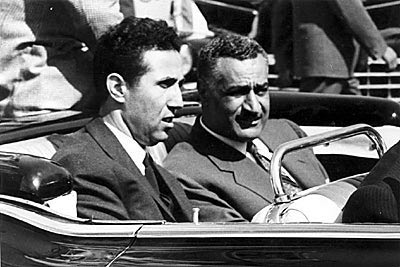
Ahmed Ben Bella and Gamal Abdel Nasser
S.C.: Since the end of multilateralism, the UN was put under the control of
Washington and neo-conservatives. All Arab countries that did not submit to their
diktats were dismissed by the community of nations. How do you judge this situation?
How to get out of it? Also, confronted by the Israeli unilateralism, was Hamas not
condemned to failure, and to give up the reason their people had struggled for 60
years?
A.B.B.: I think that Hamas is characteristic of what happens with us, of this
dimension that now takes a strong religious bent, one that endorses Islam. I am an
Arab Muslim, I do not want to live in a country run by Islamic fundamentalism. But I
want to speak very frankly: I don’t blame them. Because this need for religion was
created by the distortions of the capitalistic system. It’s a force to harm us that
finally, in place of facing them in movement — yes, which endorses Arabness, which
endorses the culture and remains open — the extremists, Israel and the United
States, find themselves face-to-face in this dimension. It is they who have created
this situation.
S.C.: You don’t want a religious response?
A.B.B.: I am a Muslim, but I do not wish that the response be religious. It’s not the
religious act in itself that I reject, no, but the fact that we can make a reading
of it that does not follow the sense of renovating Islam, that we can make a
retrograde reading of Islam; even though in Islam we have the advantage of believing
in two religions: the Jewish religion and the Christian religion. For us, Mohammed
is only a continuum of Jesus Christ and Moses.
S.C.: Were the Muslims not upset about the current anti-colonial resistance? Was it
not recognised that it is not the values of the West that Arab-Muslims fight, but
their violent politics? Hezbollah, for example, which has such bad press in our
countries — did they not reverse the American and Israeli imperialism in Lebanon?
Did the progressives not overcome their prejudice towards Muslims, considering them
as a dynamic element in the struggle against oppression, and support them?
A.B.B.: Yes, yes. There is a problem of education. It belongs to those who are in the
direction of progressive parties to respond in the correct manner to any given
situation. But this is not the case. We have a flag, we have a national anthem, the
rest of what we have is the West, with its varied tendencies, that decides our
place. All of this is clothed with pretty words, covered up with the help of
organisations like the World Bank and the IMF, who are none other than the
instruments of torture created by the West to continue their domination. This means
that we have gotten out of a system of direct colonialism in exchange for something
that seems better, but is not. However, I repeat to you, I have this hope that in
the north that has already done us so much harm, it’s youth is in the process of
taking measures against this logic of domination that creates more and more poverty
as well in the north as the south. Even if it’s not the same domination as that
which is applied in the south, it’s a situation of poverty that nobody who is free
can accept. How many people are left unemployed, in poverty, on the street? It’s
this, perhaps, that will end up provoking people of the north to change their
viewpoints and participate in a definite way with us.
S.C.: But these days we do not see many people in the West protesting against the
atrocities committed in Iraq, in Palestine, in Afghanistan. Do you not have the
impression that there are so many cleverly maintained prejudices against Arabs and
Muslims — including anti-war organizations — that to support their resistance is a
very farfetched idea?
A.B.B.: It’s true, the leftist parties for which one awaited are not at a meeting
place; they have taken a stand there on top. As soon as the one speaks of Islam,
they oppose Bin Laden. I wouldn’t want to live in his republic, but I don’t
criticise him. When I see what Bush does, I don’t allow myself to criticise Bin
Laden. I say it to you frankly: the attack against the towers in New York, I don’t
condemn them. I condemn Bush, I condemn the American government, because I consider
Bin Laden a product of their policies. They have closed all the doors of dialogue
with Arab Muslims. They have made them believe throughout the decades that if they
do this or that, the West would bring justice in Palestine. But, Israel and its
allies never wanted peace with us. Israel has not stopped making war and terrorising
our people. Bin Laden is indirectly the creation of Bush and Israel. These two
States spread death and hate in the Middle East and the world: they have left us
with no other alternative than that of a violent confrontation. All of the radical
movements, categorised as « terrorists » or « fundamentalists » are born in response
to terrorists in Tel Aviv and Washington who bring wars of destruction to Arab
people. What choice do they have, these people that have been bombarded with such
savageness? Faced by modern armies, they have no other arms than sacrificing their
lives in creating an explosion, voila. In the Quran we call this "shahadah." It’s an
extraordinary idea that is expressed in this word. It’s a state of despair, where
someone who is distressed can no longer bear living. He sacrifices himself, not to
obtain a better life for himself, but so that at least his people can live better.
It’s the greatest of sacrifices. We call them in the West "terrorists." But, I say
it in all sincerity, I myself bow down before someone who can make a similar
sacrifice, I assure you.
S.C.: If I understand well, you say that everything that puts the people of the
Middle East in revolt has been generated by the West. That all those who fight must
sacrifice themselves, suffer for others? That in the past the Arabs have
demonstrated tolerance?
A.B.B.: Completely so. The violence expressed in the Arab Muslim world is a result of
the culture of hate and violence that Israel has caused in imposing itself by force
on the land of Arabs. These are the atrocities of this illegal State that compels
the most valorous to react. I don’t think there will be a fight more noble than that
of the Palestinians who resist against their occupier. When I see what these people
have endured for more than a century, and who continue to find the force to fight, I
am in admiration. Today, the same ones who massacre these people pass off those of
Hamas as fascists, terrorists. They are not fascists, they are not terrorists, they
are resistants!
S.C.: Palestine is an imprisoned nation. How does one, even a leftist, come to speak
of « terrorism ", instead of speaking of the right to resist by arms? Do you see
major parallels or differences between the colonialisation of Algeria by France and
the colonialisation of Palestine by Israel?
A.B.B.: It’s worse in Palestine. Moreover because there is apartheid. The French
cannot chase us out of a country that is five times the size of France. They tried
to create a buffer zone in the north, with the least amount of Algerians possible,
but they didn’t succeed. They didn’t establish a true apartheid like the Israelis
and Palestinians. The State of Israel has created the most terrible of dominations.
S.C.: In your opinion, will the Palestinians live under occupation less time than the
Algerians did?
A.B.B.: I believe so. First of all, colonialism is a phenomenon that is clearly
established and sanctioned by international law. Furthermore, if there is an issue
that creates unanimity in the Arab world, it’s Palestine. As long as the
Palestinians do not obtain justice, the Arab Muslim world will not be able to feel
free either. It’s like a part of their flesh that remains captive.
S.C.: In the past, the policy was not more noble, but there was still a balance.
Since the end of global bipolarism, the most basic moral principles have been swept
aside. Everywhere we speak of fighting « terrorism », but we hardly speak of the 800
children killed in Palestine by Israeli soldiers since 2000; the millions of Iraqi
children killed or who are sick, who don’t have the right to a normal development.
Guantánamo, Abu Ghraib, would they have been possible if the international community
had had the decency to say no to the violence of Washington? Which responsible State
still has clean hands in this so-called war against « terrorism »?
A.B.B.: It’s unbelievable what has happened in Guantánamo, Abu Ghraib and elsewhere.
And all this horror continues to increase and generate great suffering. We learn
that the United States has built prisons in Eastern Europe to escape jurisdictions
of their countries and that Europe participated in all of this. Switzerland is even
blamed for having authorized the passing of planes over their territory,
transporting phantom prisoners, kidnapped, subjected to torture.
S.C.: In your opinion, what are the means to oppose the strategy put in place by Bush
and the neo-conservatives?
A.B.B.: It’s a fundamentalist movement, but Christian, that is! The problem we face
today is this: the ideology of Bush is the worst fundamentalism that one can
imagine. These are the famous Evangelist Protestants who inspire Bush. It’s a
terrible fundamentalism. What are the means that we ultimately have to fight with? I
spoke to you about the hopes that I’ve put in young people, all in knowing that
there are no real means to fight this awful system. I know, it is not enough to go
on the street. Something else needs to happen, to invent other methods of action,
but it is necessary to act and not give in. And when we have the feeling of not
advancing, it is necessary to say to ourselves that one passes through these phases,
a certain amount of time is needed before a great number of people reaches
understanding. We start to act with those who understand clearly, even if this does
not cover all the problems. But afterwards, we need to overcome the obstacles, and
say to ourselves that it’s neither the Socialist party, all Socialists who are in
favour, nor such and such association that is going to change the world.
S.C.: In order to again reach balance, could the solution come from China and Russia?
A.B.B.: I think that hope could come from China. In the past, Russia helped us in an
extraordinary way. But for now, unfortunately, Russia is not in an easy situation. I
would not put hope in it. I would count very much on China. First of all, it has
selling points that Russia doesn’t have. It’s a country ahead of others in
expansion. Even the West is going to invest in China to enrich its economy. Twenty
years from now we will see the new political map.
S.C.: While we are waiting, what should be said to people who have been left
neglected, in Palestine, in Iraq?
A.B.B.: We never act with the thought that it’s us who are going to be the
beneficiaries. We act because it’s necessary to act. The great conquests have never
been the product of a single generation. We say in my country that he who eats is
not he who serves the meal. It’s necessary to create a network of solidarity that
unconditionally supports the struggle of its people.
S.C.: What to say to these young people who you mentioned, witnesses of so much abuse?
A.B.B.: It’s necessary that they overcome, that they take initiatives. It does not
suffice to get together periodically in a big gathering, if nothing changes, it’s
necessary to move on to something else: to invent new forms of fighting instead of
waiting.
S.C.: But has the time not come that Arabs take the direction of an anti-war movement
up to this point between the hands of the West?
A.B.B.: Yes, yes. Given the gravity of the situation in the Middle East, it is the
Palestinians or the representatives of movements in the Arab world who have to make
a move. I think that the Arab movement, the Palestinian movement, all of these
forces, if they combine and go beyond their differences of opinion, are a hope not
only for the Arabs. They can equally contribute to changing the world, a world
system that functions.
S.C.: You seem to be optimistic!
A.B.B.: Oh you know, I’m nothing but optimistic: I’ve spent my life in acting. I am
not satisfied making speeches, I devote all of my time in acting by means of the
organisation North-South. Also I believe that, sometimes, the forces of hope come
from where we least expect them.
S.C.: The first constitutive congress of the Peoples’ Arab Alliance of Resistance was
held the end of March 2006 in Cairo. The participants called the people to put
themselves "under the banner of internationalism to support the Arab people in their
fight against imperialistic violence." Is it not the starting point of a campaign
that, if the progressive parties of the West rally together, could boost the
anti-war movement and go in the direction of your hopes?
A.B.B.: Yes, I am personally in favour of this initiative. What is important is to
advance. One does not advance if one doubts, if one thinks it’s finished, if one
remains only in a state of dissension. We advance and we correct our errors. Life is
like that. There are also, in the Arab camp, many obstacles to overcome. We have to
make an effort to go beyond these disagreements. In effect, we have in the Arab
movement, the same weaknesses which are present in the anti-imperialist movement in
the West.
S.C.: There are almost ten thousand Palestinians arbitrarily imprisoned in Israeli
jails. They are not recognised as political prisoners. Ahmed Sa’adat - kidnapped by
Israel in March of 2006 in Jericho, with six colleagues - whereas he was under
American and British guard - has since been subjected to continuous torture. He has
reaffirmed his will to not give up, in saying: "No matter the place where I will be,
I continue to fight." You must recognise yourself in this affirmation, you who know
what it means to be imprisoned?
A.B.B.: Yes, I spent 24 and a half years in prison. When the French locked me up in
la Santé, they put me with prisoners who would be guillotined. I saw the guillotine
from my cell. It’s terrible what Israel forces the Palestinians to undergo as ill
treatment. Currently I have only one project: it’s Palestine. I will do anything
possible to help them. To reach peace, in Palestine and the world, the system of the
marketplace needs to be rid of. Because the problems are immense, the damage is
immense. Leaving the world in the hands of finance and murderers is a crime. It’s
that which is terrorism. It’s not Bin Laden.
S.C.: When you hear the heads of State say that they’ve made a war in Iraq in the
name of liberty and democracy, what do you want to say to them?
A.B.B.: I tell them that the right to live is the first of human rights. The right of
mankind is the right to live. All the philosophies where I’m from speak of the right
to life. Safeguarding life, to live, is the first of things for which one aspires.
But the global system is not humble enough to guarantee this right. It exploits, it
kills. And when it can’t kill, it builds savage prisons, abuse which pretends to
bring about democracy. In Afghanistan and Iraq, the United States started to do what
Israel always had done against the Palestinians. One speaks of Israeli and American
democracy. But what democracy have they brought while destroying any chance to live?
S.C.: Are you suffering for Iraq?
A.B.B.: Ah yes, Iraq for me. I’ve gone to Iraq five times, you know. (Silence). I
failed to be killed in Iraq. It’s intolerable to see what one has done in Iraq! In
this country which is the cradle of civilisation! Iraq, it’s there where we started
to cultivate the land, it’s there where humanity was born, it’s there where the
first principles were based, it’s there where the alphabet was created, the first
code is that of Hammurabi. All of this was destroyed by ignorant leaders, by a
nation that has no more than 250 years of history, which was itself a colony of
Great Britain. They ridded themselves of British colonialism and established a
worldwide colonialism. What became of the 80 million American Indians? I will never
return to America, it’s a country of crooks.
S.C.: Do you feel that the wars in Afghanistan and the Middle East are racist?
A.B.B.: Completely so. These are wars brought against Islam, against the Arab
civilisation. This is clearly evident. Of the countries who are outside of the law,
according to Bush, only one is not Arab Muslim, North Korea. The others, Syria,
Iraq, Sudan, Iran, are all Muslim. The Crusades aimed supposedly at restoring the
tomb of Jesus Christ. Sometimes, to tease the West, I tell them: Jesus Christ, what
language did he speak? He spoke my language, not yours, he spoke Aramaic like me!
When you read the Bible, Jesus Christ says: "Eli; Eli, Lama sabakta-ni." And we say
in Algeria: "Ilahi limada sabakta-ni." These are exactly the same words that Jesus
pronounced. Jesus spoke like me. Islam takes many things from the Evangelists as
well as the Bible, which it came to supplement.
Forced with seeing these abuses, I explode. One has done to us so much wrong. One
has hit us in our dignity. Without speaking of the dear people of Palestine. How
many Palestinians are obliged to live under the most contemptible iron rule? Our
reaction is not racist, I assure you. We have had more than enough of that. The West
has done a lot of harm. Is it not the West that has committed the worst crimes
against humanity? Fascism, where does it come from? Nazism, where does it come from?
Stalinism, where does it come from? The famous Inquisition, which lasted 400 years,
where did it take place? Frankly, it is necessary to have a lot, a lot of
selflessness to say to oneself every day that passes, I don’t want to hate the West.
S.C.: Is it not necessary to condemn the supporters of "the clash of civilisations,"
the pro-Israelis, as the principle instigators of anti-Arab hate, anti-Islam, which
is spreading in a disturbing way against your people?
A.B.B.: Completely. The Israeli lobby in the United States is something terrible.
Until now it was forbidden to speak of them without being marked as anti-Semitic.
Recently, several studies have come to attest by undisputable examples the weight of
the Israeli lobby in the political and military options taken against us. Nobody
today can deny the importance, even the danger, of this lobby, which penetrates all
the strategic spheres. I am thus very concerned by this aspect of things that makes
the settling of the Palestinian question more difficult.
I am going to tell you, although Islam has encountered so many woes, Islam has never
done wrong to other counties. In history, Islam showed a tolerance that does not
exist at all elsewhere, whereas Israel has succeeded in establishing itself by force
in a space and in a place which was inhabited by Palestinians - one of the most
developed Arab people - and created there, in the dispossession of their land, a
racist state. As long as Israel will refuse to recognize the rights of Palestinians
to exist and come back to their land, there will not be peace in the world.
Ahmed Ben Bella was interviewed by Silvia Cattori.


 Articles by this author
 Send a message


Stay In Touch
Follow us on social networks
Subscribe to weekly newsletter