


Division General Raúl Isaias Baduel, commander in chief of the Venezuelan army, analyzes the United States’ plan for subversion of Venezuela. After having attempted to overthrow President Chavez by organizing a coup d’état and having fomented his assasination in vain, they are waging a 4th generation war in which the media have become a real weapon. By manipulating information, they try to demonize the government in front of the international community and to delegitimize it in the eyes of its own people.
Voltaire Network |
Caracas (Venezuela) |
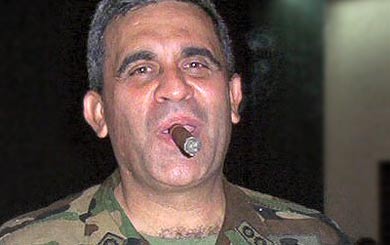
Venezuelan commander in chief Raúl Isaias Baduel
The School of the Americas
When was it that in your life as member of the Venezuelan army you began to distance yourself from the American military doctrine?
General Raúl Baduel: Since we were in the Military Academy we used to have serious discussions on the military exchange between the American and the Venezuelan armies. Obviously, that relationship was aimed at recruiting, co-opting and subordinating our Armed Forces officers to the interests of the United States, pushing the interest of our country to the background. That was evident, particularly in the higher-ranking officers, and the past years have proved we were right. As time past by links between Venezuelan officers and the Unites States Army and Security Agencies were more evident.
All this was quite evident during the April 2002 coup d’état. In addition, I belong to a generation sympathetic to the Cuban Revolution and its emblematic figures -Fidel, Che. Even when we could not share its ideological positions we did agree with its ideals of dignity, which have not often been welcomed in other parts of the world though such ideals are the most important things for us and when I say us I mean not only the Venezuelan, but this cosmic race made up of the Latin American and Caribbean people. Those who can not understand this can not properly analyze the threatening hegemonic pressures the United States makes on our countries.
How were you influenced by the School of the Americas?
During year 1993, I took a course on Command and General Staff at the School of the Americas in Fort Benning, Georgia. The school has its terrible story but, to be fair, I did not notice the gorillalike instruction environment people said it had, and it probably did. Its most sinister time was when it was located in Panama, when it served as the American penetration door in our armies. I remember the days I spent there very well; the continual protests in front of the school whose facade was even marked with blood (red ink).
Of course, it was the year in which the report of the United Nations Truth Commission was made public, where the names of dozens of Central American officers involved in the terrible crimes in El Salvador were included. More than a third of the officers mentioned were graduated from the School of the Americas.
By then, a huge debate was taking place and we followed it. But to be fair, during the year I spent there I did not see anything that would make me think that officers were being trained to torture or to practice other criminal acts. What I can say for sure is that almost at the end of the course some American comrades with whom I had a good friendship told me I had been watched during the whole year for my record as a rebel officer related to the Bolivarian Movement.
A regional block power
A proposal on the possibility of a military integration in a Regional Block Power has been presented in certain alternative circles. Do you think it can be viable?
That is Heinz Dietrich’s project, a friend who has invited me to some international events I have not been able to attend, and who has been working with Ecuadorian General René Vargas Pazos. He writes to me quite often. I have said to him I think this kind of integration is necessary though leaving aside all militaristic conceptions which may represent an assault on the dignity of other peoples. The integration must be based on what is stipulated in our Constitution, regarding issues such as National Security which goes beyond strictly military affairs and has to do with the existence of the very same Nation State.
It is already said that 51 out of the 100 biggest economies of the world are not countries, but corporations. That is why corporative crime and corporative predators are topics dealt with in the context of a trend which no longer recognizes the sovereignty of nations or legitimates the nationalistic feelings. That is the reason why taking the right steps for the economic, political, social, cultural, scientific, environmental, geographical and military integration is necessary.
Wouldn’t it be more prudent to focus on the economic integration of our peoples, by supporting ALBA (Bolivarian Alternative for The Americas), a promising and viable project to improve the social conditions of our countries?
It’s obvious. I think a debate must take place to define our priorities. I think the struggle for our economic independence linked to political and social issues must be our main goal. The human being is our most valued capital and our priority.
Many of our serious problems come from the lack of or a poor education. That is why educating the people is what will help us to find the solutions to our problems. This is a crucial issue and I am not saying it in the spirit of arguing with friend Heinz.
The assassination of the president: an option?
The news is the possibility of an assassination in Venezuela.
We have analyzed the present scenario, in which our process is being developed and we are convinced assassination is an option the United States might use. Maybe, it is the only option they have not applied in a context in which all possible resources have been used to damage the Security and the Defense of the country.
What are the other options they have applied or that they are still applying?
First, “the fourth generation war.” In the future, when we analyze what happened in our country since 1999 we’ll see more clearly that we suffered from this kind of war encouraged and financed by the United States...
... where the methods applied were already implemented during the Latin America “dirty war” ...
That’s right. A war where two sides with conventional weapons facing each other in the theater of operations is no longer necessary. The history of Venezuela over the past six years has been a panoplied one, what has also been called an “asymmetric conflict” which is not a new concept though we have seen it here very clearly: not only the media can become an operative weapon, more powerful than the armed divisions, but the distinction between war and peace, the fronts and the battlefields are not longer defined.
This is the reason why a joint responsibility precept between the State and the society regarding the Defense of the nation was included in our Constitution.
Another scenario we have analyzed is the coup d’état. Sometimes, I act sarcastically when I talk about this and I say the rulings of the Court regarding the events of April 2002 placed us in a particular position: we have to invent a new theory of Law to describe such actions with a highly innovative glossary of terms because according to the ruling the coup d’état was not a coup d’état.
And despite this, the evidence of the United States interference in the indescribable events of April 11 is overwhelming. In the 42 Paratrooper Infantry Brigade in Maracay we gathered a lot of evidences that show the American interference during and after the events because many people believed we were a proper channel to establish contacts with the coup-plotters and they gave us information. Here, in Tiuna Fort we have enough evidences to show the entrance to the barracks and the participation of American military attachés in Caracas...
The names of some were published: Lieutenant Colonel James Rodgers, assistant military attaché, and Colonel Ronald McCammon, intelligence officer, celebrated the “victory” with the military coup-plotters in the Headquarters of the Army the very same April 11. However, the United States has denied this categorically...
Yes, but there are the records of the incoming and outgoing document register of Fort Tiuna. That can not be erased; besides, we have the testimony of those who saw them. There are evidences also of the presence of American ships and airplanes in Venezuelan territory. Those who know about radars know these records can not be made up and our radars were installed by the United States. They know perfectly well what we are talking about and we are not lying. Look, there is a joke about all this: Why has the United States never had a coup d’état? Because they don’t have an American embassy there.
If we analyze closely what happened on April 2002 in Venezuela, it could be affirmed that the assassination attempt was already implemented.
Of course. The first purpose of every coup is to overthrow the President violently. If we take a look at the Latin America history we’ll see many examples where the United States has been succeedingly involved. Sometimes they killed the president but there are times in which it is not necessary to physically murder the Head of State to politically destroy him.
Killing a president is not a crime
The executive order signed by President Bush after September 11 in which he granted CIA agents the legal and executive authorization to kill the “terrorist” leaders by virtue of the United States “National Security” is public. I remember the statements that then American ambassador to Caracas, Charles Shapiro, made to AP press agency in October 2003: “Killing a president is not necessarily a crime”...
This is a very particular practice and moral of the American elite. We perfectly know the differences between the American government and the American people, which is a noble people and I can prove it because I have good memories of American friends, especially some paratroopers. But, undoubtedly, such a practice reminds us of Ortega and Gasset’s phrase: “The United States of America preach a moral they don’t practice.”
This has to do with a third scenario we have analyzed regarding the United States: the possibility of inciting a regional war as an extension of the internal conflicts of the neighboring countries, Colombia, in particular. We had and we have reasons to say to international organizations that Venezuela sees as a cause of concern the overwhelming support and imbalance regarding the combat power the United States has created and encouraged even more in Colombia, especially after the passing of the USA Patriot Act.
The fact that Venezuela has bought weapons arose a satanization campaign against the Bolivarian government in the United States and some analysts think the submittal of a bill authorizing the Department of State to increase the global efforts to eliminate and control conventional weapons is not casual.
Fortunately, some judicious voices have been raised too in Colombia and they have said they understand that Venezuela protects its borders. The American discourse about the militarization of Venezuela is very cynical though not new. During my course at the School of the Americas, I remember an Afro-American woman, a three-stars General and adviser to President Clinton on Security issues, who gave us a lecture in which she described as the region in unacceptable terms. In year 1993, that lady was saying the same things they are saying now. I was forced to reply.
What did you say?
Her conclusion was something like this: “poor Colombia which is next to Venezuela and can not move out.” For instance, she said that tensions in the Venezuelan-Colombian border were mainly due to the fact that our country was a great supplier of weapons to violence-generating elements in Colombia, the guerrilla in particular, whom we were giving refuge. When she talked about drug trafficking, she also mentioned Venezuela as the great supplier of the chemical elements necessary for the traffic, despite being a paradise for dollars-laundering and a privileged via to send the drug to other countries, in particular, the United States. She also said the position of Venezuela regarding the guerrilla was not clearly defined. Of course, I stood up and rejected that, though I specified I was not speaking on behalf of the government of my country. I said we regretted the internal problems in Colombia; that by taking into account the historical links of our two peoples, we wanted the conflict to be ended, but that was the responsibility of the Colombians people.
Venezuela does have the right to claim not to be the target and victim of the actions perpetrated by violent groups. I once heard President Uribe recognize that Colombia had the duty -and I think it was fair- to protect the corridors through which violence reached Venezuela. Our country must protect itself too and this is what we are doing. What is surprising is why our right to protect our sovereignty is so questioned, and the reason is known: this conflict can be used as a casus bellis to intervene in our country.
This is very dangerous. I have heard the same discourse in American official entities during the last ten years as well as the call to get involved in that conflict which I think would be a serious mistake. I repeat: we defend the peoples’ self-determination and sovereignty principles. Colombia is our neighbor and we are sorry for its situation but only Colombians must solve it.
The Granda Case is an example of how the United States can generate a conflict, yes or not?
Yes, absolutely. God helps us from getting involved in such a perverse game!
"Fictitious Enemy"
Once Chavez’ denounced the United States attempt to kill him, right wing sectors inside and outside Venezuela have reacted by saying that the government has created a fictitious enemy to gain political benefits and that the debate on the possible intervention is nothing but paranoia. What’s your opinion?
Among other hostile scenarios, we have also considered the possibility of a military intervention. It is not paranoia. The examples of military interventions led by the United States and its coalition are just there in the Middle East, in a context in which international organizations are not a contentious factor. A mandate from the UN Security Council to intervene anywhere in the world is not necessary.
When I listen to those puppets repeating what others say -for instance, that we are going towards militarism- I ask them to check the texts written by the experts in the field, such as Samuel Huntington, Noam Chomsky, John Berger and many other theorists who have studied the concept of militarism and pretorianism. Read what these prestigious professors -most of them are Americans- have written and compare it with the Venezuelan situation and you will clearly see who the militarists and pretorianism supporters are, if those of us who do our work or if those who one day went to a public place to demand the conciliation with the American positions in the name of freedom and democracy. This is what the fourth generation war is all about: neutralizing the population through the media by convincing our people and the world that the Venezuela of Hugo Chavez has become an outlaw state.
I don’t know if I already said that during the events of April 2002, a French journalist went to interview me in Maracay. He worked for a television station and was a war correspondent expert who had reported from several military scenarios. He told me he had left France convinced that here he was going to find a country in the middle of a civil war and showed me the reports in which it was said that I, General Baudel, was massacring the people. They also mentioned paratroopers attacking military units and the civil population. He vehemently told me: what I have seen here is the opposite, the people demanding the return of the President of the Republic, the people going into the barracks and who are not repressed at all.
Unfortunately, not everybody can come to Venezuela to see with his own eyes what is actually happening here.
Domestically speaking, we are more politically stabilized today and the revolution is more powerful. The very same opposition has acknowledged its defeat. However, American authorities have begun year 2005 by saying Venezuela is a “regional threat”, an “unstable government”, an “insecure oil supplier.”
Due to the fact that I am an active soldier I must be careful with what I say for my opinions might have a political impact. But as a soldier who has the honor of commanding the Venezuelan Army, we have to analyze the threats the supreme interests and purposes of the Venezuelan State might face. We agree with what President Hugo Chávez has said as the Head of State and Commander in Chief of the National Armed Forces, a post the people have legitimately given to him.
By the end of last year, the President presented a new strategic plan for the development of the Venezuelan State and there he outlined an objective that has to do with us directly and it is the formation of a new Venezuelan military strategy where we have three main strategic lines: strengthening the Army -that does not mean we are going to get involved in an arms race-, strengthening the civil-military ties and the reserve.
This is a mandate the people has given to us, stated in Article 328 of our Constitution. There, the people gave us ‘a what for’ which means to guarantee the sovereignty and independence of the nation and to secure the integrity of the geographical space.
It also gave us a ‘how’: the military defense, the cooperation and maintenance of the internal order and the active participation in the national development. These three missions must have a dynamic balance and I can guarantee that as soldiers we see ourselves not only as the administrators of legal and legitimate violence of the State of Venezuela but as promoters of peace and social safety.
The Venezuelan Army and the other closed forces are not a threat to the region. The American government knows it perfectly well. In any case, they would just be a contention wall against those who might attempt to subvert the sacred objectives our people have entrusted to us.


 Articles by this author


Stay In Touch
Follow us on social networks
Subscribe to weekly newsletter