


In his book, "The Wandering Who?", Gilad Atzmon goes where no one else dares to tread. He challenges what he considers to be the myths and the tribal mindset underpinning the founding of the Zionist state and its racially-driven policies. Repudiating the concept of ’chosen-ness’ that separates the Jews from the others, he has abandoned his to ’become an ordinary human being.’ His book has been acclaimed by eminent Jewish intellectuals. He responds to Silvia Cattori’s questions.
Voltaire Network |
Geneva (Switzerland) |
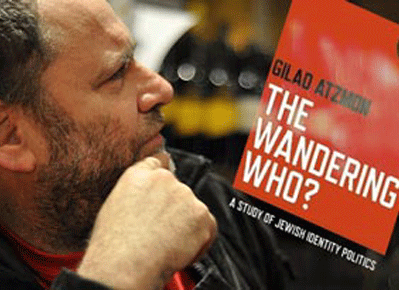
"The Wandering Who?", by Gilad Atzom
Silvia Cattori: “The Wandering who?” — What is the meaning behind this provocative title?
Gilad Atzmon: “The Wandering Who?” attempts to search for a deeper understanding of Jewish culture and Jewish identity politics. It is there to tackle some issues most of us prefer to avoid. Three years ago Israeli historian Shlomo Sand published his ground breaking work on Jewish history, thus dismantling the phantasmal Jewish historical narrative.
In my book, I attempt to take Sand’s quest one step further and elaborate on the problematic Jewish attitude towards history, the past, and temporality in general. Five years ago American academics Mearsheimer and Walt published an invaluable study on the Israeli Lobby in the United States [1]. I again try to pick up their research where they left off. I try to explain why lobbying is inherent to Jewish politics and culture.
Two decades ago, Israel Shahak published his crucially important study of the Talmud, and in my work, I want to extend his study, and grasp the deeply racist and anti-gentile attitude that is intrinsic to any form of Jewish secular identity politics, be it Zionism, Jewish socialism and even Jewish anti Zionism. In “The Wandering Who?” I try to shake every common perception of Jewish identity politics.
Silvia Cattori: “The Wandering Who?” is a very impressive testimony. It can not be ignored, including by your opponents. I think it can safely be said that no one before you has explained so frankly some of the thorniest aspects of the Israeli-Palestinian issue. Your analysis is important for anyone seeking to understand what certain groups want to hide, and why. It should lead people that are deliberately kept in the dark and in a state of confusion, to see things more clearly. This includes, of course, the so-called ‘progressive’ circles.
Gilad Atzmon: Thanks so much for your support and compliments.
Silvia Cattori: However, you are stepping into a minefield. One may also wonder whether you are exposing your thoughts and perspectives because, as an ex-Israeli, you feel shame.
Gilad Atzmon: That is a good point. I suppose that at a certain point in the past, it is true to say that I started to feel shame and guilt. However I realised many years ago that guilt only becomes a meaningful sensation once it is transformed into responsibility. Unlike some of the Jewish anti Zionists who cheerfully and righteously declare ‘not in my name’, I know very well that every Israeli crime is indeed committed in my name, in spite of the fact that I have not lived there for many years. I am very troubled by it.
Silvia Cattori: Does this mean that the writing of “The Wandering Who?” was a way for you to settle your personal score with the "tribe"?
Gilad Atzmon: To be more precise, it isn’t actually “the tribe” which I criticise but the racially oriented sense of ‘tribalism’ which stands at the core of every form of Jewish identity politics.
Silvia Cattori: Would you say that this great overhaul was spurred by your desire to alert mankind to what you consider to be the real danger, i.e. the Jewish ideology?
Gilad Atzmon: I am indeed primarily concerned with the ideology. I also argue that it isn’t just the Palestinians that are implicated. I am very alarmed by Jewish relentless lobbying and its destabilising power globally. The fact that the AJC (American Jewish Committee) advocates war against Iran is very worrying. But I am also monitoring the Jewish Left activism and I am very troubled by my findings.
Silvia Cattori: Is the book an attempt to explain to your readers why it is so difficult to fight the Israeli policy?
Gilad Atzmon: Fighting Israel for what it is — i.e. the Jewish State — simply means an open conflict with the strongest lobbying power on the land. On the one hand we are encountered by heavily funded Zionist institutions; but, on the other hand, we are chased by the so-called Jewish ‘progressive’ network that is primarily engaged in gate keeping the discourse. And, unlike the Zionists, who operate in the open, the Jewish anti Zionists work towards the same goals, but operate in clandestine settings.
Silvia Cattori: You state that “Jewish power” should be put at the centre of the problem – and that, at the same time, the discourse of certain “anti Zionists”, that you regard as misleading, should be challenged. When you write : “Zionism is not a colonial movement with an interest in Palestine, as some scholars suggest. Zionism is actually a global movement that is fuelled by unique tribal solidarity of third category members…”, you call into question those who characterize Israel as mere ‘settler colonialism’. This is indeed a crucial point. What are your arguments for claiming that it is not simply a colonialist model?
Gilad Atzmon: Indeed, I am disturbed by the lack of intellectual integrity and coherence within our discourse and beyond. It took me some time to grasp that years of Jewish (intellectual) hegemony within the Palestinian solidarity discourse has led to an absurd situation in which criticism of the Jewish state — is shaped primarily by Jewish sensitivities.
Try, for instance, to imagine a situation in which our criticism of capitalism would be shaped in a deliberately over cautious manner — just to make sure that the rich are not offended. Likewise, try to imagine another equally absurd situation, in which our criticism of Nazi ideology would have take into consideration the delicate sensitivities of biological determinists and anti-Semites. It seems equally absurd that we are in such a situation where we have to tread carefully in what we say about Palestinian rights – so as not to offend Jewish people.
And, yes, I say it openly: Zionism is not a colonial movement, and has never been one. Colonialism establishes a clear relationship between a mother-state and a settler-state — yet Zionism has never had a mother state. It is true that Israel exhibits some colonial symptoms, but this is where it starts and ends. Zionism is driven by spirit of Jewish supremacy and a phantasmal notion of ‘homecoming’.
The misleading colonial paradigm was introduced by a few ‘progressive’ thinkers just to make sure that Marx is not left out of the discourse. At least intellectually, what we see here is no more than amusing.
However, it is important to mention here, that the only noticeable colonial aspect within the Zionist reality is the relationships between the Israeli State and the settlements: the exchange there makes it clear who is the ‘mother’ and who is the ‘settler’.
Silvia Cattori: I would like to understand why advocates of Palestinian rights still refrain from labelling Israel for what it really is? Why do you think they are so reluctant to address the issue of Jewish power and its disastrous political impact?
Gilad Atzmon: I think that when it comes to Israel and ‘Jewish power’ every humanist, including myself, has a conflict to handle. I would formulate it as such: ‘how can I tell the truth about Israel, the Lobby, and Zionism and still maintain my position as a humanist’. It took me very many years to learn to differentiate between the wheat and chaff. I learned to distinguish between Jews (the people), Judaism (the religion) and Jewishness (the ideology). This differentiation is not free of problems, because, as we know, most Jews themselves do not know where they stand on those three. Most Jews do not know where Judaism ends and Jewishness starts.
Likewise, most Jewish anti Zionists fail to admit that they actually operate in Jewish exclusive political cells. We are dealing with a very peculiar political identity indeed. It is racially oriented and deeply racist. It is supremacist, yet it is saturated with victimhood. This identity conveys a universal image – yet in truth, it is driven by tribal interests.
In my writing however, I restrict myself to issues to do with Jewish ideology (Jewishness). I try to grasp that unique sense of chosen-ness and observe how it comes into play within politics, culture and practice. It is obvious that, for the time being, there are no intellectual tools to restrict criticism of ideology. And this really means that my detractors are pretty much left in a hopeless situation— they do not posses the intellectual means to silence me or my criticism, so instead, they revert to smear campaigns: they label me an ‘anti Semite’, a ‘Neo Nazi’, a ‘racist’, and so on. Tragically enough for them, no one out side of the Jewish political circuit takes any of these empty accusations at all seriously anymore.
Also, I would like to mention that the notion of ‘Jewish Power’ could be confusing and misleading: it needs elaboration. When I discuss Jewish Power, I am strictly referring to the ability of Jewish interest groups to mount political pressure. And it is very important to realise here, and I must emphasise that Jewish power is not at all a conspiracy. It is explored — in the open —through organisations that are set to mount pressure and serve Jewish interests. Such groups are AIPAC, AJC, CFI, LFI, and so on. Zionists are open about, and proud of their lobbying powers. They brag about it — they enjoy seeing the American joint house sitting and standing submissively for PM Netanyahu.
Silvia Cattori: It is easy to grasp and I agree with you when you assert that Israel and Zionism represent a unique project in history [2] and that the relation between Israel and the Jewish lobby is also unique. But when you and others suggest that it is ‘Jewish power’ which needs to be confronted, the ‘Jewish left’, Jewish intelligentsia, Jewish organizations for peace, etc., go out of their way to stop you. Does it mean that these groups also form part of what you call ‘Jewish power’?
Gilad Atzmon: Absolutely, or at least they are part of the problem. In my book I make it very clear that there is a complete ideological continuum between Zionism and the so called Jewish ‘anti’ Zionism or Jewish left in general.
I differentiate between ‘Jewish anti Zionism’ which is in most cases driven by Jewish tribalism and would care primarily for the Jews, and ‘anti Zionists who happen to be Jewish’. The latter is a totally innocent category. Needless to say that many of my supporters happen to belong to the latter group.
Jewish anti Zionism is there to deliver an image of pluralism within the Jewish Diaspora discourse. For some reason you will see twenty Jewish anti Zionists destroying a Jewish philharmonic concert — but you won’t see those same activists coming to support a Palestinian concert a week later. In short, their anti Zionism is not much more than a Jewish internal affair.
Silvia Cattori: The issue of lobbying also appears absent from the book “Gaza in Crisis” by Chomsky and Pappe [3]. Is it a surprise for you?
Gilad Atzmon: Not really — as we know Chomsky was very critical of Mearsheimer’s and Walt’s study of the Israeli Lobby. I am not familiar with Pappe’s views on the matter. As far as I am aware, he refrains from commenting on the Lobby. I guess that we cannot expect everyone to comment on everything all the time.
Silvia Cattori: Given its influence and its ability to steer the positions of the Palestinian solidarity movement, this ‘Jewish left’ must represent a big headache for someone like you.
Gilad Atzmon: I wouldn’t say that it is a big headache — it is mildly noisy in the background. It is like having a fly in the room. It is a nuisance but it is not going to kill you. However, there are two ways to deal with it — to squash it with an old Guardian paper, or, to open the window and lead it out. I prefer the second option. It is certainly far more humanist.
It is becoming clear that those elements within the Left that are dominated by Jewish ideology have clearly made themselves into irrelevant factors in this conflict or the discourse.
The Left that failed to grasp the anti imperialist impact of Islam is obviously completely detached from current world affairs. It is not a secret that the Jewish left opposed Hamas, and still does. It is not a secret that the Western Left is confused about Islam. However, there is a big difference between Anglo American Left that is struggling with an identity crisis and others forms of struggles for social justice. I, for instance, am very interested in the Spanish and Latin American attitude towards Palestine and Islam.
Silvia Cattori: When you mention ‘Jewish power’ you touch a sensitive nerve. Aren’t you concerned with the fact that it may bring to mind the “Protocols of the Elders of Zion” issue? Are you not playing with fire here?
Gilad Atzmon: To start with, it is obviously clear that I am surfing near to the wind. However, considering the volatile state of our world, someone needs to do it, and it happens to be me. Actually, over the years I have written extensively about the “Protocols Of The Elders Of Zion”, and I have repeatedly argued that questions to do with the authenticity of the Protocols are, in fact, completely irrelevant: the grim reality depicted by AIPAC, or Haim Saban, who speaks openly about transforming American politics via ‘lobbying, donations and media control’ is entirely self evidential. And what about Lord Levy being the number one British Labour Party’s fundraiser, at the time this country launched an illegal war against an Arab State?
It is totally clear then, that there is no conspiracy here and there has never been one: Jewish lobbies are operating — in the open — promoting what they believe to be Jewish interests. The explanation to it all is very simple - Zionists and Israelis realised many years ago that it is much cheaper to buy a Western politician than buying a tank.
Silvia Cattori: A chapter of your book is dedicated to the overwhelming power of the Holocaust, can you discuss it further?
Gilad Atzmon: There is no doubt in my mind that the maintenance of the Holocaust is there to sustain the primacy of Jewish suffering at the centre of every possible political discussion. With this heavy cloud over our head, we are not going to be able to respond properly (ethically) to the crimes committed by Israel in the name of the Jewish people. Hence, I do believe that the Holocaust must be stripped of its religious status or primacy in general. It must be discussed openly and treated as a historical chapter. I believe that this will happen soon and I am very proud to be amongst those who lead the discourse in that direction.
And once again, my principle detractors on that front are not the Zionists, but actually the so called Jewish ‘anti’ Zionists. This week we are holding a conference in Freiburg Germany in which we plan to elaborate on Freedom of Speech in the context of Germany, Israel and Palestine. As one would expect, Jewish ‘anti’ Zionists have been leading the futile battle to dismantle the conference — they mounted pressure on the panellists and the organisers.
Silvia Cattori: Can you give us their names?
Gilad Atzmon: Among our detractors are the American ‘anti’ Zionist Jeff Halper ( who dwells in occupied Palestine but also opposes house demolition ), Sarah Kershnar and Mich Levy of the Jewish Anti Zionist Network, (who are just desperate to stop me), Naomi Idrissi Wimborne (who openly exploits the BDS campaign mounting pressure on Palestinian scholars, attempting to dismantle freedom of speech), the (hardly active) Israeli journalist Shraga Elam [4], the overwhelmingly active and infamous Tony Greenstein, and others.
And they all operated exactly as one would expect Zionists to behave: they smeared, defamed, labelled, they mounted pressure, but they were totally ignored. Interestingly enough, Zionist operators actually performed with much more dignity, and launched a counter conference in Freiburg on the same day. Interestingly enough, one of the founders of the ISM told me a while back that he much prefers to combat an Israeli soldier in a roadblock rather than fight our so called Jewish ‘anti’ Zionists detractors. I couldn’t agree more.
It is a big shame: these people could have been such a great contribution to the discourse instead of becoming just a cliché of tribal activism. Needless to say; we actually openly invited all our detractors to come to our conference, and to present their opposition to freedom of speech; but as you may imagine, they failed to react positively.
Silvia Cattori: Zionism is often presented, even within the left, as a good thing — besides some Zionists, like Uri Avnery, are regarded by progressives as a positive reference. But you argue that Zionism, portrayed initially as a secular project, was not all that nice.
Gilad Atzmon: Early Zionism was not at all a monolithic movement: it had more than one face and voice. We are all aware of the dispute between Left Zionism and the Revisionists, but there are a few other variants to Zionism that have disappeared over the years. However, it is hard to interpret Israeli action within a Zionist template because Israel is not driven by Zionism any more – if Zionism was created to solve the Jewish Question, Israel has introduced new sets of questions to do with Jewish identity, tribalism, supremacy, and so on.
Increasingly, in my writing I differentiate between Israel and Zionism. Zionism hardly means a thing anymore to Israelis. Zionism is largely reduced to a Jewish Diaspora discourse. Zionism is there to differentiate between the vast majority of world Jews and half a dozen secular Jews who identify themselves as ‘anti’ Zionists.
You mentioned Uri Avnery, I realise that some people in this movement are critical of Avnery whom they regard as a Zionist. Actually, I have a lot of respect for the man — I think that he is an incredible and prolific writer. We must appreciate where he lives and what he tries to achieve. I obviously do not agree with Avnery on certain issues but I do not have any doubt that Avnery would engage in an open debate with me and others, and that is a quality I really miss within our discourse.
Silvia Cattori: The Israeli left and most of the dissenting Jewish voices clearly support the “right of Israel to exist”. What about you?
Gilad Atzmon: I am not in any such position to determine who has, and who does not have the right to exist. But I am qualified to argue that one’s existence shouldn’t be celebrated at the expense of the other. I find it hard to deal with Israeli Left, but make no mistake; there are some elements within Israeli dissidence that are courageous beyond words. These people are taking a real personal risk supporting justice. I have a lot of respect for their actions.
Silvia Cattori: When reading “The Wandering Who?” one wonders if it is not just a bit Judeo-centric of you to be paying so much attention to Jewish identity?
Gilad Atzmon: I agree; I have spent a lot of my time dealing with these issues — in my early 30’s, I started to realise that I was deeply involved in a crime of huge scale. I left Israel because I wanted to believe that this would be enough to liberate me, and to emancipate Palestinians of my presence.
But then I soon learned about the Zionist Lobby and global Zionist operations. And then it didn’t take long before I started to grasp the deceitful nature of some elements within the Jewish left network. I have never been involved in any political activity. I have never been a party member; but this issue to do with Jewish politics intrigued me both intellectually and ethically. I started to read about it. I started to monitor their activity; and at a certain stage, I started to write about it. Within a very short time I bought myself a few enemies who actually provided me with a deeper understanding of the Jewish political discourse. And here we are: I produced “The Wandering Who?” These are my thoughts about Jewish Identity Politics.
Silvia Cattori: By carefully reading your thoughts, one may wonder whether you avoid discussing Jewish religion just to "protect" religion in general.
Gilad Atzmon: Indeed, that is a very subtle observation. I am not a leftist and I am far from being an atheist. I am a musician, and I guess that this fact alone makes me into a religious, or at least a spiritual person. When I play, I really do not know where the notes come from. For me beauty is divine, and thus, I have a lot of respect for believers and spiritual people.
I have a lot of admiration for Muslims. But I also think that the only coherent and genuine Jewish anti-Zionists are actually the Torah Jews. I understand their argument. And as everyone can see, they do not try to steer this movement; they instead do what ever they can to support the Palestinians. And they are remarkably humble and modest. I like them a lot.
Silvia Cattori: But, in your opinion, is not Judaism just as tribal as Jewish political identity?
Gilad Atzmon: Judaism is indeed a tribal, national, and racially oriented religion. And yet, Judaism has it means to contain it all. Tragically enough, something went horribly wrong in the process of Jewish secularisation and the rise of Jewish political discourse.
Jews may have managed to drop their God, but they have maintained goy-hating and racist ideologies at the heart of their newly emerging secular political identity. This explains why some Talmudic goy-hating elements have been transformed within the Zionist discourse into genocidal practices.
Silvia Cattori: How, do you think, does nationalism come into play in other religions, such as Islam or Christianity — is it different from Jewish nationalism?
Gilad Atzmon: As opposed to Judaism that is tribally oriented, Islam and Christianity are universal precepts. The latter attempted to provide an answer to humanity as a whole, rather than maintain a single tribe at the expense of others.
Silvia Cattori: It was very enjoyable to read you saying: "Already then I somehow yearned to become a Goy or at least to be surrounded by Goyim." What do you mean by that?
Gilad Atzmon: It is rather simple; to become an ex-Jew is to stop being chosen. It is not an easy task I still have to practice on a daily basis.
Silvia Cattori: When visiting Israel, one wonders, how these bunches of foreign settlers manage to feel at home there, on stolen land. Is it simply because they are Jewish ? How do you feel about that?
Gilad Atzmon: I was born there. I loved it there. I had a very happy childhood and a successful career as a young adult. It indeed took me many years to understand that something was wrong. I felt something in the first Lebanon War (1981). In Lebanon I started to wonder where all these refuges came from. Then in the first Intifada (1987) I gathered that some people out there were extremely unhappy. In the early 1990’s I was working with a lot of Palestinians from Gaza. I then realised that my existence in the region was entangled with an unbearable crime. In 1994 I left Israel for good. And since 1996 I have not visited the place. But you have to understand that Israelis do not see the Palestinians or their plight. Chosen-ness is a form of blindness. Israel can only see themselves. And this may well mean that we do not have the remedy for the conflict.
Silvia Cattori: What is fascinating about you is that you seem almost pleased to have been ostracized and accused of being an anti-Semite. Do not you fear the next campaign to discredit "The Wandering Who?"
Gilad Atzmon: I believe that as things stand, those who bring up the anti Semite label do very little except expose their deep affiliation with Zionism and Judeo centrism.
The campaign against my book has begun already. But I also receive a lot of support. I accept that this is my karma. By now I know that as long as I am opposed, it only means that I am doing the right thing. I guess that the more opposition I receive, the more people can read into my argument.
As you probably noticed, in the old days, anti Semites were those who didn’t like Jews, Nowadays, anti Semites are those whom the Jews hate. Some Jews out there really do not appreciate my efforts. But the good news is that no one takes notice of the anti Semite accusation any more. It has been over used.
Silvia Cattori: You wrote that Israel’s days are numbered. How exactly can you evaluate that?
Gilad Atzmon: Regardless of the Palestinian struggle, Israel cannot hold it together anymore. It is a morbid society driven by relentless greed. It is on the verge of imploding. If anything, the Jewish state has amplified the Jewish Question rather than eliminate it. And I believe that time is ripe to admit that there may not be a collective answer to the question. I guess that by the time Israelis learn to love their neighbours, peace may prevail — however, when this happens they may as well stop regarding themselves as Chosen. They will be ordinary people.
Silvia Cattori: Thank you Gilad Atzmon. Talking with you is really a treat.
Gilad Atzmon: Thanks so much for your attention and dedication. It is always a great pleasure to talk to you too.
(*) Gilad Atzmon’s New Book: “The Wandering Who? A Study of Jewish Identity Politics”. Zero Books 2011.
Jewish identity is tied up with some of the most difficult and contentious issues of today. The purpose in this book is to open many of these issues up for discussion. Since Israel defines itself openly as the ‘Jewish State’, we should ask what the notions of ’Judaism’, ‘Jewishness’, ‘Jewish culture’ and ‘Jewish ideology’ stand for. Gilad examines the tribal aspects embedded in Jewish secular discourse, both Zionist and anti Zionist; the ‘holocaust religion’; the meaning of ‘history’ and ‘time’ within the Jewish political discourse; the anti-Gentile ideologies entangled within different forms of secular Jewish political discourse and even within the Jewish left. He questions what it is that leads Diaspora Jews to identify themselves with Israel and affiliate with its politics. The devastating state of our world affairs raises an immediate demand for a conceptual shift in our intellectual and philosophical attitude towards politics, identity politics and history.
You can pre-order the book on Amazon.com or Amazon.co.uk
First reactions to the book, see:
– “Tearing the Veil From Israel’s Civility”, by William A. Cook, Counterpunch, September 17-18, 2011.
– “London JC launched an attack on Prof’ John Mearsheimer”, by Gilad Atzmon, gilad.co.uk, 22 September, 2011.
– “Mearsheimer responds to Goldberg’s latest smear”, by John Mearsheimer (and posted by Stephen M. Walt), walt.foreignpolicy.com, September 26, 2011.
[1] “The Israel Lobby and U.S. Foreign Policy”, John J. Mearsheimer and Stephen M. Walt. (Farrar, Straus & Giroux)
[2] See: “Israeli occupation: Calling A Spade A Spade
– An Interview with Gilad Atzmon”, by Silvia Cattori, Voltaire Network, 27 February 2011.
[3] “Gaza in Crisis: Reflections on Israel’s War Against the Palestinians”, Noam Chomsky and Ilan Pappe. (Frank Barat Editor)
[4] He lives in Zürich


 Articles by this author
 Send a message
Israel/State of Palestine

Israel’s complex relations with Iran

Iran’s hypersonic missiles generate deterrence through terror, says Scott Ritter

Protest against the bombing of the Iranian consulate in Damascus

Iranian response to attack on its consulate in Damascus could lead to wider warfare
continue


Stay In Touch
Follow us on social networks
Subscribe to weekly newsletter