


The Arab Spring
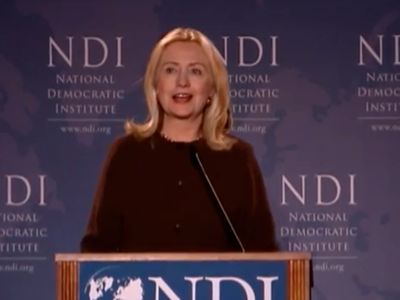
Thank you. Well, it’s a great pleasure for me to be here this evening. And I thank my friend and my predecessor, Madeleine Albright, for not only that kind introduction, but for her extraordinary leadership, and in particular of NDI. Thanks also to Shari Bryan and Ken Wollack for inviting me here today. And I want to begin by wishing an Eid Mubarak to Muslims here tonight and around the world.
I think it’s important to recognize that back when the streets of Arab cities were quiet, the National Democratic Institute was already on the ground, building relationships, supporting the voices that would turn a long Arab winter into a new Arab Spring. Now, we may not know where and when brave people will claim their rights next, but it’s a safe bet that NDI is there now, because freedom knows no better champion. More than a quarter-century old, NDI and its siblings in the National Endowment for Democracy family have become vital elements of America’s engagement with the world.
And tonight I want particularly to congratulate the winners of NDI’s 2011 Madeleine Albright Award, the women of Appropriate Communication Techniques for Development. Women risked everything to demand their rights for the Egyptian people, and they deserve those rights extended to them. And so we’re grateful for their work, and we hope to see the rights that they’ve fought for and advocated for enshrined in Egypt’s new constitution, and we’re proud to support efforts like these through our Middle East Partnership Initiative. (Applause.)
Now, tonight it’s also a singular, special honor for me to join with you in remembering three friends of NDI, three people I was lucky enough to call my friends as well: Geraldine Ferraro, a trailblazing pioneer, who lived to the fullest her conviction that women belong at the heart of democracy; Chuck Manatt, a passionate chairman of the Democratic National Committee, who understood that some things are too important to belong to any one party, and with his counterpart at the RNC, Frank Fahrenkopf, put together a bipartisan coalition to found the National Endowment for Democracy; and of course the indomitable, unforgettable Richard Holbrooke. Now, Richard has many reasons why those of us here tonight applaud and remember him. He died just four days before the desperate act of a Tunisian fruit vendor set the Arab uprisings in motion. And I often wonder what Richard would have made of all that has happened since. I’m sure he would have had a lot to say and even more that he wanted to do to promote the principles that we all cherish. And so these three individuals are very worthy of the awards that you have granted them this evening.
And what a year 2011 has been for freedom in the Middle East and North Africa. We have seen what may well have been the first Arab revolution for democracy, then the second, then the third. And in Yemen, people are demanding a transition to democracy that they deserve to see delivered. And Syrians are refusing to relent until they, too, can decide their own future.
Throughout the Arab world this year, people have given each other courage. Old fears have melted away and men and women have begun making their demands in broad daylight. They have given many of our diplomats courage, too, and I want to single out someone who is here with us tonight. When our Ambassador to Syria was mobbed, assaulted, and threatened, just for meeting with peaceful protestors, he put his personal safety on the line to let the Syrian people know that America stands with them. And he said he was inspired by their bravery. And as he drove into Hama, a city under assault by Asad’s regime, the people of that city covered his car with flowers. Please join me in giving our own warm welcome to Ambassador Robert Ford and his wife and fellow Foreign Service Officer, Alison Barkley. (Applause.) Thanks to you, Robert, and to you, Alison, for your dedicated service to our country.
Now, in Tunis, Cairo, and a newly free Tripoli, I have met people lifted by a sense that their futures actually do belong to them. In my travels across the region, I have heard joy, purpose, and newfound pride.
But I’ve also heard questions. I’ve heard skepticism about American motives and commitments, people wondering if, after decades of working with the governments of the region, America doesn’t — in our heart of hearts — actually long for the old days. I’ve heard from activists who think we aren’t pushing hard enough for democratic change, and I’ve heard from government officials who think we’re pushing too hard. I’ve heard from people asking why our policies vary from country to country, and what would happen if elections bring to power parties we don’t agree with or people who just don’t like us very much. I’ve heard people asking America to solve all their problems and others wondering whether we have any role to play at all. And beneath our excitement for the millions who are claiming the rights and freedoms we cherish, many Americans are asking the same questions.
Tonight, I want to ask and answer a few of these tough questions. It’s a fitting tribute to people like Gerry Ferraro and Richard Holbrooke and Chuck Manatt. They liked to pose difficult questions and then push us to answer them. And in Richard’s case, that meant even following me into a ladies’ room in Pakistan one time. (Laughter.) As we live this history day by day, we approach these questions with a large dose of humility, because many of the choices ahead are, honestly, not ours to make. Still, it’s worth stepping back and doing our best to speak directly to what is on people’s minds.
So let me start with one question I hear often: Do we really believe that democratic change in the Middle East and North Africa is in America’s interest? That is a totally fair question. After all, transitions are filled with uncertainty. They can be chaotic, unstable, even violent. And, even if they succeed, they are rarely linear, quick, or easy.
As we saw in the Balkans and again in Iraq, rivalries between members of different religions, sects, and tribes can resurface and explode. Toppling tyrants does not guarantee that democracy will follow, or that it will last. Just ask the Iranians who overthrew a dictator 32 years ago only to have their revolution hijacked by the extremists who have oppressed them ever since. And even where democracy does takes hold, it is a safe bet that some of those elected will not embrace us or agree with our policies.
And yet, as President Obama said at the State Department in May, “It will be the policy of the United States to promote reform across the region and to support transitions to democracy.” We believe that real democratic change in the Middle East and North Africa is in the national interest of the United States. And here’s why.
We begin by rejecting the false choice between progress and stability. For years, dictators told their people they had to accept the autocrats they knew to avoid the extremists they feared. And too often, we accepted that narrative ourselves. Now, America did push for reform, but often not hard enough or publicly enough. And today, we recognize that the real choice is between reform and unrest.
Last January, I told Arab leaders that the region’s foundations were sinking into the sand. Even if we didn’t know exactly how or when the breaking point would come, it was clear that the status quo was unsustainable because of changes in demography and technology, high unemployment, endemic corruption and a lack of human rights and fundamental freedoms. After a year of revolutions broadcast on Al Jazeera into homes from Rabat to Riyadh, going back to the way things were in December 2010 isn’t just undesirable. It’s impossible.
The truth is that the greatest single source of instability in today’s Middle East is not the demand for change. It is the refusal to change. That is certainly true in Syria, where a crackdown on small, peaceful protests drove thousands into the streets and thousands more over the borders. It is true in Yemen, where President Saleh has reneged repeatedly on his promises to transition to democracy and suppressed his people’s rights and freedoms. And it is true in Egypt. If — over time — the most powerful political force in Egypt remains a roomful of unelected officials, they will have planted the seeds for future unrest, and Egyptians will have missed a historic opportunity.
And so will we, because democracies make for stronger and stabler partners. They trade more, innovate more, and fight less. They help divided societies to air and hopefully resolve their differences. They hold inept leaders accountable at the polls. They channel people’s energies away from extremism and toward political and civic engagement. Now, democracies do not always agree with us, and in the Middle East and North Africa they may disagree strongly with some of our policies. But at the end of the day, it is no coincidence that our closest allies — from Britain to South Korea — are democracies.
Now, we do work with many different governments to pursue our interests and to keep Americans safe — and certainly not all of them are democracies. But as the fall of Hosni Mubarak in Egypt made clear, the enduring cooperation we seek will be difficult to sustain without democratic legitimacy and public consent. We cannot have one set of policies to advance security in the here-and-now and another to promote democracy in a long run that never quite arrives.
So for all these reasons, as I said back in March, opening political systems, societies, and economies is not simply a matter of idealism. It is a strategic necessity. But we are not simply acting in our self-interest. Americans believe that the desire for dignity and self-determination is universal — and we do try to act on that belief around the world. Americans have fought and died for these ideals. And when freedom gains ground anywhere, Americans are inspired.
So the risks posed by transitions will not keep us from pursuing positive change. But they do raise the stakes for getting it right. Free, fair, and meaningful elections are essential — but they are not enough if they bring new autocrats to power or disenfranchise minorities. And any democracy that does not include half its population — its women — is a contradiction in terms. Durable democracies depend on strong civil societies, respect for the rule of law, independent institutions, free expression, and a free press. Legitimate political parties cannot have a militia wing and a political wing. Parties have to accept the results of free and fair elections. And this is not just in the Middle East. In Liberia, the leading opposition party is making unsubstantiated charges of fraud and refusing to accept first round voting in which it came in second. And this is already having harmful consequences on the ground. We urge all parties in Liberia to accept the will of the people in the next round of voting tomorrow. That is what democracy anywhere requires.
And that brings me to my second question. Why does America promote democracy one way in some countries and another way in others? Well, the answer starts with a very practical point: situations vary dramatically from country to country. It would be foolish to take a one-size-fits-all approach and barrel forward regardless of circumstances on the ground. Sometimes, as in Libya, we can bring dozens of countries together to protect civilians and help people liberate their country without a single American life lost. In other cases, to achieve that same goal, we would have to act alone, at a much greater cost, with far greater risks, and perhaps even with troops on the ground.
But that’s just part of the answer. Our choices also reflect other interests in the region with a real impact on Americans’ lives — including our fight against al-Qaida, defense of our allies, and a secure supply of energy. Over time, a more democratic Middle East and North Africa can provide a more sustainable basis for addressing all three of those challenges. But there will be times when not all of our interests align. We work to align them, but that is just reality.
As a country with many complex interests, we’ll always have to walk and chew gum at the same time. That is our challenge in a country like Bahrain, which has been America’s close friend and partner for decades. And yet, President Obama and I have been frank, in public and in private, that mass arrests and brute force are at odds with the universal rights of Bahrain’s citizens and will not make legitimate calls for reform go away. Meaningful reform and equal treatment for all Bahrainis are in Bahrain’s interest, in the region’s interest, and in ours — while endless unrest benefits Iran and extremists. The government has recognized the need for dialogue, reconciliation, and concrete reforms. And they have committed to provide access to human rights groups, to allow peaceful protest, and to ensure that those who cross lines in responding to civil unrest are held accountable. King Hamad called for an independent commission of inquiry, which will issue its report soon. And we do intend to hold the Bahraini Government to these commitments and to encourage the opposition to respond constructively to secure lasting reform.
We also have candid conversations with others in the neighborhood, like Saudi Arabia — a country that is key to stability and peace — about our view that democratic advancement is not just possible but a necessary part of preparing for the future.
Fundamentally, there is a right side of history. And we want to be on it. And — without exception — we want our partners in the region to reform so that they are on it as well. Now, we don’t expect countries to do this overnight, but without reforms, we are convinced their challenges will only grow. So it is in their interest to begin now.
These questions about our interests and consistency merge in a third difficult question: How will America respond if and when democracy brings to power people and parties we disagree with?
We hear these questions most often when it comes to Islamist religious parties. Now, of course, I hasten to add that not all Islamists are alike. Turkey and Iran are both governed by parties with religious roots, but their models and behavior are radically different. There are plenty of political parties with religious affiliations — Hindu, Christian, Jewish, Muslim — that respect the rules of democratic politics. The suggestion that faithful Muslims cannot thrive in a democracy is insulting, dangerous, and wrong. They do it in this country every day.
Now, reasonable people can disagree on a lot, but there are things that all parties, religious and secular, must get right — not just for us to trust them, but most importantly for the people of the region and of the countries themselves to trust them to protect their hard-won rights.
Parties committed to democracy must reject violence; they must abide by the rule of law and respect the freedoms of speech, religion, association, and assembly; they must respect the rights of women and minorities; they must let go of power if defeated at the polls; and in a region with deep divisions within and between religions, they cannot be the spark that starts a conflagration. In other words, what parties call themselves is less important to us than what they actually do. We applaud NDI for its work to arrive at a model code of conduct for political parties across the political spectrum and around the globe. We need to reinforce these norms and to hold people accountable for following them.
In Tunisia, an Islamist party has just won a plurality of the votes in an open, competitive election. Its leaders have promised to embrace freedom of religion and full rights for women. To write a constitution and govern, they will have to persuade secular parties to work with them. And as they do, America will work with them, too, because we share the desire to see a Tunisian democracy emerge that delivers for its citizens and because America respects the right of the Tunisian people to choose their own leaders.
And so we move forward with clear convictions. Parties and candidates must respect the rules of democracy, to take part in elections, and hold elective office. And no one has the right to use the trappings of democracy to deny the rights and security of others. People throughout the region worry about this prospect, and so do we. Nobody wants another Iran. Nobody wants to see political parties with military wings and militant foreign policies gain influence. When members of any group seek to oppress their fellow citizens or undermine core democratic principles, we will stand on the side of the people who push back to defend their democracy.
And that brings me to my next question: What is America’s role in the Arab Spring? These revolutions are not ours. They are not by us, for us, or against us, but we do have a role. We have the resources, capabilities, and expertise to support those who seek peaceful, meaningful, democratic reform. And with so much that can go wrong, and so much that can go right, support for emerging Arab democracies is an investment we cannot afford not to make.
Now, of course, we have to be smart in how we go about it. For example, as tens of millions of young people enter the job market each year, we recognize that the Arab political awakening must also deliver an economic awakening. And we are working to help societies create jobs to ensure that it does. We are promoting trade, investment, regional integration, entrepreneurship, and economic reforms. We are helping societies fight corruption and replace the old politics of patronage with a new focus on economic empowerment and opportunity. And we are working with Congress on debt relief for Egypt and loan guarantees for Tunisia so that these countries can invest in their own futures.
We also have real expertise to offer as a democracy, including the wisdom that NDI has gleaned from decades of working around the globe to support democratic transitions. Democracies, after all, aren’t born knowing how to run themselves. In a country like Libya, Qadhafi spent 42 years hollowing out every part of his government not connected to oil or to keeping him in power. Under the Libyan penal code, simply joining an NGO could be punishable by death. When I traveled last month to Libya, the students I met at Tripoli University had all sorts of practical, even technical, questions: How do you form a political party? How do you ensure women’s participation in government institutions? What recommendations do you have for citizens in a democracy?
These are questions NDI and its kindred organizations, many of whom are represented here tonight, are uniquely qualified to help new democracies answer. NDI has earned a lot of praise for this work, but also a lot of pushback that stretches far beyond the Arab world. In part, this resistance comes from misconceptions about what our support for democracy does and does not include.
The United States does not fund political candidates or political parties. We do offer training to parties and candidates committed to democracy. We do not try to shift outcomes or impose an American model. We do support election commissions, as well as nongovernmental election monitors, to ensure free and fair balloting. We help watchdog groups learn their trade. We help groups find the tools to exercise their rights to free expression and assembly, online and off. And of course we support civil society, the lifeblood of democratic politics.
But in part, the pushback comes from autocrats around the world wondering if the next Tahrir Square will be their capital square, and some are cracking down when they should be opening up. Groups like NDI are no strangers to pressure, and neither are the brave local groups you partner with. And I want you to know that as the pressure on you increases, our support will not waver.
And I want to offer a special word of thanks for NDI’s efforts to empower women across the Middle East and beyond. Just last week, the World Economic Forum released a report on the remarkable benefits countries see when they bridge the social, economic, and political gap separating women from men, and helping them get there is a priority for the State Department and for me personally. Graduates of NDI training programs designed to help women run for office now sit in local councils and parliaments from Morocco to Kuwait.
But we all know a great deal of work lies ahead to help all people, women and men, find justice and opportunity as full participants in new democratic societies. Along with our economic and technical help, America will also use our presence, influence, and global leadership to support change. And later this week, I am issuing new policy guidance to our embassies across the region to structure our efforts.
In Tunisia, Egypt, and Libya, we are working to help citizens safeguard the principles of democracy. That means supporting the forces of reconciliation rather than retribution. It means defending freedom of expression when bloggers are arrested for criticizing public officials. It means standing up for tolerance when state-run television fans sectarian tensions. And it means that when unelected authorities say they want to be out of the business of governing, we will look to them to lay out a clear roadmap and urge them to abide by it.
Where countries are making gradual reforms, we have frank conversations and urge them to move faster. It’s good to hold multi-party elections and allow women to take part. It’s better when those elections are meaningful and parliaments have real powers to improve people’s lives. Change needs to be tangible and real. When autocrats tell us the transition to democracy will take time, we answer, “Well, then let’s get started.”
And those leaders trying to hold back the future at the point of a gun should know their days are numbered. As Syrians gather to celebrate a sacred holiday, their government continues to shoot people in the streets. In the week since Bashar al-Asad said he accepted the terms of an Arab League peace plan to protect Syrian civilians, he has systematically violated each of its basic requirements. He has not released all detainees. He has not allowed free and unfettered access to journalists or Arab League monitors. He has not withdrawn all armed forces from populated areas. And he has certainly not stopped all acts of violence. In fact, the regime has increased violence against civilians in places like the city of Homs. Now, Asad may be able to delay change. But he cannot deny his people’s legitimate demands indefinitely. He must step down; and until he does, America and the international community will continue to increase pressure on him and his brutal regime.
And for all of Iran’s bluster, there is no country in the Middle East where the gulf between rulers and ruled is greater. When Iran claims to support democracy abroad, then kills peaceful protestors in the streets of Tehran, its hypocrisy is breathtaking and plain to the people of the region.
And there is one last question that I’m asked, in one form or another, all the time: What about the rights and aspirations of the Palestinians? Israelis and Palestinians are not immune to the profound changes sweeping the region. And make no mistake, President Obama and I believe that the Palestinian people — just like their Arab neighbors, just like Israelis, just like us — deserve dignity, liberty, and the right to decide their own future. They deserve an independent, democratic Palestinian state of their own, alongside a secure Jewish democracy next door. And we know from decades in the diplomatic trenches that the only way to get there is through a negotiated peace — a peace we work every day to achieve, despite all the setbacks.
Of course, we understand that Israel faces risks in a changing region — just as it did before the Arab Spring began. And it will remain an American priority to ensure that all parties honor the peace treaties they have signed and commitments they have made. And we will always help Israel defend itself. We will address threats to regional peace whether they come from dictatorships or democracies. But it would be shortsighted to think either side can simply put peacemaking on hold until the current upheaval is done. The truth is, the stalemate in the Arab-Israeli conflict is one more status quo in the Middle East that cannot be sustained.
This brings me to my last and perhaps most important point of all. For all the hard questions I’ve asked and tried to answer on behalf of the United States, the most consequential questions of all are those the people and leaders of the region will have to answer for themselves. Because ultimately, it is up to them. It is up to them to resist the calls of demagogues, to build coalitions, to keep faith in the system even when they lose at the polls, and to protect the principles and institutions that ultimately will protect them. Every democracy has to guard against those who would hijack its freedoms for ignoble ends. Our founders and every generation since have fought to prevent that from happening here. The founding fathers and mothers of Arab revolutions must do the same. No one bears a greater responsibility for what happens next.
When Deputy Secretary Bill Burns addressed the National Endowment for Democracy over the summer, he recounted the story of an Egyptian teenager who told her father a few years back that she wanted to spend her life bringing democracy to Egypt. “Good,” her father said, “because then you will always have a job.” (Laughter.)
Now, we should never fall prey to the belief that human beings anywhere are not ready for freedom. In the 1970s, people said Latin America and East Asia were not ready. Well, the 1980s began proving them wrong. In the 1980s, it was African soil where democracy supposedly couldn’t grow. And the 1990s started proving them wrong. And until this year, some people said Arabs don’t really want democracy. Well, starting in 2011, that too is being proved wrong. And funnily enough, it proved that Egyptian father right, because we all still have a job to do.
So we have to keep at it. We have to keep asking the tough questions. We have to be honest with ourselves and with each other about the answers we offer. And we cannot waver in our commitment to help the people of the Middle East and North Africa realize their own God-given potentials and the dreams they risked so much to make real.
And on this journey that they have begun, the United States will be their partner. And of the many tools at our disposal — the National Endowment and NDI and all of the family of organizations that were created three decades ago to help people make this journey successfully — will be right there.
I heard Madeleine say when she introduced me that I defend NDI. Well, I do. And I also defend IRI. I defend those organizations that we have created, that the American taxpayers pay for, who try to do what needs to be done to translate the rhetoric and the calls for democracy into the reality, step by step. And we have to be reminded from time to time that it truly is — or at least can seem to be — a foreign language. Like some of you, I’ve met with the young people who started these revolutions. And they are still passionate, but perhaps not clear about what it takes to translate that passion into reality within a political system.
So there are going to be a lot of bumps along this road. But far better that we travel this path, that we do what we can to make sure that our ideals and values, our belief and experience with democracy, are shared widely and well. It’s an exciting time. It’s an uncertain time. But it’s a good time for the United States of America to be standing for freedom and democracy. And I thank you all for making that journey possible. Thank you very much. (Applause.)


 Articles by this author


Stay In Touch
Follow us on social networks
Subscribe to weekly newsletter