


Had Muammar Gaddafi become too pesky for the likes of Nicolas Sarkozy and his Atlanticist partners, by standing in the way of their agenda for the domination of the Mediterranean sea region? France’s direct role in nurturing the rebellion against the Libyan leader is no longer a secret. In this article, Rick Rozoff offers some additional pointers, and analyzes the Libyan war in the context of the advancing transformation of the Mediterranean into NATO’s mare nostrum.
Voltaire Network |
Chicago |
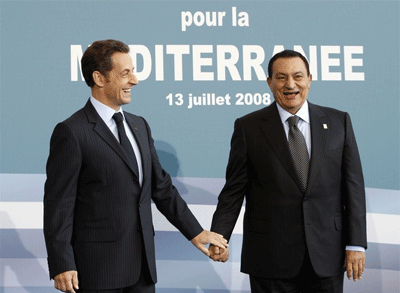
French President Nicolas Sarkozy and fallen Egyptian President Hosni Mubarack are the merry co-chairs of the EU-Mediterranean summit held in Paris on July 13, 2008.
A year after assuming the post of president of the French Republic in 2007, and while his nation held the rotating European Union presidency, Nicolas Sarkozy invited the heads of state of the EU’s 27 members and those of 17 non-EU Mediterranean countries to attend a conference in Paris to launch a Mediterranean Union.
In the words of Britain’s Daily Telegraph regarding the subsequent summit held for the purpose on July 13, 2008, “Sarkozy’s big idea is to use imperial Rome’s centre of the world as a unifying factor linking 44 countries that are home to 800 million people.”
Libyan leader Muammar Gaddafi, however, announced that his nation would boycott the gathering, denouncing the initiative as one aimed at dividing both Africa and the Arab world, and stating:
“We shall have another Roman empire and imperialist design. There are imperialist maps and designs that we have already rolled up. We should not have them again.” [1]
The unprecedented summit was held with the intention of “shift[ing] Europe’s strategic focus towards the Middle East, North Africa and the Balkans.” [2]

Blue: Members of the European Union Union for the Mediterranean / Green: Other members (primarily from the African Union & Arab League) / Striped green: Libya is currently only an observer member in the Union for the Mediterranean
The Mediterranean Union was renamed the less controversial Union for the Mediterranean and its members include all 44 nations originally invited to join except for Libya.
Less than three years later Sarkozy’s Mirage and Rafale warplanes were bombing Libyan government targets, initiating an ongoing war being waged by France, the United States, Britain and what the world news media refer to as an international coalition – 12 members of the North Atlantic Treaty Organization and the emirate of Qatar – to overthrow the Gaddafi government and implant a more pliant replacement.
The Mediterranean Sea is the main battle front in the world currently, superseding the Afghanistan-Pakistan war theater, and the empire of the new third millennium – that of the U.S., the world’s sole military superpower in the words of President Barack Obama in his Nobel Peace Prize acceptance speech, and its NATO partners – is completing the transformation of the Mediterranean into its mare nostrum.
The attack on Libya followed by slightly more than three weeks a move in the parliament of the Eastern Mediterranean island nation of Cyprus to drag that state into NATO’s Partnership for Peace program [3], which if ultimately successful would leave only three of twenty nations (excluding microstate Monaco) on or in the Mediterranean Sea not full members of NATO or beholden to it through partnership entanglements, including those of the Mediterranean Dialogue (Algeria, Egypt, Israel, Jordan, Mauritania, Morocco and Tunisia): Libya, Lebanon and Syria.
NATO membership and partnerships obligate the affected governments to open their countries to the U.S. military. For example, less than a year after becoming independent Montenegro had already joined the Partnership for Peace and was visited by then-commander of U.S. Naval Forces Europe Admiral Harry Ulrich and the submarine tender Emory S. Land in an effort “to provide training and assistance for the Montenegrin Navy and to strengthen the relationship between the two navies.” [4] The next month four NATO warships, including the USS Roosevelt guided missile destroyer, docked in Montenegro’s Tivat harbor.
If the current Libyan model is duplicated in Syria as increasingly seems to be the case, and with Lebanon already blockaded by warships from NATO nations since 2006 in what is the prototype for what NATO will soon replicate off the coast of Libya, the Mediterranean Sea will be entirely under the control of NATO and its leading member, the U.S.
Cyprus in the only European Union member and indeed the only European nation (except for microstates) that is – for the time being – not a NATO member or partner, and Libya is the only African nation bordering the Mediterranean not a member of NATO’s Mediterranean Dialogue partnership program.
Libya is also one of only five of Africa’s 54 countries that have not been integrated into, which is to say subordinated to, the new U.S. Africa Command (AFRICOM).
The others are:
Sudan, which is being balkanized as Libya may also soon be.
Ivory Coast, now embroiled in what is for all intents a civil war with the West backing the armed groups of Alassane Ouattara against standing president Laurent Gbagbo and under the threat of foreign military intervention, likely by the AFRICOM- and NATO-supported West African Standby Force and possibly with direct Western involvement. [5]
Eritrea, which borders Djibouti where some 5,000 U.S. and French troops are based and which was involved in an armed border conflict with its neighbor three years ago in which French military forces intervened on behalf of Djibouti.
Zimbabwe, which is among likely candidates for the next U.S.-NATO Operation Odyssey Dawn-type military intervention.
The Mediterranean has been history’s most strategically important sea and is the only one whose waves lap the shores of three continents.
Control of the sea has been fought over by the Persian, Alexandrian, Carthaginian, Roman, Byzantine, Ottoman, Spanish, British and Napoleonic empires, in part or in whole, and by Mussolini’s Italy and Hitler’s Germany.
Since the end of World War Two the major military power in the sea has been the U.S. In 1946 Washington established Naval Forces Mediterranean, which in 1950 became the U.S. Sixth Fleet and has its headquarters in the Mediterranean port city of Naples.
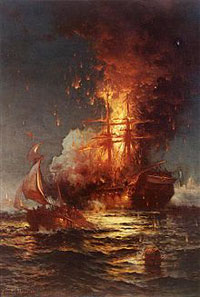
The burning frigate USS Philadelphia in the harbor of Tripoli, February 16, 1804. The Tripolitan War was the first of two wars fought between the United States and the North African Muslim states known collectively as the Barbary States.
Painted by Edward Moran in 1897.
In fact the genesis of the U.S. Navy was the Naval Act of 1794, passed in response to the capture of American merchant vessels off the coast of North Africa. The Mediterranean Squadron (also Station) was created in reaction to the first Barbary War of 1801-1805, also known as the Tripolitan War after what is now northwestern Libya. The U.S. fought its first naval battle outside the Western Hemisphere against Tripolitania in 1801.
U.S. Naval Forces Europe-Africa, also based in Naples, is assigned to the Sixth Fleet and provides forces for both U.S. European Command and U.S. Africa Command. Its commander is Admiral Samuel Locklear III, who is also commander of NATO’s Allied Joint Force Command Naples.
He has been coordinating U.S. and NATO air and missile strikes against Libya from USS Mount Whitney, the flagship of the Sixth Fleet, as commander of Joint Task Force Odyssey Dawn, the U.S. Africa Command operation in charge of U.S. guided missile destroyers, submarines and stealth bombers conducting attacks inside Libya.
Admiral Gary Roughead, Chief of Naval Operations (the highest-ranking officer in the U.S. Navy), recently stated that the permanent U.S. military presence in the Mediterranean allowed the Pentagon, which “already was positioned for operations over Libya,” to launch Odyssey Dawn on March 19. “The need, for example in the opening rounds, for the Tomahawk strikes, the shooters were already in place. They were already loaded, and that went off as we expected it would.”
“That’s what you get when you have a global Navy that’s forward all the time….We’re there, and when the guns go off, we’re ready to conduct combat operations….” [6]
On March 22 General Carter Ham, the new chief of U.S. Africa Command, visited the U.S. air base in Ramstein, Germany and met with British, French and Italian air force leaders to evaluate the bombing campaign in Libya. He praised cooperation with NATO partners before the war began, stating, “You can’t bring 14 different nations together without ever having prepared for this before.” [7]
As the AFRICOM commander was in Germany, Defense Secretary Robert Gates was in Egypt to meet with Field Marshal Mohamed Hussein Tantawi, commander in chief of the Egyptian armed forces and chairman of the Supreme Council of the Armed Forces, to coordinate the campaign against Libya.

Operation Odyssey Dawn: USS Barry (DDG 52) fires a Tomahawk cruise missile against Libyan targets.
The Pentagon’s website reported on March 23 that forces attached to AFRICOM’s Task Force Odyssey Dawn had flown 336 air sorties, 108 of them launching strikes and 212 conducted by the U.S. The operations included 162 Tomahawk cruise missile attacks.
Admiral Roughead stated that he envisioned “no problem in keeping operations going,” as the Tomahawks will be replaced from the existing inventory of 3,200. Enough to level Libya and still have plenty left over for the next war. [8]
The defeat and conquest, directly or by proxy, of Libya would secure a key outpost for the Pentagon and NATO on the Mediterranean Sea.
The consolidation of U.S. control over North Africa would have more than just regional repercussions, important as they are.
Shortly after the inauguration of U.S. Africa Command, Lin Zhiyuan, deputy director of the Chinese People’s Liberation Army Academy of Military Sciences, wrote the following:
“By building a dozen forward bases or establishments in Tunisia, Morocco, Algeria and other African nations, the U.S. will gradually establish a network of military bases to cover the entire continent and make essential preparations for docking an aircraft carrier fleet in the region.”
“The North Atlantic Treaty Organization (NATO) with the U.S. at the head had [in 2006] carried out a large-scale military exercise in Cape Verde, a western African island nation, with the sole purpose of controlling the sea and air corridors of crude oil extracting zones and monitoring how the situation is with oil pipelines operating there.”
“[A]frica Command represents a vital, crucial link for the US adjustment of its global military deployment. At present, it is moving the gravity of its forces in Europe eastward and opening new bases in Eastern Europe.”
“The present US global military redeployment centers mainly on an ‘arc of instability’ from the Caucasus, Central and Southern Asia down to the Korean Peninsula, and so the African continent is taken as a strong point to prop up the US global strategy.
“Therefore, AFRICOM facilitates the United States advancing on the African continent, taking control of the Eurasian continent and proceeding to take the helm of the entire globe.” [9]
Far more is at stake in the war with Libya than control of Africa’s largest proven oil reserves and subjugating the last North African nation not yet under the thumb of the U.S. and NATO. Even more than domination of the Mediterranean Sea region.
[1] Daily Telegraph, July 10, 2008.
[2] Daily Telegraph, July 14, 2008.
[3] Cyprus: U.S. To Dominate All Europe, Mediterranean Through NATO, Stop NATO, March 3, 2011.
[4] United States European Command, May 24, 2007.
[5] Ivory Coast: Testing Ground For U.S.-Backed African Standby Force, Stop NATO, January 23, 2011.
[6] U.S. Department of Defense, March 23, 2011.
[7] U.S. Air Forces in Europe, March 23, 2011.
[8] U.S. Department of Defense, March 23, 2011.
[9] People’s Daily, February 26, 2007.


 Articles by this author
 Send a message




Stay In Touch
Follow us on social networks
Subscribe to weekly newsletter