


Through the new North Stream and South Stream pipeline systems, Russia is clearly redrawing the energy map of Europe. Its status as the pre-eminent supplier of natural gas-hungry European countries, including major NATO member states, is certain to significantly transform future east-west relations. As expounded by this author, energy is the lever for Russia’s return to the world stage and for checkmating Washington’s NATO encirclement strategy.
Voltaire Network |
Frankfurt (Germany) |

The new Nord Stream gas pipeline was officially opened in the North German town of Lubmin. German Chancellor Merkel, Russian President Medvedev, Dutch Prime Minister Rutte, French Prime Minister Fillon and European Commissioner Oettinger attended the opening.
On November 7 the first of two pipelines for Nord Stream, the huge Russian-German gas pipeline project, began delivery of gas. The event was no minor affair. German Chancellor Merkel and Russian President Medvedev along with the prime ministers of France and the Netherlands and the EU Energy Commissioner formally opened the first of two 1224-kilometre pipelines at Lubmin in northern Germany, beginning delivery of the first gas direct from Russia’s Yuzhno-Russkoye gas field in Siberia to Germany.
Nord Stream was not cheap. It cost a total of more than $12 billion for the complex 760 mile long undersea pipeline through the Baltic Sea from Vyborg near Russia’s St Petersburg to north eastern Germany. It was laid in remarkable time and with extraordinary environmental precautions to insure protection of sea life, a precondition set by several EU Baltic countries. When the second pipeline is finished in late 2012, Nord Stream will be able to deliver 55 billion cubic meters of Russian gas a year, almost ten percent the entire EU annual gas consumption, or roughly one third the entire current gas consumption of China.
Nord Stream estimates it will provide enough energy to fuel 56 million West European households. With current EU political decisions over reducing CO² “carbon footprint” emissions, the Russian gas giant argues its natural gas gives 50% less CO² than rival coal plants at as much as 50% greater energy efficiency.
Even if Moscow is being more than somewhat opportunist and is not convinced about the shoddy science of global warming, Gazprom does not hesitate to use this as a shrewd political selling point. The EU is going for natural gas energy big time and Moscow intends to be a major, if not the major beneficiary of that push. In addition to delivering Siberian gas to Germany, Nord Stream will deliver to the United Kingdom, Denmark, the Netherlands, Belgium, France and the Czech Republic.
Moscow appears to hold a winning hand in the one important non-military lever it has to tip the global geopolitical balance of power in its direction and away from Washington’s overwhelming dominance. Oil and natural gas are at the heart of the strategy. For some months Russian production of crude oil has surpassed Saudi Arabia’s to be the world’s largest oil producer with over 10.3 million barrels daily, nearly one million barrels more. [1] And in terms of known reserves of natural gas Russia is far away the world leader according to industry data.
Russian natural gas has increasingly been the foundation for a brilliant series of Russian energy geopolitical initiatives for several years. Gazprom, a closely-held state company, is the centerpiece of this energy strategy.
To counter the eastward march of NATO into countries of the former Warsaw Pact such as Poland, the Czech Republic or Romania and the various US attempts to lure Ukraine and Georgia into NATO, Russia’s Vladimir Putin, both as President and more recently as Prime Minister, has used the economic lever of Gazprom. With its enormous gas resources Russia seeks to win stronger economic ties in western Europe, thereby hopefully neutralizing somewhat the potential military strategic threat from the NATO encirclement. No country has been more the focus of this Russian pipeline diplomacy than former wartime foe Germany where Nord Stream lands.

North Stream map
The undersea route across the Baltic to Germany was chosen by a German-Russian consortium including Gazprom with 51% and the German chemicals group BASF Wintershall and E.ON Ruhrgas of Germany each today with 15.5% share, giving the German-Russian partners a dominating 82% control. Further adding to the political support from key EU countries, later they were joined by N.V. Nederlandse Gasunie and France’s GDF Suez which each own a 9% share.
The Baltic undersea route was chosen deliberately to avoid potential geopolitical disruptions such as occurred several years ago when a pro-NATO Ukrainian government blocked Russian gas deliveries to Western Europe to undercut Russian attempts to come closer to western Europe. Behind Ukraine was the long arm of Washington. [2]
Had Ukraine joined NATO as Washington urgently sought after Kiev’s 2004 "Orange Revolution" brought Washington’s man Viktor Yushchenko in as President, then Ukraine would have been in a strategic position to economically strangle Russia on command. Prior to opening of Nord Stream in November some 80% of all Russian gas exports to EU countries—mainly to Germany, Italy and France—were flowing across Ukrainian territory. Political instability and ongoing NATO meddling in Ukraine dictated the decision to build the new Nord Stream undersea route to Germany and other EU markets bypassing entirely Ukraine and Poland. Today some 40% of all state revenue in Russia comes from Russia’s oil and gas exports. [3]
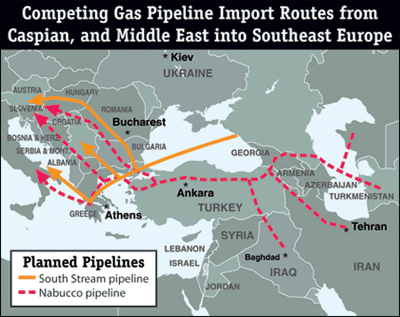
South Stream vs Nabucco
While few outside the energy industry and special political interest groups have paid much attention to it, at the same time Nord Stream was coming into play a ferocious geopolitical battle has also been raging over a second planned major Gazprom Russian gas pipeline project to EU countries called South Stream. South Stream gas pipeline will be laid on the Black Sea floor, pass through Bulgaria, Serbia, Hungary and Slovakia and on to west European markets from the southern part of the EU.
To politically counter the growing Russian energy ties to the EU, with strong Washington backing, the EU Commission proposed an alternative in 2002 called the Nabucco pipeline, curiously named after the Verdi opera. To date Turkey, Romania, Bulgaria, Hungary and Austria have agreed “in principle” to build the 3,900 km Nabucco pipeline that theoretically would pump up to 31 billion cubic meters of gas annually from the Caspian and the Middle East across Turkey into western Europe. Nabucco partners to date include energy companies RWE of Germany; OMV of Austria; MOL of Hungary; Botas of Turkey; Bulgaria Energy Holding of Bulgaria; and Transgaz of Romania.
The problem is that the Nabucco partners have yet to secure gas anywhere to fill the pipeline. Moscow has deftly locked up the gas from the obvious supplier Azerbaijan, and surplus gas from former Soviet Republic Turkmenistan is also secured in deals with Gazprom, leaving only Iran as an option, something politically Washington is not ready to consider, to put it mildly.
Both Nord Stream and South Stream came into being when Ukraine’s previous Yushchenko regime, with reported strong US behind-the-scenes backing, twice disrupted transit gas flows to European markets beginning 2006. To assure stability of supplies, Moscow created both new pipeline projects to bypass Ukraine. [4]
The geopolitical problem for Washington and its allies in Brussels is the fact that its Nabucco project appears dead in the water before it even gets started. Not only has Gazprom locked up the major gas supply sources including Azerbaijan. Nabucco is also far more costly than its Russian rival.
Latest estimates put Nabucco’s ultimate construction cost at almost double that of South Stream. Tamás Fellegi, Hungarian National Development Minister, recently stated that the cost of Nabucco gas pipeline will exceed original plans by four times. "No one can predict the final cost of Nabucco, but according to optimistic estimates, its cost may reach 24-26 billion euro," Fellegi said. [5]

Former Italian Prime Minister Silvio Berlusconi with Russian leaders Medvedev (center) and Putin. Italy’s Eni and Russian state firm Gazprom are partners on the South Stream project.
In late October Gazprom made a major move to secure partners for its South Stream in a Moscow meeting with its largest consortium partner, Italy’s ENI. [6]
Some days before in September, Gazprom secured the significant participation into South Stream of its major Nord Stream German partner, BASF Wintershall, a major blow to Nabucco hopes. They joined the major French energy company EDF to give the South Stream project major clout versus the floundering Nabucco.
Last April, Turkey, also at least on paper a key player in Nabucco, gave permission to Gazprom to begin offshore prospecting for the potential undersea route of South Stream, a first step to gain Turkish approval to begin construction in Turkish territorial waters on the Black Sea. Turkey is trying to play a new role as an energy crossroads between the EU and its neighbors. By giving Gazprom the green light to begin prospecting, Turkey’s Erdogan government clearly has decided not to put all its energy eggs into the NATO Nabucco basket. [7]
Possible routes for Gazprom’s South Stream Pipeline
Already Gazprom is the largest natural gas supplier to the EU. Gazprom with Nord Stream and other lines plans to increase its gas supply to Europe this year by 12% to 155 billion cubic meters. It now controls 25% of the total European gas market and aims to reach 30% with completion of South Stream and other projects.
Rainer Seele, chairman of Wintershall, suggested the geopolitical thinking behind the decision to join South Stream: "In the global race against Asian countries for raw materials, South Stream, like Nord Stream, will ensure access to energy resources which are vital to our economy." [8]
But rather than Asia, the real focus of South Stream lies to the West. The ongoing battle between Russia’s South Stream and the Washington-backed Nabucco is intensely geopolitical. The winner will hold a major advantage in the future political terrain of Europe.
According to Andrei Polischuk, an energy analyst at the BKS Finance Group, Nabucco is in far the weaker position at present. “This project is facing several problems. One of them is how to fill it with gas and how to find a resource basis. The second is its growing cost. Earlier, the project was estimated at 8 billion US dollars, but at present, it has grown up to 12 to 15 billion US dollars.” says Polischuk. “All these projects have first and foremost a hidden political motive. By implementing them, Europe tries to lower its dependence on Russian gas.” [9]
Reinhard Mitschek, director of Nabucco Gas Pipeline International, recently admitted that Nabucco now has been pushed back until 2017, three years later than originally planned. The construction work won’t begin until at least 2013. He feebly admitted in a recent press conference when pressed on a date for gas deliveries, that gas would flow, “as soon as there are firm indications that gas supply commitments are in place.” [10]
EU Nacht und Nebel Raid on Gazprom
As if on cue, just days before the planned opening ceremony for Gazprom’s Nord Stream pipeline the EU launched an unprecedented “nacht und nebel” style raid on the offices of Gazprom and its EU partners covering ten countries.
In response to a complaint by the Washington-friendly government of Lithuania, on 28 September EU officials raided Gazprom and associated offices in central and eastern European states to investigate firms involved in the supply, transmission and storage of natural gas. The Commission claimed the raids were linked to “suspicions” about anti-competitive practices.
The raids were an unprecedented use of new EU “antitrust” weapons including the threat of fines up to 10% of a company’s global turnover. Following a Thatcherite “free market” model, the EU Commission has in recent years forced E.ON, RWE and ENI to open up or sell their energy pipelines to rivals. E.ON and GDF were also forced to dismantle their market-sharing deals.
The EU is working a so-called Third Energy Package, which imposes limits on ownership of EU pipeline infrastructure by gas suppliers and calls for the "unbundling" of over-concentrated ownership. Under the rules, Russia could be forced to sell off parts of its pipeline network in the EU, something Moscow is understandably not about to do. It could open a Pandora’s box of geopolitical interference with potential for anti-Russian companies to in effect sabotage the vital and growing Russian gas trade with the EU, a mainstay today of Russian state finances.
The Gazprom raids were explicitly political. The EU even admits it has little evidence: “We’re at the beginning of the investigation; we have our suspicions and we have to see whether these are confirmed on the basis of the evidence we find and our analysis," Commission spokeswoman Amelia Torres told press in Brussels. [11]
According to Reuters, “A Commission official, who declined to be named, told Reuters the raids were part of the EU’s efforts to wean itself off reliance on Russian gas and concerns about Gazprom’s power as a state-controlled entity.” Gazprom itself clearly links the raids to their recent progress on South Stream: “My guess is that it comes as Russia is speeding up its projects, including the South Stream underwater link,” a Gazprom source said. [12]
Vladimir Feigin, a member of the Russian delegation discussing the issue with EU officials, charges the European Commission with taking a "dangerous path" with the raids. “It’s not a simple demonstration of muscles ... There are lots of issues, which are highly politicized, including Gazprom’s long-term contracts,” he insisted. [13]
While free market game rules may sound attractive to market outsiders, for the future planning of Gazprom long-term fixed contracts are essential. As oil markets reveal in recent years, while prices sometimes fall, most often they are subject to manipulation by major Wall Street banks like JP Morgan Chase, Citigroup or Goldman Sachs, the gang that pushed oil prices above $147 a barrel in June 2008 at a time supply on the world market was in glut, making a literal killing in the process. [14]
In anticipation of the larger export market for its gas to Europe, Gazprom has been making huge infrastructure investments across Europe which could be wiped out by an adverse EU decision. It is in the process of doubling its underground storage capacities for gas. It already operates gas storage facilities in Austria and leases facilities in Britain, France and Germany to handle the planned new flow from Nord Stream and South Stream. As well, Gazprom has built a joint venture storage facility with Serbia to serve gas exports to Serbia, Bosnia-Herzegovina and Hungary. Feasibility studies are being done for similar joint storage projects in the Czech Republic, France, Romania, Belgium, Britain, Slovakia, Turkey and Greece. This, in addition to the major investment in the pipelines, makes it clear the EU raids are aimed at Moscow’s energy jugular. [15]
Were Moscow to succeed in completing South Stream and retain its integral control over the delivery pipeline infrastructure, it would represent nothing less than a major geopolitical defeat for Washington. Since the collapse of the Soviet Union in the early 1990’s, Washington energy geopolitics in the Caspian region and across Eurasia into Russia have attempted to weaken if not permanently cripple the one major remaining geopolitical lever Moscow holds to counter Washington’s NATO encirclement strategy. Not letting itself be totally dependent on EU gas or oil revenues, Moscow has recently indicated it is greatly increasing its focus on building long-term energy partnerships with its eastern neighbors of Eurasia, most notably with China. The geopolitical implications for Washington of that shift will be examined in a subsequent article.
[1] News Wires, Russian Output Hits Post-Soviet Highs, 2 November 2011.
[2] "Ukraine Geopolitics and the US-NATO Military Agenda”, by F. William Engdahl, Voltaire Network, 24 March 2010.
[3] Friedbert Pflüger, "Russia and Europe: Time to bury the hatchet-and embrace the market," 20 October, 2011, European Energy Review.
[4] RIA Novosti, "Ukraine lost reputation of reliable gas transit country – Yanukovych," 19 October 2011.
[5] ABC.AZ, "Nabucco project cost to exceed value of South Stream and make it world’s most expensive gas pipeline," 24 October 2011.
[6] "ENI, Gazprom CEOs discuss South Stream Development," October 17, 2011, www.offshoreenergy.com
[7] Newswires, "Turkey gives offshore permit to Gazprom for South Stream project," 11 April, 2011.
[8] UPI, "Wintershall joins South Stream consortium," 16 September 2011.
[9] Moscow Times, "Europe still wants to go around South Stream," 30 September 2011.
[10] M K Bhadrakumar, "Russia redrawing Europe energy map," Asia Times Online, 12 May 2011.
[11] Reuters, "EU raids Gazprom offices in anti-trust probe," 29 September 2011.
[12] Ibid.
[13] Ibid.
[14] F. William Engdahl, "More on the real reason behind high oil prices: Part II," Global Research, 21 May 2008.
[15] M K Bhadrakumar, op. cit.


 Articles by this author
 Send a message


Stay In Touch
Follow us on social networks
Subscribe to weekly newsletter