


Since the collapse of the Soviet Union, the world has been searching for a new geopolitical balance. All the various models have failed, starting with the unipolar world order of the New American Century. What emerges is not the result of an ideology, but a tectonic shift in the global balance of power, observes geopolitician Imad Fawzi Shueib. The double Russian and Chinese veto related to the Syrian crisis marks the dawn of this new world configuration, which is still groping to find its own operating rules in a complete break with past models.
Voltaire Network |
Damascus (Syria) |
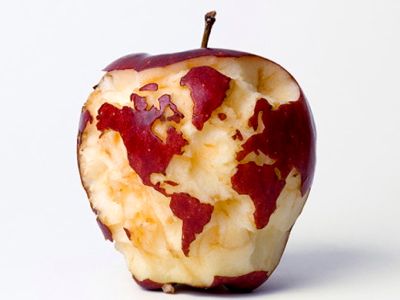
With the Russian-Chinese joint/double veto as regards Syria, the French –Anglo-Saxon shock was not taken as a transient contingency in international strategies. Such a veto was intended to be a message sent by the emerging economies; China, Russia and its satellite Eurasian states, in addition to states of the Shanghai Treaty, to the European and American flagging economies that it is high time for the crystallization of a new world order after the dominance of two phases over the international system in the aftermath of the collapse of the USSR; unipolarity (1991-2006) and non-polarity (2006-2011). These are not actual world systems due to absence of international game rules and discord between the phase of unipolarity and a multinational global economy in the first phase, and to the inability of the phase of non-polarity to substantially be a international system.
International apportionment, according to the current conflict balances, looks like labors of a new Yalta whereby Russia and China occupy, internationally, the first and second positions, whereas the United States of America, France and Britain step backward to occupy later positions. On the other hand, India, Brazil, and some eastern Asian countries gain more political weight, at a time when Germany longs to free itself from the American occupation militarily, and the European one politically, by jumping into the wagon-band of humanitarian considerations and the rejection of multiculturalism. In other words, Germany wants to share the United States of America and France in the Humanitarian Considerations, but, it, at the same time, wants to oppose its philosophical basis represented by Multiculturalism in an attempt to break free from the Post-World War II legacy. Yet, Berlin secretly whispers to Moscow that it feels embarrassed and in need of an exit strategy due to the French – Anglo-Saxon embroilment in the region’s affairs because Germany did not have, as regards oil, any share whatsoever in the Libyan cake.
In this context, the tendency to attack Syria does not seem to suggest any promising economic or political benefits/gains to the Germanic bloc (Germany, Czech, Austria, Switzerland), or to the economically falling Europe. Hence, the French attack is no more than a geostrategic rashness that could achieve nothing in Libya nor is it likely to achieve anything elsewhere. Thus, it is an act that could be called "the last minute breath" which is a conceivable conduct of a super power that wants to fill in a vacuum in a historic moment, be it in or out of history context. This is because super powers have the right to do what they deem appropriate in an attempt to save their face or to improve their negotiation position with the advent of the instant of international apportionment.
Remarkably, the United States has presented the worst type of the International fore-apportionment when it revived the controversial issues and prompted Moscow towards taking a tense opposite stance, on the one hand, yet a stance that goes ahead of the tampered US-Nato scheming, on the other hand. At that time, the project of the missile defense emerged and the situation was provocatively escalated at an early time. An even more provocative rivalry in the Caspian Sea and raising the “Greater Central Asia” strategy encouraged for more convergence between Russia and China as to resolve international events and crystallize a new world order – or at least rushing towards voicing a NO awaiting an international instant for this stubborn crystallization to manifest on the basis of the economic and geopolitical power balances and all that is potentially promising in economies and strategic positions. This clarifies, to a great extent, the Chinese - Russian non-hesitation in using a veto that was considered as an international message which sounded like the ultimatum addressed to France and Britain during the Suez Crisis which paved the way for a new world arrangement, whereby the aforementioned states were brought back into the third and fourth positions, and paved the way for the bipolar system, the Bay of Pigs Invasion, and installing of missiles in Cuba in 1962.
The United States spared no effort in provoking Russia and China in different parts of the world. Politically, the United States was involved in Georgia’s events, an act which Moscow completely rejects, in addition to hastening towards the deployment of the Anti-Ballistic Missile Shield (ABM) in Poland, Turkey and Bulgaria. Not only that, it held an agreement with Spain at the end of October 2011 to deploy bases of Aegis cruisers on Spain’s coast as part of the completion of that project which Moscow considers it to be a significant missile potential building in the European Region. This made the Russian Foreign Minister Sergey Lavrov send out a warning during the Arab Gulf Forum that Russia will find itself obliged to take military actions if the NATO goes on in turning its back to the Russian stance. Synchronically, Russia officially discloses that it has supplied Syria with air-land and land-sea weapons; a significant message sent out at the climax of the conflict which Syria has lately been the hub of. This, of course, is not a declaration of the ultimate result of threatening of military actions in the entire regions conflicting over interests.
The Russian-American incompatibility gets wider and it might turn to be more than a dispute between Russia and the United States of America, and consequently, the West. The United States engages Japan and South Korea in the missile Shield Project, an act that provokes China, else than Russia. This explains the qualitative Russian-Chinese convergence in issues related to formation of New World Order especially that Syria (with respect to the latest Russian-Chinese Veto) has no geopolitical Chinese neighbourhood. However, the Russian-Chinese concerns intersect, as regards the recent American move to revive the so-called “the Strategy of Central Asia” or what Washington calls “The Silk Road” that is associated with currently unavailable stability in Afghanistan. Washington spared no effort in disturbing the Indian-Chinese geopolitical neighbourhood when it called India by the end of September 2011 to become a partner in the Anti-Ballistic Missile Programme which might drive New Delhi out of the international apportionment and make it a follower in case it pants after seizing the small opportunity of a situation benefiting from a damping (at the hands of the US) but giving rise to the growth of China’s power in the geostrategic neighbourhood. This will cause India to lose its coming position for the sake of gaining some current crumbs. Thus, instead of becoming a veto state in a coming system, it will not be but a state under the patronage of the American veto power.
The “Silk Road” or the “Strategy of Central Asia” – which were raised since the initial formation of the World Order which George W. Bush Jr. wanted it to be entirely unilateral – were no more than a mercy bullet shot on the Chinese waiting for showing up in the International Scenery in 2035. this showing up was also said to be due when the economic preparations were complete since such an emergence practically constitutes an advanced attempt to defeat the Chinese influence, first, and the Russian one, second, in Central Asia.
Notably, Turkey was involved by hosting such a project and the debates related on November 2, 2011. Uzbekistan, however, became the forefront of this strategy when it expressed its desire to put the NATO on the New Alliance schedule with the hope that it will gain the US military supply.
It is enough to look at the map and see that Uzbekistan looks like a geographical protuberant in Central Asia since it is the closest to China and Russia (having Kazakhstan in between) to find out how upsetting this situation is for both Beijing and Moscow especially that the vicinity of Uzbekistan to Afghanistan, where the US and NATO have had new residence, and talking about a non-implementable soap bubble as to declaring a final withdrawal date by 2014 are a bad message to Russia and China since such an issue goes beyond being upsetting to being an excessively negligent threat of the economy and geography considerations.
This gives an explanation of the Russian desire for the speedy announcement of a new Russian space that does not exclude China. It will compose of Russia, Belarus and Kazakhstan to build (Eurasia) similarly like the Soviet Union but with a stronger economy based on a political-strategic line that is developmentally propped and has a considerable partnership with China.
The Sino-Russian relation exceeded all that was mentioned before to the extent that they have created a body in 2001 in response to all US-NATO provocation; namely, the Shanghai Cooperation Organization (SCO) which consisted of Russia, China, Kazakhstan, Kirgizstan, Uzbekistan and Tajikistan. The last five states were joined together in the “Shanghai Quintuple” that was established as early as 1995 and was a kind of geo-strategic precaution of the absence of an international system after the collapse of the Soviet Union, then it turned into “Shanghai Cooperation Organization (SCO)” with the aforementioned members.
Soon, four observer states joined the SCO; Mongolia, Iran, India and Pakistan, in addition to two dialogue partners; Belarus and Sri Lanka, and an Afghan liaison group. The SCO’s stated objectives were combating terrorism and countering extremism, separatist movements and drugs and arms trading. However, the organization actually constitutes an advanced project that might change to be a military alliance to confront the NATO.
To show the importance of this Sino-Russian gathering, we should notice that the member states occupy a territory of 30 million square kilometers which makes up three-fifths of the Eurasian continent and have a population of 1.5 billion, which makes up a quarter of the world’s population.
This gathering is an implicit sharing of the strategic balance between Moscow and Beijing which can not attain its objectives with that Americans remaining in Afghanistan and extending to Pakistan. China chairs the gathering in 2011-2012. This clarifies the Russian-Chinese interdependence in face of the NATO and the US in the UN Security Council whereby China has the priority to take leadership while Russia tops the policy of strategy planning for international encounter, especially in the UN Security Council.
It has been clear so far that having joint military exercise between China and (Kirgizstan and Tajikistan) twice (2006-2011) means more than just economic relations, even if such exercises raised the slogan of countering terrorism. The Chinese Vice President Xi Jinping non-hesitation in using the term “defense and security cooperation” made a significant departure from the term “security” that SCO had used since the moment it was founded up to the May announcement (2011) that China was willing to enhance the SCO against terrorism, other (security risks), accelerating cooperation and exchange in the areas of defense and improving capabilities of countering the evil triangle of (terrorism, separatism and extremism), in addition to aerial dangers and threats as to create a stable and peaceful environment where defense and security are, irrevocably, the main objectives of the SCO. This manifested initially in the complete settlement of disputes along its 3000-kilometer borders.
The official declaration of the SCO’s member states that the events taking place in the Arab States since the spring of 2011 are a commonplace for China and all other member states is remarkable since such events raise concerns as regards security and defense.
In fact, we are still at the beginning of the 1000-mile way in a long international conflict due to the inability to form a world order that consists of an old continent, a semi-bankrupt America, a Russian phoenix, a Reich wanting to break away, a Chinese wall that wants to regain its youth, a historical Indian bloc that is heading up despite its internal poverty and inability, and a Latin America that says “No”. It is the longest way ever known by the International System towards crystallizing a world order. Here, wars stumble (because of nuclear arms of the major countries), so as the wars by proxy (as the Iraqi type of war in different parts and not only in Iran) because of the presence of chemical deterrence that is equal to a little nuclear weapon in the hands of countries that have already been an operation arena of international apportionment and now such countries are appointed to be a key (party) in the apportionment (as a partner not as an affected-by or a tool). This inability will take time and its events will be atypical but unable of resolving the conflict. The conflict will, rather, be more violent in the conflict zones (Iran, Syria, Georgia, Turkey and Azerbaijan). It will, however, be a signal that the Syrian Veto is a flash in the Russian and Chinese silence. This veto is expected to declare Syria as a geostrategic struggle that is unlikely to be a passerby moment in the history of the United Nations which is no more than a tool of that struggle a time when major interests – at instants of reality – are the ones to remain.


 Articles by this author
 Send a message
Shanghai Cooperation Organisation


Turkey seeks to join SCO

Ceasefire between Kyrgyzstan and Tajikistan

The Shanghai Cooperation Organization and the end of the unipolar world

Dushanbe Declaration on the Twentieth Anniversary of the Shanghai Cooperation Organisation
continue
Russian Federation


Vladimir Putin’s Address to the Federal Assembly

The Silence of the Guilty

Vladimir Putin’s speech at the inauguration of the Zaitsevo Memorial

Russian Duma to address French Parliament
continue


Stay In Touch
Follow us on social networks
Subscribe to weekly newsletter