


Since the 1982 war against the United Kingdom, Argentina has attempted to settle the Falkland/Malvinas Islands sovereignty dispute through diplomatic channels. But news that a British company has launched oil exploration in the area has brought bi-lateral relations to a new low. The U.K. should be reminded that the balance of power has shifted, as Latin America has steadily moved towards higher regional integration and greater independence from Washington and its allies. As Hugo Chávez bluntly put it to H.M. Queen Elizabeth II: ’The time for empires is over!’
Voltaire Network |
Chicago |
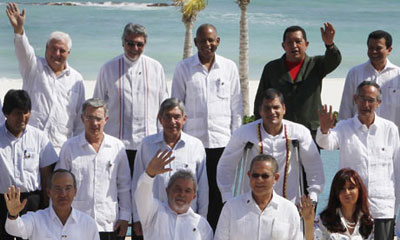
Latin American leaders at the Rio Group "Unity Summit" pose for the official photo; Playa del Carmen (Cancún), Mexico, 22 February 2010.
Photograph: Israel Leal/AP
On February 22 two major developments occurred in the Americas south of the Rio Grande. The two-day Rio Group summit opened in Mexico and Great Britain started drilling for oil 60 miles north of the Falklands Islands, known as Las Malvinas to Argentina.
The meeting in Mexico was identified as a Unity Summit because for the first time the 24 members of the Rio Group (minus Honduras, not invited because of the illegitimacy of its post-coup regime) – Argentina, Belize, Bolivia, Brazil, Chile, Colombia, Costa Rica, Cuba, the Dominican Republic, Ecuador, El Salvador, Guatemala, Guyana, Haiti, Jamaica, Mexico, Nicaragua, Panama, Paraguay, Peru, Suriname, Uruguay and Venezuela – were joined by the fifteen members of the Caribbean Community (CARICOM): Antigua and Barbuda, the Bahamas, Barbados, Belize, Dominica, Grenada, Guyana, Haiti, Jamaica, Montserrat, Saint Lucia, St. Kitts and Nevis, St. Vincent and the Grenadines, Suriname, Trinidad and Tobago. (Haiti, Jamaica and Suriname are members of both organizations.)
Ahead of the summit the Financial Times wrote, “The Mexican-led initiative, a clear sign of Latin America’s growing confidence as a region, will exclude both the US and Canada. Some observers believe it could even eventually rival the 35-member Organisation of American States (OAS), which includes the US and Canada and has been the principal forum for hemispheric issues during the past half century.” [1]
In fact on the first day of the summit Bolivian President Evo Morales called for a “a new US-free OAS,” [2] stressing Washington’s centuries-long history of perpetrating military coups, blackmail, looting of natural resources and, over the past generation, the scourge of neo-liberalism in the Americas.
In 1986 the Rio Group grew out of the four-member Contradora Group consisting of Colombia, Mexico, Panama and Venezuela which was formed in response to Washington’s Contra and death squad campaigns in Nicaragua, El Salvador and Guatemala in the 1980s. Part of the legacy Bolivia’s Morales was referring to.
Coinciding to the day if not the hour of the beginning of the summit, the British Desire Petroleum company began exploring for oil and gas off the Falklands/Las Malvinas, seized from Argentina by Britain in 1833 and fought over by the nations in a 74-day war in 1982. “Neighbouring Argentina, which lays claim to the islands, is fiercely opposed to the drilling. Earlier this month, the Argentinian government filed a formal protest with the British government.” [3]

The Falkland/Malvinas Islands are located in the South Atlantic Ocean, about 300 miles (483 km) east of the Argentina coastline; they are separated from the United Kingdom by approximately 7,900 miles (12,700 Kms). The Islands were a portion of Argentina’s territory when it was still ruled by Spain.
Britain lost 255 soldiers in the conflict, the highest wartime fatalities it had suffered since the Korean War and the Malayan conflict. The British death toll in Afghanistan recently surpassed that number.
London’s energy grab in the South Atlantic did not go unnoticed in Mexico, where 26 presidents and prime ministers were among the participants at the Unity Summit. Argentine President Cristina Fernandez denounced the British actions as “unilateral and illegal” [4] and a breach of her nation’s sovereignty.
She further stated “There continues to be systematic violation of international law that should be respected by all countries…. In the name of our government and in the name of my people I am grateful…for the support this meeting has given to our demands.” [5]
Fernandez characterized the unanimous backing provided her at the summit as an “exercise in self-defence for all” [6] and blasted nations with permanent seats in the United Nations Security Council – she undoubtedly meant Britain, the United States and France – for “continu[ing] to use that place of privilege to disregard international law.” [7]
Her Venezuelan colleague President Hugo Chavez, indicating the dangerous dimension a new British-provoked altercation with Argentina can escalate into, said, “The English are still threatening Argentina. Things have changed. We are no longer in 1982. If conflict breaks out, be sure Argentina will not be alone like it was back then.” [8]
Before the summit began he said, “We support unconditionally the Argentine government and the Argentine people in their complaints. That sea and that land belongs to Argentina and to Latin America.” [9]
He reiterated that position during his speech on February 22. While highlighting the military threat posed by Britain off the coast of Argentina, he alluded to a British submarine site in the Falklands/Las Malvinas and said “we demand not only [that] the submarine platform…be removed, but also [that] the British government…follow the resolutions of the United Nations and give back that territory to the Argentine People.” [10]
Nicaragua’s President Daniel Ortega, also in attendance at the summit, stated “We will back a resolution demanding that England return Las Malvinas to its rightful owner, that it return the islands to Argentina.” [11]
The Times of London quoted Marco Aurelio Garcia, foreign policy adviser to Brazil’s President Lula da Silva, as adding: “Las Malvinas must be reintegrated into Argentine sovereignty. Unlike in the past, today there is a consensus in Latin America behind Argentina’s claims.” [12]
The comments by Venezuela’s president, addressing as they did the threat of a new military confrontation between Britain and Argentina, bear particular scrutiny in light of recent actions by London and statements by its head of state.
In late December Britain conducted a two-day military operation off the coast of the Falklands/Las Malvinas which included the use of Typhoon multi-role fighters and warships. The exercises, code-named Cape Bayonet, “took place during a tour of the Falklands by British forces ahead of the start of drilling in the basin in February 2010″ and “simulated an enemy invasion….” [13]
A news report at the time added, “Britain has strengthened its military presence in the Falklands since the [1982] war and has a major operational base at Mount Pleasant, 35 miles from the capital Stanley.
“The prospect of the islands transforming into a major source of oil revenue for Britain has raised the military’s argument for more funding to beef up the forces in South Atlantic.” [14]
Four days before British drilling began off the islands, Prime Minister Gordon Brown stated “We have made all the preparations that are necessary to make sure that the Falkland Islanders are properly protected,” [15] although Argentine officials have repeatedly denied the possibility of a military response to British encroachments and provocations in the South Atlantic Ocean.
On the same day, February 18, Argentina’s Vice Minister of Foreign Relations Victorio Taccetti accused Britain of “a unilateral act of aggression and subjugation” [16] in moving to seize oil and gas in the disputed region. Buenos Aires has prohibited ships from going to and coming from the Falklands/Las Malvinas through Argentine waters.
What is at stake are, according to British Geological Survey estimates, as many as 60 billion barrels of oil under the waters off the Falklands/Las Malvinas.
In late January a Russian military analyst explained that even that colossal energy bonanza is not all that Britain covets near the Falklands/Las Malvinas and further south.
Ilya Kramnik wrote that “along with the neighboring islands controlled by the U.K., the Falklands are the de facto gateway to the Antarctic, which explains London’s tenacity in maintaining sovereignty over them and the South Georgia and the South Sandwich Islands, as well as territorial claims regarding the South Shetland and South Orkney Islands under the Antarctic Treaty.”
Regarding Antarctica itself, “Under the ice, under the continental shelf, there are enormous mineral resources and the surrounding seas are full of bio-resources. In addition, the glaciers of Antarctica contain 90% of the world’s fresh water, the shortage of which becomes all the more acute with the growth in the world’s population.” [17]
A Chinese analysis of over two years earlier described what Britain in part went to war for in 1982 and why it may do so again: Control of broad tracts of Antarctica.
“The vastness of seemingly barren, ice-covered land is uncovered and exposed to the outside world, revealing a ‘treasure basin’ with incredibly abundant mineral deposits and energy reserves….A layer of Permian Period coal exists on the mainland, and holds 500 billion tons in known reserves.
“The thick ice dome over the land is home to the world’s largest reservoir for fresh water; holds approximately 29.3 million cubic kilometers of ice; and makes up 75% of earth’s fresh water supply.
“It is possible to say that the South Pole could feed the entire world with its abundant supplies of food [fish] and fresh water…[T]he value of the South Pole is not confined to the economic sphere; it also lies in its strategic position.
“The US Coast Guard has long had garrisons in the region, and the US Air Force is the number one air power in the region.” [18]
The feature from which the preceding excerpts originated ended with a warning: “[T]he South Pole [Antarctic] Treaty points out that the South Pole can only be exploited and developed for the sake of peace; and can not be a battle ground. Otherwise, the ice-cold South Pole could prove a fiercely hot battlefield.” [19]
Two days before the May 13, 2009 deadline for “states to stake their claims in what some experts [have described] as the last big carve-up of maritime territory in history,” [20] Britain submitted a claim to the United Nations Commission on the Limits of the Continental Shelf for one million square kilometers in the South Atlantic reaching into the Antarctic Ocean.
An article in this series written five days afterward detailed the new scramble for Antarctica initiated by Britain and Australia, the second being granted 2.5 million additional square kilometers in the Antarctic Ocean in April of 2008. [21]
A newspaper in the United Kingdom wrote about London’s million-kilometer South Atlantic and Antarctic ambitions beforehand that “Not since the Golden Age of the Empire has Britain staked its claim to such a vast area of land on the world stage. And while the British Empire may be long gone, the Antarctic has emerged as the latest battleground for rival powers competing on several fronts to secure valuable oil-rich territory….The Falklands claim has the most potential for political fall-out, given that Britain and Argentina fought over the islands 25 years ago, and the value of the oil under the sea in the region is understood to be immense. Seismic tests suggest there could be about 60 billion barrels of oil under the ocean floor.” [22]
Last autumn a Russian news source warned about the exact initiative of this February 22 in stating “Many believe that the 1982 war between Britain and Argentina with almost 1,000 servicemen killed in the hostilities was all about oil and gas fields in the South Atlantic. In this sense, Desire Petroleum should certainly think twice before starting to capitalize on what was a subject of the bloodbath in 1982 ….”
Regarding the territorial claims submitted by Britain last May (still in deliberations at the UN Commission on the Limits of the Continental Shelf), the report pointed out London’s “eagerness to expand its Falkland Islands’ continental shelf from 200 to 350 nautical miles, which would enable Britain to develop new oil fields in South Georgia and the South Sandwich Islands,” and ended with a somber warning:
“Given London’s unwillingness to try to arrive at a political accommodation with Buenos Aires, a UN special commission will surely have tougher times ahead as far as its final decision on the continental shelf goes. And it is only to be hoped that Britain will be wise enough not to turn the Falkland Islands into another regional hot spot.” [23]
Unlike the first South Atlantic war of 1982, when the regime of General Leopoldo Galtieri garnered no support from other Latin American nations, a future standoff or armed conflict between Argentina and Britain over the Falklands/Las Malvinas will see Latin American and Caribbean states acting in solidarity with Argentina.
If the United Kingdom succeeds in provoking a new war, it in turn will appeal to its NATO allies for logistical, surveillance and other forms of assistance, including direct military intervention if required. In addition to the U.S. and Canada, Britain’s NATO allies in the Western Hemisphere include France and the Netherlands with their possessions and military bases in the Caribbean and South America.
Britain is playing with fire and if it ignites a new conflict it could rapidly spread far beyond the waters off the southern tip of South America.
[1] Financial Times, February 19, 2010.
[2] Prensa Latina, February 22, 2010.
[3] Radio Netherlands, February 22, 2010.
[4] Associated Press, February 22, 2010.
[5] Reuters, February 22, 2010.
[6] Deutsche Presse-Agentur, February 22, 2010.
[7] Ibid.
[8] The Times (London), February 23, 2010.
[9] Reuters, February 22, 2010.
[10] Xinhua News Agency, February 23, 2010.
[11] The Times, February 23, 2010.
[12] Ibid.
[13] United Press International, December 28, 2009.
[14] Ibid.
[15] Reuters, February 18, 2010.
[16] Xinhua News Agency, February 19, 2010.
[17] Russian Information Agency Novosti, January 28, 2010.
[18] People’s Daily, December 4, 2007.
[19] Ibid.
[20] Reuters, October 7, 2007.
[21] Scramble For World Resources: Battle For Antarctica, Stop NATO, May 16, 2009.
[22] The Scotsman, October 23, 2007.
[23] Voice of Russia, September 16, 2009.


 Articles by this author
 Send a message
United Kingdom of Great Britain and Northern Ireland


100,000 protesters in London against war in Gaza

Two worlds, staged on May 6 and 9

London and Vilnius implicated in Crimean Bridge attack

British Archives: London was opposed to NATO enlargement
continue
Argentina


Facebook uses media to make or break politicians

Argentina hounds Cristina Kirchner for an imaginary crime

Ronald Noble denounces the false allegations made against Cristina Kirchner

What is Israël’s project in Argentina?
continue


Stay In Touch
Follow us on social networks
Subscribe to weekly newsletter