


Presented as a spontaneous and non violent movement, the riot that forced Eduard Shevardnadze’s resignation from the presidency of Georgia is, in real life, the result of a patient manipulation. Georgia, a disputed strategic oil target between the Russian Federation and the U.S., has become the center of their conflict. The popular anger, skillfully manipulated by Madeleine Albright’s Democratic Institute and formed by youth associations funded by George Soros, allowed the CIA to put its men in control of Tbilisi, the capital of the country.
Voltaire Network |
Ruled since 1991 by the USSR former Minister of Foreign Relations, Eduard Shevardnadze, Georgia has overcome a pacifist revolution. The so called "White Zorro" was expelled by his people -tired of a total corruption and an endless economic fragility- who questioned the regularity of last November 2003 elections. This spontaneous movement (compared with the "carnation revolution" by which the Portuguese people overthrew without violence Marcelo Caetano’s regime, heir of Salazar’s dictatorship) has been named the "roses revolution" for such a movement will lead to the reestablishment of a more transparent and less corrupted democratic regime that would give hope to the people.
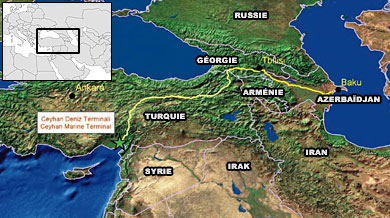
But then we would believe the extraordinary propaganda campaign that led to this coup planned abroad for a long time. And the thing is that Georgia is far from being a country without any international perspective. Its importance is even crucial in the international arena. In fact, its territory occupies the south of the Caspian Sea and has borders with Turkey, Russia, Armenia and Azerbaijan. This central position usually places it in the middle of a turbulent area since the collapse of the Soviet Union in 1991, especially in the middle of the pipelines war between the U.S. and the Russian Federation.
Georgia in the Middle of the "Great Game"
Hostilities began on April 17, 1999 with the inauguration of the pipeline that goes from Baku (Azerbaijan) to the port of Supsa (Georgia) in the Black Sea. The project, financed by Washington, put an end to the Russian hegemony on the hydrocarbon exports of the Caspian Sea. During that year too, Georgia allied with Ukraine and Azerbaijan and separated from Russia. It also broke the borders collective defense treaty of the Commonwealth of Independent States (CIS) and the Tashkent collective security treaty (signed in this city, capital of Uzbekistan, another former Soviet republic).
Instead of this diplomatic system of alliances organized around Russia, Georgia preferred to join NATO and its American leading. This attitude forced president Yeltsin to sign, in November 1999 during the Summit of the Organization for Security and Cooperation in Europe (OSCE) in Istanbul, an agreement to dismantle two of the four Russian military bases in Georgia, a dismantling that began in year 2000 despite the General Staff’s reluctance.
The Georgian decision of siding with the U.S. in a moment, in which its strategic position was fundamental, was a tendency which characterized the countries of the southern Caucasus. After the collapse of the Soviet Union, the U.S. changed its "containment" strategy in the region and applied the "rollback" strategy which consisted in causing the rise and falls of the Russian positions. Thus, the most important countries of the region formed Guuam, an acronym composed by the first letter of Georgia, Ukraine, Uzbekistan, Azerbaijan and Moldavia. This organization, in favor of the U.S., met in May 2000 -in Washington- to address military and security issues.
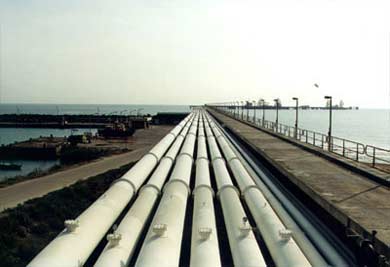
The Guuam countries are the core of the Baku-Tbilisi-Ceyhan (BTC) pipeline American project that would link up Azerbaijan with Turkey through the Georgian capital. Its route does not include the Russian territory, goes through Chechnya and surrounds both Iran and Armenia. Armenia and Azerbaijan have a conflict regarding the Nagorno-Karabakh region and Armenia is still the only member state of the area working for Moscow’s military cooperation bodies. Therefore, western countries are putting a lot of pressure on Armenians for they want them to make the necessary concessions on the conflict with Azerbaijan and join the great BTC pipeline project.
In October 1999, Armenia’s Primer Minister and President of Parliament were murdered. These pressures were aimed at stabilizing the countries the pipeline would go through.
However, oil is not the only thing at risk, but political and military objectives too. The CIA presented an extremely optimistic report -completely false, according to experts- on the reserves of the Caspian Sea to exaggerate its importance. According to experts on the Caucasus Jean Radvanyi and Philippe Rekacewicz, «the pressure exerted by Washington and Ankara on the companies so that they co-finance the pipeline construction in Georgia and Turkey show the priority given to political purposes over economics». [1].
Eduard Shevardnadze, an Ungrateful Ally
In this new "Great Game", characterized as a sort of a new Cold War, [2]. Georgia was a key country for it could guarantee the stability of oil installations and Turkey’s supplies. Consequently, Shevardnadze’s regimen was especially "spoiled" by Washington which turned it into the main regional recipient of its economic assistance. In return, Georgia followed the White House’s foreign policy without hesitation.
In 1999, when Russian president Boris Yeltsin decided to use the Georgian territory to invade Chechnya, Shevardnadze did what Clinton’s special adviser to Russia -Strobe Talbott- told him to do: reject the Russian request. A month after September 11, 2001, Shevardnadze proposed the admission of American troops in the region in exchange of a huge financial assistance. Georgia was later used as a stopover for the US Air Force flights during the war against Afghanistan and authorized several hundreds of American military men to supposedly direct Georgian commandos in the search for hypothetical members of al-Qaeda in neighboring Chechnya. By the end of 2001, Shevardnadze even purged his own intelligence agencies and appointed his pro-American former ambassador to Washington, Tedo Dzhaparidze, as head of the national security.
But as years passed by, the Georgian president lost his influence, the corruption and the poor economic results weakened his position and led him to review his exclusively alignment with Washington’s policy. Gradually, he allied with Alan Abchidze, the Russian follower governor of Adjaria autonomous region, which shared borders with Turkey and was strategically important because the oil coming from neighboring Azerbaijan was essentially transferred through its port which was also Turkey’s main trade door. This rapprochement forced Shevardnadze to improve his relations with Moscow and review his strategic partnership with the U.S. According to agency AFP, in 2003, «American firms were taken out of the Georgian market due to an arbitrary tax». [3]. In this context, Washington gradually withdrew its unconditional support to this ungrateful ally, especially when it fell behind with the construction of the pipeline.
Several officers of the American administration then traveled to Georgia during year 2003 to meet with Shevardnadze. According to English journal The Guardian, the purpose of these official visits was to let Georgian president know that his days as president were counted. Richard Miles, the American ambassador to Georgia, told the Washington Post that the U.S. wanted a "stronger government", an unusual critic that came from a long time ally. The very same Richard Mile devoted a lot of time to prepare young Mijail Saakashvili for his future job [4].
The U.S. Planning of the Spontaneous Revolution
Saakashvili, 35 years old, got his Law degree at Columbia University, New York and after working for a while in an enterprise there, he went back to Georgia as a protégée and leader of Eduard Shevardnadze’s former party Union of Citizens. In year 2000, he was appointed Minister of Justice. After using his position to denounce the corruption of politicians even in the meetings of the Council of Ministers, he was forced to resign in 2002. He founded then his own party and became one of the leaders of the opposition. Actually, Saakashvili became Washington’s man to overthrow Shevardnadze. The operation, based on Slobodan Milosevic’s overthrow in Serbia, needed the manipulation of several forces.
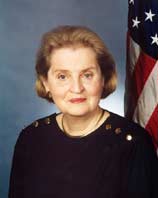
Madeleine Albright
Clinton’s former Secretary of State directed the NGO that said elections were manipulated.
The first thing to be done was to denounce the result of the legislative elections of November 2, 2003 that allowed President Shevardnadze and Aslan Abchidze’s political forces achieve a victory by a narrow margin over the opposition led by Mijail Saakashvili and Nina Burjanadze, then president of the parliament. The "spontaneous" protest was based on two elements: first, it was said the electoral registers were falsified; and second, the result of the last minute polls was different from the official ones. But the problem was that these accusations were made by the same institution: the National Democratic Institute, which, supposedly was an American NGO but in real life was a creation of the National Endowment for Democracy, [5] directed by Bill Clinton’s former Secretary of State Madeleine Albright. This foundation also made the electoral registers electronically and its numerous mistakes led to the popular distrust and fraud suspicion. It was also in charge of conducting the last minute polls in which the results of the opposition parties were overestimated.
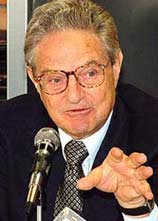
George Soros
The multimillionaire funded the youth movement called Kmara which was a copy of the Serbian movement Otpor that challenged and withdrew Milosevic.
But fraud was not the most important thing. The key issue was to find out if the opposition could use this argument and mobilized the public opinion to finally withdraw the regime and force Georgian president’s resignation, something that happened on November 23, 2003. It must be acknowledged that, as Eduard Shevardnadze said to the Russian press some time later; there were no spontaneous movements too. But according to him, the organizers of the whole thing were, first of all, millionaire George Soros [6], the said American Democratic Institute and former Secretary of State James Baker; «George Soros founded youth groups Kmara [Enough!] to challenge the power. They recruited very young boys, 15 years old and trained them in two months [...] The American National Institute did the same thing». [7].
These methods were similar to those used by the U.S. in Serbia in year 2000 to withdraw Slobodan Milosevic. According to the former Georgian minister of security, Igor Giorgadze, «Mijail Saakashvili followed exactly the instructions given to him». It is also true that the youth movement called Kmara denounced by Shevardnadze was financed by George Soros and was a copy of Otpor, the Serbian movement that challenged Milosevic in Belgrade. [8].
The first telephone call made by the interim president was: "the oil pipeline is ok". Nina Burdjanadze, the interim president of the parliament according to the constitution, announced on November 23, 2003 that she wanted to continue with "the fair political direction" that former president Eduard Shevardnadze had chosen, by making emphasis on the "western values", the "strategic partnership" with the U.S. and improving relations with Russia. In an interview granted to CNN, she reaffirmed that Georgia’s goal was to «be a member of the European family, of the Euro-Atlantic alliance. We want to keep our strategic partnership with the U.S. who has made a lot for our country». But, according to The Guardian, «the first telephone call made by the acting interim president [...] was to BP [the Anglo-Dutch oil company]. She called them to ‘guarantee that the pipeline is OK’, pointed out an important Georgian official». This first act showed the real purposes of the coup d’état that ended on Sunday, January 4, 2004 with the election of Mijail Saakashvili (Washington’s favorite) as president of the republic.
Then, Russia was forced to react. During the crisis, Vladimir Putin sent his Minister of Foreign Relations, Igor Ivanov, to strengthen the Kremlin’s image in a moment in which its position was considerably weakened. The return to regional tensions was perceived due to the remarkable presence of the Russian forces in the country since the Soviet era that controlled three secessionist or autonomous enclaves (South Osetia, Abkhazia and Adjaria) and two military bases.
The episode was an evidence of the new American interfering methods, inspired by those of the stay behind though greatly modernized, as shown by the Serbian example. But in order to make them operative, these methods must have a real popular support. The last failure of the attempted coup in Venezuela was a cruel warning for the CIA and questioned the doctrine of those that, in Washington, think they can impose their will upon the peoples of the world.
[1] Jean Radvanyi y Philippe Rekacewicz: «Conflits caucasiens et bras de fer russo-américain», Le Monde diplomatique, October 2000
[2] The Cold War was characterized by the confrontation of two blocks: the U.S. and the USSR without being a direct military clash. This is similar to what we have nowadays in the Caspian Sea region where Washington and Moscow are using intermediary forces to undermine each other’s position. An example of this are the attacks against the northern pipeline which links up Baku with the Russian port of Novorossiysk, registered as part of the Chechnyan territory since it was opened on April 1999 though immediately closed.
On August 1999, Chamil Basaev and Khabib Abdarrahman’s Chechnyan fighters took control of Dagestan where, by proposing the establishment of an Islamic state, they weakened Russian’s southern flank. On their side, the Russian tried to used the conflicts in Abkhazia, Osetia and Karabakh to maintain its own influence in the region and, especially, to keep Azerbaijan and Georgia out of the American influence
[3] «Crise géorgienne: l’ami américain n’est plus ce qu’il était», AFP, November 22, 2003
[4] Ian Traynor: "The people smoke out the grey fox", The Guardian, November 24, 2003
[5] This organization, founded by Ronald Reagan to counteract the "axis of evil" forces is the CIA’s official political funding structure in the world. Its existence allows CIA to fund several political manipulation operations by financing false "left-wing" parties through the American National Democratic Institute or financing "right-wing" organizations thanks to the International Republican Institute
[6] George Soros is an American millionaire of Hungarian origin that owes his fortune to an intense speculative activity. As a member of the International Crisis Group, George Soros funded, with his personal fortune, a number of non governmental organizations and associations. At the beginning of November, the offices of the Soros Foundation in Moscow were confiscated and its activities in Russia were halted
[7] «L’ex-président Chevardnadzé dénonce le rôle des Américains dans sa chute», AFP, December, 1st., 2003
[8] «’It looks disturbingly like a coup’», The Guardian, November 25, 2003


 Articles by this author
 Send a message
Georgia


EU pushes Georgia to go to war

Georgia denounces the transformation by Russia of the demarcation lines

Gilead Sciences’s criminal drug testing: a cover for the Pentagon’s illegal arms testing?

NATO-Georgia Commission Declaration at the Brussels Summit
continue


Stay In Touch
Follow us on social networks
Subscribe to weekly newsletter