


Zbigniew Brzezinski, President Jimmy Carter’s former adviser, embodies the continuity of U.S. foreign policy whether it is democratic or republican. A great admirer of Henry Kissinger, Brzezinski has always defended, praised and shown an absolute respect for the master’s two diplomacy concepts: the balance of the powers theorized by Metternich and George Kennan’s containment doctrine. Zbigniew Brzezinski recommends how Russia should be militarily weakened and intimidated. He is convinced that the best way to achieve it is by destabilizing its border regions, a political strategy that aroused the interest of former presidential candidate John Kerry’s team who recruited his son Mark Brzezinski as its foreign policy adviser.
Voltaire Network |
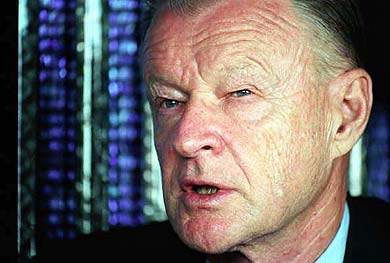
Zbigniew Brzezinski
Based on George W. Bush’s speech during year 2000 presidential campaign, a rigid, even aggressive attitude towards Vladimir Putin’s Russia would have been expected -according to his adviser “hawk” Wolfowitz’s doctrine. But, instead, we have seen an unprecedented approach in the political relations of these two great nations. And this has happened after September 11, 2001.
For many observers and analysts there was an agreement between Putin and Bush not to criticize Russian military operations in Chechnya whereas Putin would ignore American interventions and interferences in the Middle East.
This explanation does not really value September 11 facts. It actually considers them as an abstraction and the same with Kremlin’s position on this. We can say that Republican administrations have always attached too much importance to the Middle East whereas Democrat’s political tradition on foreign policy has been more focused in Eurasia.
To design its strategy towards the former USRR and then on the Easter states, recently emancipated from the Soviet influence, Democrats have trusted -since Jimmy Carter took power- a brilliant, unscrupulous and anti-Russian man: Zbigniew Brzezinski.
This well-known professor’s doctrine has many followers outside of the Democratic Party because it has defined the actual imperative of the empire’s survival and prosperity: the conquest of Eurasia.
This professor was born in Warsaw in 1928, the son of a Polish diplomat. At the age of ten, Brzezinski immigrated to Canada when his father was distinguished. He did his degree and his master at the University of Mc Gill, Montreal, and then his PhD at Harvard in 1953. After that, he became an American citizen and married the daughter of Czechoslovakia’s former president Eduardo Benes.
Between 1966 and 1968 he was a member of the Council of Policy Planning of the State Department where he developed the “peaceful involvement” strategy towards the Soviet Union in the framework of the Cold War. In October 1966, he convinced President Johnson to modify the strategic priorities in order to have the “thawing-out” before the German reunification.
During 1968 presidential campaign, Brzezinski was the head of the working party in charge of democratic candidate Hubert H. Humphrey’s foreign policy, who would lose to Richard Nixon.
The Inspiring Leader of the Trilateral Commission
At the beginning of the 1960s, Brzezinski distinguished himself as an analyst when prophetically announced the appearance of bigger actors in the world power. He was talking about Europe and Japan whose economies have had a rapid growth after WWII.
In an article published in Foreign Affairs magazine in 1970, he talked about his vision of this “new world order”. «A new and more daring vision is needed - the creation of a community of developed countries capable of efficiently handling the problems of mankind. Apart from the U.S. and Western Europe, Japan should be included (...) A good start would be a council formed by representatives of the U.S, Western Europe and Japan, which will hold regular meetings among the heads of governments and less relevant personalities.»
In 1970, Brzezinski also proposed new ideas in his new book Between two Ages [1] where he explained that the moment to balance world power had arrived and it had to be in the hands of a new global political order based on a trilateral economic tie between Japan, Europe and the U.S. The revolution in production techniques and the transformation of the heavy industry into electronics had to cause a disruption of political systems and a new generation of power elites. David Rockefeller, excited about these concepts, hired him to create the Trilateral Commission and appointed him director. The commission was officially established in 1973 and gathered important personalities related to world trade, the international banking system, governors and the big European, Japanese and American media.
When the first oil crisis took place, the main concern of these world finance masters was to get rid of the foreign debt of developing countries by strengthening the role of the International Monetary Fund (IMF). It was also about strengthening and extending U.S.’s hegemony - by that time vulnerable due to its military defeat in Viet Nam- in every geographical boundary of the Eurasian continent where they were very influential after WWII
This mission, if analyzed from an outsider’s point of view, depicts Brzezinski as a peace advocate, a man in favor of multilateral relations and diminishing world tension (Cold War) and -to the eyes of the extreme right- as a man inspired by Marxism.
The best to be done in order to implement the plans of the Trilateral Commission was to make one of its members the President of the United States.
President Carter and the Double-Dealing
Since the creation of the Trilateral Commission, shepherd Jimmy Carter was among the members of Rockefeller-Brzezinski’s team. He has opened the first trade offices of the state of Georgia in Brussels and Tokyo and this turned him into the ideal model or the founding concept of the Commission. [2] For his nomination as an election candidate and to the presidential election in 1976, Rockefeller used his relations in Wall Street and put Brzezinski to work, whose academic influence assisting democratic candidate Jimmy Carter was very helpful for wining the election. And, of course, when Carter won the elections, Brzezinski was appointed national security adviser. [3]
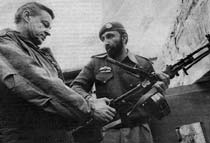
Brzezinski examining the weapon
of a pakistani officer
of a pakistani officer
As president, Carter stated the reduction of the military nuclear arsenal of the two blocks (U.S. -USRR) as a priority. However, the Soviet SS-20 missile crisis aimed at Europe forced Carter to deploy the Pershing missiles, an action that ruined his efforts, whether they were sincere or not, and caused the reciprocal distrust of the two countries.
It can be affirmed that by that time, the Soviet block had good reasons to believe that its adversary was involved in double-dealing: the U.S. military defeat in Viet Nam forced it to keep certain reserve in the strategic and military fields whereas Brzezinski was working on his war plan to set a trap for the Soviet Union and force it to come into a peripheral conflict.
The destabilization of the Afghan communist regime and the financing and delivering of the first weapons to anticommunist Jihad followers in 1979 caused, as expected, the intervention of the Red Army in Afghanistan. Brzezinski had the support of Pakistan intelligence and espionage services, the fearful ISI.
When the French magazine Le Nouvel Observateur interviewed Brzezinski in 1998, he admitted that the equipping of Bin Laden’s anti-Soviet troops was before the Russian invasion and was aimed at provoking its reaction:
Le Nouvel Observateur: Former CIA director, Robert Gates, says in his memoirs: the American secret services assisted Afghan mujahedeen six months before the Soviet invasion. By that time, you were President Carter’s adviser and you played a key role on this. Do you confirm it?
Zbigniew Brzezinski: Yes. According to the official version of the story, the CIA began to assist mujahedeen in the year 1980, that is, after the invasion of the Soviet army against Afghanistan on December 24, 1979. But the truth that remained secret until today is quite different: it was on July 3, 1979 that President Carter signed his first order on the secret assistance to Kabul’s pro-Soviet regime opponents. That day I wrote a memorandum to the President in which I told him that that assistance would cause the Soviet intervention (...) we did not force the Russian intervention, we just, conscientiously, increase the intervention possibilities.
NO: When the Soviets justified their intervention by affirming they were fighting against a secret American interference nobody believed them, though they were telling the truth. Don’t you regret it?
Z. Brz.: Regret what? That secret operation was an excellent idea. Its objective was to lead the Russian to the Afghan trap, and you want me to regret it? The very same day the Soviets crossed the Afghan border I wrote the following to President Carter: «This is our chance to give Russia its Viet Nam» (...).
N.O.: Aren’t you sorry either for favoring Islamic fundamentalism and providing weapons and consultancies to future terrorists?
ZBrz.: What is the most important thing when you look at world history, the Taliban or the fall of the Soviet empire? Some excited Islamists or the liberation of Central Europe and the end of the Cold War? [4]
When Brzezinski talked about «some excited Islamists» in this interview, he did not underestimate Al Qaeda’s power. He just described the reality of what the neo-conservatives has turned into a myth while justifying their world crusade. It is obvious that none of the members of the Council on Foreign Relations would be so categorical.
Objective Alliance with China and Unconditional Support to the Shah of Iran
Even when Nixon and Kissinger were cautious about besieging the Soviet Union and restored relations with China, a number of Carter’s closest advisers did not support this rapprochement Brzezinski had in mind.
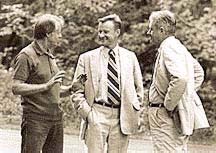
When Carter became President, he stated he would establish a dialogue with the USRR and keep the People’s Republic of China at a distance. But, his Secretary of State, Cyrus Vance, opposed Brzezinski anti-Russian obsession and Carter had no choice but to conciliate its administration’s antagonism.
Usually, the mediator between these two poles was Richard C. Holbrooke, U.S. future ambassador to the UN and John Kerry’s foreign policy adviser during his campaign, along with Mark Brzezinski, Zbigniew’s son. According to Cyrus Vance and some others in favor of establishing the dialogue, like democrat renegade Averell Arriman, the triangular logic of besieging would only lead, at its best, to a misunderstanding with the USRR, not to mention war.
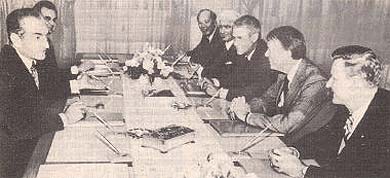
Meeting between the Shah of Iran, Alfred Atherton, William Sullivan, Cyrus Vance, president Carter and Zbigniew Brzezinski in 1977
They recommended dialogues on disarmament and cooperation with the Soviet Union to neutralize the Third World conflicts. The re-establishment of relations with China kept on; Brzezinski even completed a joint program of strategic cooperation and managed to have good personal relations with Deng Xiaoping, something that has really helped him nowadays.
Brzezinski’s distrust towards the USRR can be perceived again in his attitude towards Iran, which under the Shah’s regimen was considered as a bastion against the Soviet influence in the Middle East. Brzezinski promised Shah his support until the last moment and requested U.S. military intervention to keep him in power even when part of Carter’s administration, led by his Secretary of State, opposed it.
However, Washington’s concrete actions were implemented according to the state Department’s point of view and despite all negotiations with the generals that defeated Shah to guarantee a moderate regime in the country; it was Khomeini who took power after a popular seafloor spreading. Khomeini joined Carter at Camp David negotiations in 1977 and played a key role in the peace agreement between Israel and Egypt without even being present in the most important debates. However, when the USRR was the main topic, he was always there.
The Russian Threat and the American Supremacy
In 1989, Brzezinski quit his job at Columbia University where he taught since 1960 to work on Ukraine’s independent status plan. This marks the beginning of his compromise to prevent the resurgence of Russia as a superpower. He defended Russia’s integration to the Western system and the “geopolitical multiparty system” in the territory of the former Soviet Union.
He also developed a “plan for Europe” that included NATO’s expansion to the Baltic republics, a dream that came true when three of them joined NATO in 2002. During the 90s he was the special envoy of the American President to promote the most important oil infrastructure project of the world: the Baku-Tbilissi-Ceyhan pipeline which was his best opportunity to prevent the resurgence of Russia. He has also been, since 1999, the president of the American Committee for Peace in Chechnya, whose headquarters are located at the Freedom House facility. This position allows him to intervene in peace negotiations between the Russian government and independence fighters led by Mashkadov. However, the truth behind these good will “democratic” activities is to assist independence followers to maintain a war in the area, like the Afghan one, to weaken Russian and to keep it away from the gains of the Caspian Sea.
Brzezinski’s doctrine («The power ruling Eurasia will control two of the most economically advanced and productive areas of the world») is related to NATO’s expansion to the East, something the Clinton’s Administration actively worked on. But, how could they sell NATO to Europeans? «The European region located in the Western border of Eurasia and next to Africa is much more exposed to the risks of the increasing global disorder than a more politically united, military powerful and geographically isolated America (...).
The Europeans will be more exposed to risk if an imperialist chauvinism encourages Russia’s foreign policy», said Brzezinski to National Interest magazine in year 2000. [5] The whole thing is quite clear: the deployment of NATO’s forces around Russia was a preventive measure. If Russia’s reaction is to be defensive, it means that it is planning to restore its empire and totalitarianism.
Brzezinski has been working also as a consultant for BP-Amoco and Freedom House in Azerbaijan. His objective is to worship Heidar Alyiev’s image and in a New York Times interview he characterized the dictator as a «nice guy». [6] Brzezinski justifies Aliyev’s Anglo-Saxon support by explaining that after seven decades of communist government nobody can expect Azerbaijan and the former Soviet republics to become democratic nations in such a short period of time.
Even when Aliyev’s political repression increased during the last few years and the gains from the Caspian Sea diminished, Azerbaijan was still considered by Freedom House as a “partially free” country. In 1999, Secretary of State and Brzezinski’s disciple, Madeleine Albright, invited Heidar Aliyev to NATO’s anniversary ceremony. On their part, Georgia, Azerbaijan and Ukraine organized some joint military maneuvers, sponsored by NATO’s “Association for Peace” program, on April 16, 1996. [7]
Despite his activities as BP-Amoco and Freedom House’s consultant, Brzezinski assisted a system of funds and NGOs (non governmental organizations) in support of the former Soviet top-classes, intellectuals and elites.
As an initiative of the American Committee for Peace in Chechnya, whose chairman was Brzezinski, a meeting between the main leaders of the Chechnya movement was held from August 16 to August 18, 2002 in Lichtenstein, two months after the one held in Bassaiev and Maskhadov, where an agreement was signed on the mutual direction of the “Armed Forces of the Ichkeria Republic of Chechnya”. The participants concluded that Chechnya should not longer be a part of Russia, that a real autonomy was necessary and the time to negotiate with Maskhadov had arrived. But, was Beslán’s hostages event, as claimed by Bassaiev, part of Chechnya independence demand process or part of Russia’s destabilizing process? [8]
Several questions could be raised if we take into account that the main consequence of this action was a tightening of tensions between North Odessa and neighboring Inguchia, that is, a much more relevant balkanization of the region.
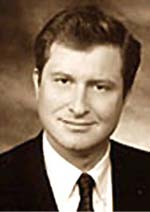
Mark Brzezinski
Nowadays, Brzezinski is very active in CSIS but he still the brain of the Democrats foreign policy program, something that is quite evident in candidate Kerry and his partner John Edwards’s obsession with Russia. Following Mark Brzezinski’s advises they chose as their main priority Russia’s nuclear disarmament in a moment in which it has recovered the same oil production it had before its demise and is benefiting widely of the current oil prices which has allowed it to double its defense budget. Therefore, Russia’s nuclear arsenal is not, as John Kerry says, a present-day threat.
Kerry’s real objective is related to Zbigniew Brzezinski’s strategy of Russia’s subordination but, from now on, it will be much more difficult to convince the world public opinion of Russia’s evil and totalitarianism. [9] Therefore, it is necessary to provoke its reaction as was done with the Afghan case in 1979, because Russia will have no problems with its energy supply in the next decades, a real concern the U.S. has. This is why in some recent Wall Street Journal and Novaya Gazetta interviews, Brzezinski characterized Vladimir Putin as «Russian Benito Mussolini».
[1] Zbigniew Brzezinski, Between two Ages: America’s Role in the Technotronic Era, Harper publishing house, 1971. French Edition, Révolution technetronique, Calman-Lévy publishing house, 1971.
[2] The Trilateral Commission will also lead French President Giscard d’Estaing to choose one of its members, Raymond Barre, professor of economics and political unexperienced, as Primer Minister.
[3] Brzezinski included in his team Madeleine K. Albright (whose father served in Czechoslovakia during Eduard Benes’s government, Brzezinksi’s father in law) and the two theorists of The Clash of Civilization, Bernard Lewis and Samuel P.Huntington.
[4] Le Nouvel Observateur, No. 1732, from January 15 to January 21, 1998, p.76.
[5] Quoted in George Szamuely : «Bribing Montenegro - It didn’t work», antiwar, June 15, 2000.
[6] «Freedom spells B-A-K-U», Counterpunch Magazine, 1999.
[7] See: «Freedom House, quand la liberté n’est qu’un slogan», Voltaire, September 7, 2004. Article written in French that will soon be published by Red Voltaire.
[8] Marivilia Carrasco : «Beslan: responsibility of slaughter points towards the Anglosaxons», Voltaire, September 19, 2004.
[9] Thierry Meyssan: «115 atlantists against Rusia», Voltaire, November 26, 2004.


 Articles by this author
 Send a message
United States of America


Linda Thomas-Greenfield, Madame Veto has blood on her hands

Jared Kushner’s cruel shenanigans with Gaza’s beaches

Bombs and Humanitarian Aid from the USA in Gaza

State of the Union Address
continue


Stay In Touch
Follow us on social networks
Subscribe to weekly newsletter