


On February 10th, 2007, Speaking before the Munich Conference on Security Policy, Vladimir V. Putin denounced explicitly the United States’ fantasy of the world one-sided governance as lacking any legal and moral basis. He also criticized deeply the OSCE and the subversive usage by certain States of organizations which have of non-governmental but the name. We publish below the complete text of this very important speech which marks a swing in the Russian foreign policy.
Voltaire Network |
Munich (Germanay) |
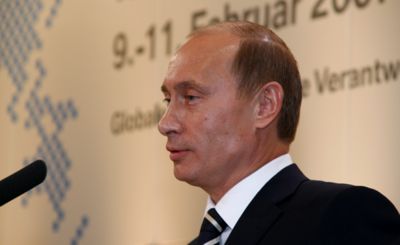
Thank you very much
Dear Madam Federal Chancellor,
Mr Teltschik,
Ladies and gentlemen!
I am truly grateful to be invited to such a representative conference that has assembled politicians, military officials, entrepreneurs and experts from more than 40 nations.
This conference’s structure allows me to avoid excessive politeness and the need to speak in roundabout, pleasant but empty diplomatic terms. This conference’s format will allow me to say what I really think about international security problems. And if my comments seem unduly polemical, pointed or inexact to our colleagues, then I would ask you not to get angry with me. After all, this is only a conference. And I hope that after the first two or three minutes of my speech Mr Teltschik will not turn on the red light over there.
Therefore. It is well known that international security comprises much more than issues relating to military and political stability. It involves the stability of the global economy, overcoming poverty, economic security and developing a dialogue between civilisations.
This universal, indivisible character of security is expressed as the basic principle that “security for one is security for all”. As Franklin D. Roosevelt said during the first few days that the Second World War was breaking out: “When peace has been broken anywhere, the peace of all countries everywhere is in danger.”
These words remain topical today. Incidentally, the theme of our conference – global crises, global responsibility – exemplifies this.
Only two decades ago the world was ideologically and economically divided and it was the huge strategic potential of two superpowers that ensured global security.
This global stand-off pushed the sharpest economic and social problems to the margins of the international community’s and the world’s agenda. And, just like any war, the Cold War left us with live ammunition, figuratively speaking. I am referring to ideological stereotypes, double standards and other typical aspects of Cold War bloc thinking.
The unipolar world that had been proposed after the Cold War did not take place either.
The history of humanity certainly has gone through unipolar periods and seen aspirations to world supremacy. And what hasn’t happened in world history?
However, what is a unipolar world? However one might embellish this term, at the end of the day it refers to one type of situation, namely one centre of authority, one centre of force, one centre of decision-making.
It is world in which there is one master, one sovereign. And at the end of the day this is pernicious not only for all those within this system, but also for the sovereign itself because it destroys itself from within.
And this certainly has nothing in common with democracy. Because, as you know, democracy is the power of the majority in light of the interests and opinions of the minority.
Incidentally, Russia – we – are constantly being taught about democracy. But for some reason those who teach us do not want to learn themselves.
I consider that the unipolar model is not only unacceptable but also impossible in today’s world. And this is not only because if there was individual leadership in today’s – and precisely in today’s – world, then the military, political and economic resources would not suffice. What is even more important is that the model itself is flawed because at its basis there is and can be no moral foundations for modern civilisation.
Along with this, what is happening in today’s world – and we just started to discuss this – is a tentative to introduce precisely this concept into international affairs, the concept of a unipolar world.
And with which results?
Unilateral and frequently illegitimate actions have not resolved any problems. Moreover, they have caused new human tragedies and created new centres of tension. Judge for yourselves: wars as well as local and regional conflicts have not diminished. Mr Teltschik mentioned this very gently. And no less people perish in these conflicts – even more are dying than before. Significantly more, significantly more!
Today we are witnessing an almost uncontained
hyper use of force – military force – in
international relations, force that is plunging
the world into an abyss of permanent conflicts.
As a result we do not have sufficient strength to
find a comprehensive solution to any one of these
conflicts. Finding a political settlement also becomes impossible.
We are seeing a greater and greater disdain for
the basic principles of international law. And
independent legal norms are, as a matter of fact,
coming increasingly closer to one state’s legal
system. One state and, of course, first and
foremost the United States, has overstepped its
national borders in every way. This is visible in
the economic, political, cultural and educational
policies it imposes on other nations. Well, who
likes this? Who is happy about this?
In international relations we increasingly see
the desire to resolve a given question according
to so-called issues of political expediency,
based on the current political climate.
And of course this is extremely dangerous. It
results in the fact that no one feels safe. I
want to emphasise this – no one feels safe!
Because no one can feel that international law is
like a stone wall that will protect them. Of
course such a policy stimulates an arms race.
The force’s dominance inevitably encourages a
number of countries to acquire weapons of mass
destruction. Moreover, significantly new threats
– though they were also well-known before – have
appeared, and today threats such as terrorism
have taken on a global character.
I am convinced that we have reached that decisive
moment when we must seriously think about the architecture of global security.
And we must proceed by searching for a reasonable
balance between the interests of all participants
in the international dialogue. Especially since
the international landscape is so varied and
changes so quickly – changes in light of the
dynamic development in a whole number of countries and regions.
Madam Federal Chancellor already mentioned this.
The combined GDP measured in purchasing power
parity of countries such as India and China is
already greater than that of the United States.
And a similar calculation with the GDP of the
BRIC countries – Brazil, Russia, India and China
– surpasses the cumulative GDP of the EU. And
according to experts this gap will only increase in the future.
There is no reason to doubt that the economic
potential of the new centres of global economic
growth will inevitably be converted into
political influence and will strengthen multipolarity.
In connection with this the role of multilateral
diplomacy is significantly increasing. The need
for principles such as openness, transparency and
predictability in politics is uncontested and the
use of force should be a really exceptional
measure, comparable to using the death penalty in
the judicial systems of certain states.
However, today we are witnessing the opposite
tendency, namely a situation in which countries
that forbid the death penalty even for murderers
and other, dangerous criminals are airily
participating in military operations that are
difficult to consider legitimate. And as a matter
of fact, these conflicts are killing people –
hundreds and thousands of civilians!
But at the same time the question arises of
whether we should be indifferent and aloof to
various internal conflicts inside countries, to
authoritarian regimes, to tyrants, and to the
proliferation of weapons of mass destruction? As
a matter of fact, this was also at the centre of
the question that our dear colleague Mr Lieberman
asked the Federal Chancellor. If I correctly
understood your question (addressing Mr
Lieberman), then of course it is a serious one!
Can we be indifferent observers in view of what
is happening? I will try to answer your question as well: of course not.
But do we have the means to counter these
threats? Certainly we do. It is sufficient to
look at recent history. Did not our country have
a peaceful transition to democracy? Indeed, we
witnessed a peaceful transformation of the Soviet
regime – a peaceful transformation! And what a
regime! With what a number of weapons, including
nuclear weapons! Why should we start bombing and
shooting now at every available opportunity? Is
it the case when without the threat of mutual
destruction we do not have enough political
culture, respect for democratic values and for the law?
I am convinced that the only mechanism that can
make decisions about using military force as a
last resort is the Charter of the United Nations.
And in connection with this, either I did not
understand what our colleague, the Italian
Defence Minister, just said or what he said was
inexact. In any case, I understood that the use
of force can only be legitimate when the decision
is taken by NATO, the EU, or the UN. If he really
does think so, then we have different points of
view. Or I didn’t hear correctly. The use of
force can only be considered legitimate if the
decision is sanctioned by the UN. And we do not
need to substitute NATO or the EU for the UN.
When the UN will truly unite the forces of the
international community and can really react to
events in various countries, when we will leave
behind this disdain for international law, then
the situation will be able to change. Otherwise
the situation will simply result in a dead end,
and the number of serious mistakes will be
multiplied. Along with this, it is necessary to
make sure that international law have a universal
character both in the conception and application of its norms.
And one must not forget that democratic political
actions necessarily go along with discussion and
a laborious decision-making process.
Dear ladies and gentlemen!
The potential danger of the destabilisation of
international relations is connected with obvious
stagnation in the disarmament issue.
Russia supports the renewal of dialogue on this important question.
It is important to conserve the international
legal framework relating to weapons destruction
and therefore ensure continuity in the process of reducing nuclear weapons.
Together with the United States of America we
agreed to reduce our nuclear strategic missile
capabilities to up to 1700-2000 nuclear warheads
by 31 December 2012. Russia intends to strictly
fulfil the obligations it has taken on. We hope
that our partners will also act in a transparent
way and will refrain from laying aside a couple
of hundred superfluous nuclear warheads for a
rainy day. And if today the new American Defence
Minister declares that the United States will not
hide these superfluous weapons in warehouse or,
as one might say, under a pillow or under the
blanket, then I suggest that we all rise and
greet this declaration standing. It would be a very important declaration.
Russia strictly adheres to and intends to further
adhere to the Treaty on the Non-Proliferation of
Nuclear Weapons as well as the multilateral
supervision regime for missile technologies. The
principles incorporated in these documents are universal ones.
In connection with this I would like to recall
that in the 1980s the USSR and the United States
signed an agreement on destroying a whole range
of small- and medium-range missiles but these
documents do not have a universal character.
Today many other countries have these missiles,
including the Democratic People’s Republic of
Korea, the Republic of Korea, India, Iran,
Pakistan and Israel. Many countries are working
on these systems and plan to incorporate them as
part of their weapons arsenals. And only the
United States and Russia bear the responsibility
to not create such weapons systems.
It is obvious that in these conditions we must
think about ensuring our own security.
At the same time, it is impossible to sanction
the appearance of new, destabilising high-tech
weapons. Needless to say it refers to measures to
prevent a new area of confrontation, especially
in outer space. Star wars is no longer a fantasy
– it is a reality. In the middle of the 1980s our
American partners were already able to intercept their own satellite.
In Russia’s opinion, the militarisation of outer
space could have unpredictable consequences for
the international community, and provoke nothing
less than the beginning of a nuclear era. And we
have come forward more than once with initiatives
designed to prevent the use of weapons in outer space.
Today I would like to tell you that we have
prepared a project for an agreement on the
prevention of deploying weapons in outer space.
And in the near future it will be sent to our
partners as an official proposal. Let’s work on this together.
Plans to expand certain elements of the
anti-missile defence system to Europe cannot help
but disturb us. Who needs the next step of what
would be, in this case, an inevitable arms race?
I deeply doubt that Europeans themselves do.
Missile weapons with a range of about five to
eight thousand kilometres that really pose a
threat to Europe do not exist in any of the
so-called problem countries. And in the near
future and prospects, this will not happen and is
not even foreseeable. And any hypothetical launch
of, for example, a North Korean rocket to
American territory through western Europe
obviously contradicts the laws of ballistics. As
we say in Russia, it would be like using the right hand to reach the left ear.
And here in Germany I cannot help but mention the
pitiable condition of the Treaty on Conventional Armed Forces in Europe.
The Adapted Treaty on Conventional Armed Forces
in Europe was signed in 1999. It took into
account a new geopolitical reality, namely the
elimination of the Warsaw bloc. Seven years have
passed and only four states have ratified this
document, including the Russian Federation.
NATO countries openly declared that they will not
ratify this treaty, including the provisions on
flank restrictions (on deploying a certain number
of armed forces in the flank zones), until Russia
removed its military bases from Georgia and
Moldova. Our army is leaving Georgia, even
according to an accelerated schedule. We resolved
the problems we had with our Georgian colleagues,
as everybody knows. There are still 1,500
servicemen in Moldova that are carrying out
peacekeeping operations and protecting warehouses
with ammunition left over from Soviet times. We
constantly discuss this issue with Mr Solana and
he knows our position. We are ready to further work in this direction.
But what is happening at the same time?
Simultaneously the so-called flexible frontline
American bases with up to five thousand men in
each. It turns out that NATO has put its
frontline forces on our borders, and we continue
to strictly fulfil the treaty obligations and do
not react to these actions at all.
I think it is obvious that NATO expansion does
not have any relation with the modernisation of
the Alliance itself or with ensuring security in
Europe. On the contrary, it represents a serious
provocation that reduces the level of mutual
trust. And we have the right to ask: against whom
is this expansion intended? And what happened to
the assurances our western partners made after
the dissolution of the Warsaw Pact? Where are
those declarations today? No one even remembers
them. But I will allow myself to remind this
audience what was said. I would like to quote the
speech of NATO General Secretary Mr Woerner in
Brussels on 17 May 1990. He said at the time
that: “the fact that we are ready not to place a
NATO army outside of German territory gives the
Soviet Union a firm security guarantee”. Where are these guarantees?
The stones and concrete blocks of the Berlin Wall
have long been distributed as souvenirs. But we
should not forget that the fall of the Berlin
Wall was possible thanks to a historic choice –
one that was also made by our people, the people
of Russia – a choice in favour of democracy,
freedom, openness and a sincere partnership with
all the members of the big European family.
And now they are trying to impose new dividing
lines and walls on us – these walls may be
virtual but they are nevertheless dividing, ones
that cut through our continent. And is it
possible that we will once again require many
years and decades, as well as several generations
of politicians, to dissemble and dismantle these new walls?
Dear ladies and gentlemen!
We are unequivocally in favour of strengthening
the regime of non-proliferation. The present
international legal principles allow us to
develop technologies to manufacture nuclear fuel
for peaceful purposes. And many countries with
all good reasons want to create their own nuclear
energy as a basis for their energy independence.
But we also understand that these technologies
can be quickly transformed into nuclear weapons.
This creates serious international tensions. The
situation surrounding the Iranian nuclear
programme acts as a clear example. And if the
international community does not find a
reasonable solution for resolving this conflict
of interests, the world will continue to suffer
similar, destabilising crises because there are
more threshold countries than simply Iran. We
both know this. We are going to constantly fight
against the threat of the proliferation of weapons of mass destruction.
Last year Russia put forward the initiative to
establish international centres for the
enrichment of uranium. We are open to the
possibility that such centres not only be created
in Russia, but also in other countries where
there is a legitimate basis for using civil
nuclear energy. Countries that want to develop
their nuclear energy could guarantee that they
will receive fuel through direct participation in
these centres. And the centres would, of course,
operate under strict IAEA supervision.
The latest initiatives put forward by American
President George W. Bush are in conformity with
the Russian proposals. I consider that Russia and
the USA are objectively and equally interested in
strengthening the regime of the non-proliferation
of weapons of mass destruction and their
deployment. It is precisely our countries, with
leading nuclear and missile capabilities, that
must act as leaders in developing new, stricter
non-proliferation measures. Russia is ready for
such work. We are engaged in consultations with our American friends.
In general, we should talk about establishing a
whole system of political incentives and economic
stimuli whereby it would not be in states’
interests to establish their own capabilities in
the nuclear fuel cycle but they would still have
the opportunity to develop nuclear energy and
strengthen their energy capabilities.
In connection with this I shall talk about
international energy cooperation in more detail.
Madam Federal Chancellor also spoke about this
briefly – she mentioned, touched on this theme.
In the energy sector Russia intends to create
uniform market principles and transparent
conditions for all. It is obvious that energy
prices must be determined by the market instead
of being the subject of political speculation, economic pressure or blackmail.
We are open to cooperation. Foreign companies
participate in all our major energy projects.
According to different estimates, up to 26
percent of the oil extraction in Russia – and
please think about this figure – up to 26 percent
of the oil extraction in Russia is done by
foreign capital. Try, try to find me a similar
example where Russian business participates
extensively in key economic sectors in western
countries. Such examples do not exist! There are no such examples.
I would also recall the parity of foreign
investments in Russia and those Russia makes
abroad. The parity is about fifteen to one. And
here you have an obvious example of the openness
and stability of the Russian economy.
Economic security is the sector in which all must
adhere to uniform principles. We are ready to compete fairly.
For that reason more and more opportunities are
appearing in the Russian economy. Experts and our
western partners are objectively evaluating these
changes. As such, Russia’s OECD sovereign credit
rating improved and Russia passed from the fourth
to the third group. And today in Munich I would
like to use this occasion to thank our German
colleagues for their help in the above decision.
Furthermore. As you know, the process of Russia
joining the WTO has reached its final stages. I
would point out that during long, difficult talks
we heard words about freedom of speech, free
trade, and equal possibilities more than once
but, for some reason, exclusively in reference to the Russian market.
And there is still one more important theme that
directly affects global security. Today many talk
about the struggle against poverty. What is
actually happening in this sphere? On the one
hand, financial resources are allocated for
programmes to help the world’s poorest countries
– and at times substantial financial resources.
But to be honest — and many here also know this
– linked with the development of that same donor
country’s companies. And on the other hand,
developed countries simultaneously keep their
agricultural subsidies and limit some countries’ access to high-tech products.
And let’s say things as they are – one hand
distributes charitable help and the other hand
not only preserves economic backwardness but also
reaps the profits thereof. The increasing social
tension in depressed regions inevitably results
in the growth of radicalism, extremism, feeds
terrorism and local conflicts. And if all this
happens in, shall we say, a region such as the
Middle East where there is increasingly the sense
that the world at large is unfair, then there is
the risk of global destabilisation.
It is obvious that the world’s leading countries
should see this threat. And that they should
therefore build a more democratic, fairer system
of global economic relations, a system that would
give everyone the chance and the possibility to develop.
Dear ladies and gentlemen, speaking at the
Conference on Security Policy, it is impossible
not to mention the activities of the Organisation
for Security and Cooperation in Europe (OSCE). As
is well-known, this organisation was created to
examine all – I shall emphasise this – all
aspects of security: military, political,
economic, humanitarian and, especially, the relations between these spheres.
What do we see happening today? We see that this
balance is clearly destroyed. People are trying
to transform the OSCE into a vulgar instrument
designed to promote the foreign policy interests
of one or a group of countries. And this task is
also being accomplished by the OSCE’s
bureaucratic apparatus which is absolutely not
connected with the state founders in any way.
Decision-making procedures and the
involvement of so-called non-governmental
organisations are tailored for this task. These
organisations are formally independent but they
are purposefully financed and therefore under control.
According to the founding documents, in the
humanitarian sphere the OSCE is designed to
assist country members in observing international
human rights norms at their request. This is an
important task. We support this. But this does
not mean interfering in the internal affairs of
other countries, and especially not imposing a
regime that determines how these states should live and develop.
It is obvious that such interference does not
promote the development of democratic states at
all. On the contrary, it makes them dependent
and, as a consequence, politically and economically unstable.
We expect that the OSCE be guided by its primary
tasks and build relations with sovereign states
based on respect, trust and transparency.
Dear ladies and gentlemen!
In conclusion I would like to note the following.
We very often – and personally, I very often –
hear appeals by our partners, including our
European partners, to the effect that Russia
should play an increasingly active role in world affairs.
In connection with this I would allow myself to
make one small remark. It is hardly necessary to
incite us to do so. Russia is a country with a
history that spans more than a thousand years and
has practically always used the privilege to
carry out an independent foreign policy.
We are not going to change this tradition today.
At the same time, we are well aware of how the
world has changed and we have a realistic sense
of our own opportunities and potential. And of
course we would like to interact with responsible
and independent partners with whom we could work
together in constructing a fair and democratic
world order that would ensure security and
prosperity not only for a select few, but for all.
Thank you for your attention.


 Articles by this author


Stay In Touch
Follow us on social networks
Subscribe to weekly newsletter