
Voltaire Network
Subversion

Ukraine: The Street Against the People

Ukraine: The Street Against the People

In order to change the regime in the Ukraine, the CIA ordered exit polls that they presented as definite even before the counting of the votes. It sent out thousands of observers, recruited through the intermediary of Eastern European associations, to cry out about the falsification of the elections. Finally, it paid thousands of cadres from the opposition and trained them in street demonstrations. The richest revolution in the world was conceived as a spectacle for Western television.

Voltaire Network
+
JPEG - 25.8 kb
Victor Yushchenko (right) during his visit to NATO headquarters on May 22nd, 2000, with Lord Robertson

Prior to the first round of presidential elections in the Ukraine, we alerted our readers to the deployment of US agents mandated to influence the election [« Washington et Mocou se livrent bataille en Ukraine » by Emilia Nazarenko and the editors of, Voltaire, 1er November 2004.]. The operation was headed for the CIA by Colonel Robert Helvey who had already supervised the elections in Yugoslavia and Georgia. It was officially financed, for its public part, to the tune of 13 million dollars.

To complete our readers’ information, we have reconstructed a chronology of the events from dispatches from Interfax to which we have added information on the protagonists.

Three Days That Shook the Ukraine

Sunday, November 21, 2004, at around 3 pm, the headquarters of the candidate Yushchenko informed press agencies that more than 2,500 foreign observers were prohibited from entering the polling stations. Immediately, several hundred young supporters assembled in front of the office of the Electoral Commission to denounce the “fixing of the elections”.

When voting ended, at 8 pm, Richard G. Lugar, Chairman of the Foreign Affairs Committee of the US Senate and special envoy of President George W. Bush, declared to the press that the elections should be invalidated. At the same time, Socis Institute published an exit poll showing Yushchenko had won with 49% against 45.9% for Yanukovych. For its part, the Razumkov Centre of the International Sociological Institute gave Yushchenko 58% against 39% for Yanukovych. Without waiting for the counting of the votes, 3,000 supporters of Viktor Yushchenko descended upon the centre of Kiev to proclaim their victory. Their number reached several tens of thousands during the evening.

Towards midnight, the demonstrators dispersed. At 1 am, the Electoral Commission announced that one quarter of the polling stations had finished counting the ballots and broadcast the first results. But, contradicting the exit polls, it was Yanukovych who arrived on top with 53% against 45.48% for his opponent. Immediately, Viktor Yushchenko, denouncing a fix, went to the office of the Commission to demand a recount in the first polling stations.

Monday morning the 22nd, the crowd gathered again in Independence Square where Yushchenko had prepared a large stage. He arrived himself around 11 am. The Electoral Commission was to publish the latest results at noon. But, at 11:55, speaking before his militants, Yushchenko denounced the fixed results ahead of time and called for non-violent resistance against the dictatorship.

By noon, the Commission had received 98% of the results. The spread between the two candidates had narrowed, but Yanukovych remained in the lead with 49.57% of the votes against 46.57% for his opponent.

Around 3 pm, the Organisation for European Security and Cooperation declared that the Ukraine had failed to meet international standards for democratic elections. At 4 pm, Senator Lugar issued a press release accusing the authorities of falsifying the results.

During this time, the Kiev Municipal Council denounced the results and proclaimed Yushchenko the president of the Ukraine. Then, it voted a motion to defy the Electoral Commission and called upon Parliament to recognise the new president.

At 5:40, the Secretary of the Defence, Rudkovsky, called the military back to their bases. At 7:40, the Procurer General’s Office issued a press release indicating that it was ready to repress any violation of the constitutional order, but several minutes later, Lytvyn, the head of the Parliament, assured that there was no question of declaring a state of emergency.

At 8:15, Russian president Vladimir Putin is the first foreign head of state to recognise a winner. He sent a message of congratulations to Mr. Yanukovych. Tuesday the 23rd, Lytvyn tries to mediate. He invites the two candidates and the members of the Electoral Commission to a meeting at the Parliament. There are reports of 100,000 demonstrators in Kiev.

At 12:30, Freedom House calls upon foreign governments and intergovernmental agencies to condemn the fraud. Several minutes later, the European Union demands a revision of the results. At 1:30, the National Democratic Institute declares that it does not recognise the legitimacy of the vote.

At 2:55, the Minister of the Interior dismisses the rumour that Russian special troops had entered the Ukraine. At 4:00 the president of Belarus is the second foreign head of state to congratulate M. Yanukovych on his election. The crowd moves towards Parliament. Even though the session was over, a hundred or so members of parliament declare Yushchenko elected and swear him in. The “new” president pronounces a short speech during which he accuses the outgoing president Leonid Kuchma of leading the country towards civil war.
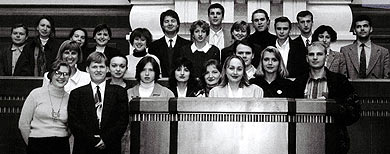
JPEG - 21.6 kb
Youngsters of the PORA movement during their training period at NED/CIA

At 8 pm, Poland is the first foreign country to denounce the official result. «President» Yushchenko announces the creation of a Coordinating Council for the Protection of the Constitution and starts a provisional government.

On Wednesday, November 24, the crowd is still as thick in Independence Square. At 12:30, the Canadian Foreign Affairs Minister invites the Ukrainian authorities to do a recount. At 1 pm, the Electoral Commission announces the complete and final results: Yanukovych is elected with 49.53% of the vote. Viktor Yanukovych declares himself ready to assume the functions the people have just confided upon him. At 4:30, “President” Yeshchenko calls on the police and the military to fraternise with the demonstrators. At 8:30 pm, Secretary of State Colin Powell announces that the United States does not recognise the election results.

Decoding

During the election campaign, Viktor Yanukovych abused his position as sitting Prime Minister to use private and public media to bolster his campaign. During the same period, Viktor Yushchenko paid and trained thousands of activists from funds coming from the United States.

Contravening the rules of the OESC, the Ukrainian Elections Code recognises as international observers only official delegations, not NGOs. According to the right-hand man of M. Yushchenko, 2,500 observers were turned away from polling stations. It seems these were 1,000 observers from the European Network of Election Monitoring Organizations (ENEMO).
The election delegates chosen by the candidates and the international observers from the Parliamentary Assembly of the OESC, the Parliamentary Assembly from NATO, from the European Council, from the European Parliament, and from OESC were able to survey the voting normally.
ENEMO is a collection of Eastern European associations. Each of them is financed by Madeleine Albright’s National Democratic Institute, while the common secretariat of the collection is financed by the Open Society Institute of George Soros and is led by British diplomats. The group includes the Ukrainian association Committee on Voters of Ukraine (CVU), editor of the paper Tochka Zory. The displacement of 1,000 observers was jointly financed by James Woolsey’s Freedom House, Albright’s National Democratic Institute, and John McCain’s International Republican Institute. Remember that these two organizations are appendices of the National Endowment for Democracy, the public face of the CIA [1].

The exit polls, published by the Socis Institute and the Razumkov Centre, were funded by the United States. The same procedure was used during the revocation referendum in Venezuela where an exit poll was conducted by Penn Shoen & Berland Associates for the opposition association Sumate, financed by the US. The exit poll showed the opposition winning by 59% while the Electoral Commission had them losing with 41%. On the basis of this exit poll, a crowd amassed in the centre of Caracas to drive out President Chavez. Ultimately, the international observers, such as the Carter Center and the Réseau Voltaire, confirmed the official results. [2]

More than 10,000 cadres of the Pora youth association and the Committee on Voters of Ukraine received an average salary of $3,000 per month, a more than comfortable income for the Ukraine. This remuneration was financed by the United States, via USAID and NED. The first experiment in paying thousands of extras to act in a demonstration before the press was carried out by Britain’s MI6 and the CIA for Operation Ajax: in 1952, they recruited 6,000 extras in Iran to march against the Royal Palace and overthrow Mossadegh. [3]
Thousands of tents and blankets were made available to demonstrators so they could camp out in Independence Square where free meals were served. All the logistics were prepared by USAID.

The declaration of the OESC claiming the Ukraine had failed to meet international standards for a democratic election was based largely on the disequilibrium of the election campaign and not on the vote itself which, although marked by a number of incidents, didn’t appear too irregular.

The various statements from Senator Richard G. Lugar demanding the annulation of the election were not accompanied by any precise descriptions of the alleged fraudulent activity.

Polish President Kwasniewski, after denouncing the official results, proposed to mediate between the two candidates. Simultaneously, he made available to his predecessor, Lech Walesa, public monies to visit Kiev where Walesa participated in M. Yushchenko’s meetings in Independence Square.

This “richest revolution in the world” was conceived for the public in the United States. Yushchenko’s Internet site is entirely translated into English. The street demonstrations were orchestrated for Western television with a know-how that hasn’t failed since the overthrow of Ceausescu and the mass graves of Timisoara.

Translated by Signs of the Times

[1] « NED : La nébuleuse de l’ingérence démocratique » by Thierry Meyssan, Voltaire, 22 January 2004.

[2] « Les sondages ou les urnes ? » Voltaire, 23 August 2004.

[3] « BP Amoco, coalition pétrolière anglo-saxonne » by Arthur Lepic, Voltaire, 10 June 2004.

<span lang='fr'>Thierry Meyssan</span>

Thierry Meyssan French intellectual, founder and chairman of Voltaire Network and the Axis for Peace Conference. His columns specializing in international relations feature in daily newspapers and weekly magazines in Arabic, Spanish and Russian. His last two books published in English : 9/11 the Big Lie and Pentagate.

 
The GCC and NATO lose their leadership
DOUBLE VETO BANS IMPERIAL WAR AGAINST SYRIA
 
Covert Action
Although the principle of state sovereignty lies at the heart of international law, the super powers have not refrained from corrupting governments, destabilising societies, eliminating their leaders and even overthrowing regimes by means of covert action. While this form of interference is relatively inexpensive when weighed against the potential gains, it inevitably undermines trust among nations.
The Anglo-Saxons have become the masters of the game. As joint signatories to a 1948 secret military pact (UK-USA + Canada, Australia, New Zealand), they fashioned espionage and covert action tools to serve their common project: the Cold War. They were rivaling in this field against the Soviet Union, over which they had already attained undeniable superiority. Both Maoist China and post-colonial France also resorted to analogous means with a view to securing zones of interest, mainly in Africa.
The landscape changed completely after the demise of the USSR. China stopped financing armed revolutionary groups all around and concentrated on pragmatic intelligence efforts to sustain economic cooperation development. France withdrew from its private reserve in Africa to leave room for the European Union. Having outlived the Yeltsin abyss, Russian intelligence set about restructuring at the national level and in their historical area of influence (newly independent ex-Soviet states) by mobilizing against external intrusions rather than interfering in the affairs of other countries.
As of 1995, the Anglo-Saxons invested massively in their secret services, whose budget tripled over a 15-year period. In addition, they have drawn the Israeli services into their structure either as full members or as subcontractors. In 2009, the Anglo-Saxon services (except Israel) operate on an employment level of 250,000 men and a budget exceeding 100 billion dollars (i.e. 15 times higher than Russia’s, virtually their main competitor). In effect, espionage and covert action have become the essential tools of forced globalisation.
+

Article licensed under Creative Commons

The articles on Voltaire Network may be freely reproduced provided the source is cited, their integrity is respected and they are not used for commercial purposes (license CC BY-NC-ND).

Support Voltaire Network

You visit this website to seek quality analysis that enables you to forge your own understanding of today’s world. In order to continue our work, we need you to support our efforts.
Help us by making a contribution.

How to participate in Voltaire Network?

The members of our team are all volunteers.
- Authors : diplomats, economists, geographers, historians, journalists, military servicemen, philosophers, sociologists. You can send us your article proposals.
- Professional-level mother-tongue translators: you can help us by translating our articles.

International edition
français
English
Español
italiano
عربي
Deutsch
 
95 <span lang='fr'>articles cette semaine dans toutes les langues</span>
Le Qatar achète la démission du général al-Dabi Le Qatar achète la démission du général al-Dabi
Réseau Voltaire, 13 février 2012
 
2012, année de tous les périls ? 2012, année de tous les périls ?
par Joseph Stiglitz, Réseau Voltaire, 13 février 2012
 
Jeux de guerre états-uniens dans le sud-est asiatique Jeux de guerre états-uniens dans le sud-est asiatique
Réseau Voltaire, 13 février 2012
 
مجلس التعاون الخليجي والناتو يفقدان زمام القيادة
الفيتو المزدوج لمنع حرب الإمبراطوريات على سوريا
مجلس التعاون الخليجي والناتو يفقدان زمام القيادة
بقلم ثييري ميسان, Shabakat Voltaire, 13 شباط (فبراير) 2012
 
الصين تصبح الشريك التجاري الأول لألمانيا الصين تصبح الشريك التجاري الأول لألمانيا
Shabakat Voltaire, 13 شباط (فبراير) 2012
 
Iran's Historic Anniversary Iran’s Historic Anniversary
by Stephen Lendman, Voltaire Network, 13 February 2012
 
Páginas Libres
Mafia de complicidad y reacción en el Apra
Socios, 12 de febrero de 2012
 
Syria 2011-2012, a rematch of Israel's 2006 war on Lebanon Syria 2011-2012, a rematch of Israel’s 2006 war on Lebanon
by Mahdi Darius Nazemroaya, Voltaire Network, 12 February 2012
 
Páginas Libres
¿Se incrementa riesgo personal con este gobierno?
por Guillermo Olivera Díaz, Socios, 12 de febrero de 2012
 
Ante la competencia de la OCS, ¿escogerá la OTAN la diplomacia o las armas?
« Revista de prensa sobre Siria » #49
Ante la competencia de la OCS, ¿escogerá la OTAN la diplomacia o las armas?
Socios, 12 de febrero de 2012
 
Wladimir Putin tritt als Beschützer der Orient-Christen auf Wladimir Putin tritt als Beschützer der Orient-Christen auf
Voltaire Netzwerk, 12. Februar 2012
 
Großbritannien „verpackt“ die Al-Qaida neu Großbritannien „verpackt“ die Al-Qaida neu
Voltaire Netzwerk, 12. Februar 2012
 
Moscow and the formation of The New World System Moscow and the formation of The New World System
by Imad Fawzi Shueibi, Voltaire Network, 11 February 2012
 
Assassinats anonymes
« L’art de la guerre »
Assassinats anonymes
par Manlio Dinucci , Réseau Voltaire, 11 février 2012
 
Sergei Lavrov von Damaskus als Held empfangen Sergei Lavrov von Damaskus als Held empfangen
Voltaire Netzwerk, 11. Februar 2012
 
Al-Qaeda refashioned by the UK Al-Qaeda refashioned by the UK
Voltaire Network, 11 February 2012
 
الإرهاب في سورية
إغلاق السفارات والارهاب في حلب
بقلم مازن بلال, Partners, 11 شباط (فبراير) 2012
 
حلب تستفيق على الإرهاب...
وتصعيد دبلوماسي إعلامي وإرهابي
بقلم سورية الغد, Partners, 11 شباط (فبراير) 2012
 
الإرهاب في سورية
أغفو في وطني
بقلم نضال الخضري, Partners, 11 شباط (فبراير) 2012
 
الإرهاب في سورية
التحرك الخليجي إلى أين...
بقلم مازن بلال, Partners, 11 شباط (فبراير) 2012
 
Páginas Libres
¿Sófero retroceso post marcha por el agua?
por Guillermo Olivera Díaz, Socios, 11 de febrero de 2012
 
Face à la concurrence de l'OCS, l'OTAN choisira t-elle la diplomatie ou les armes ?
« Revue de presse Syrie » #49
Face à la concurrence de l’OCS, l’OTAN choisira t-elle la diplomatie ou les armes ?
Partenaires, 10 février 2012
 
 Im Wettstreit mit der SCO, wird die NATO Diplomatie oder Waffen wählen?
« Presseschau Syrien » #49
Im Wettstreit mit der SCO, wird die NATO Diplomatie oder Waffen wählen?
Partner, 10. Februar 2012
 
U.S. Prepares Georgia for New Wars in Caucasus and Iran
"NATO’s favorite despot"
U.S. Prepares Georgia for New Wars in Caucasus and Iran
by Rick Rozoff, Voltaire Network, 10 February 2012
 
La Grande-Bretagne « reconditionne » Al-Qaïda La Grande-Bretagne « reconditionne » Al-Qaïda
Réseau Voltaire, 10 février 2012
 
Faced with competition from the SCO, will NATO choose diplomacy or arms?
« SYRIA PRESS REVIEW » #49
Faced with competition from the SCO, will NATO choose diplomacy or arms?
Partners, 10 February 2012
 
Señal de Alerta
Risas inexplicables en la radio
por Herbert Mujica Rojas, Socios, 10 de febrero de 2012
 
Vladimir Putin emerges as protector of Eastern Christians Vladimir Putin emerges as protector of Eastern Christians
Voltaire Network, 9 February 2012
 
Censura británica: cómo seguir viendo Press TV Censura británica: cómo seguir viendo Press TV
Red Voltaire, 9 de febrero de 2012
 
El CCG y la OTAN pierden su liderazgo
El doble veto prohíbe la guerra imperial contra Siria
El CCG y la OTAN pierden su liderazgo
por Thierry Meyssan, Red Voltaire, 9 de febrero de 2012
 
Westerners looking for a "Plan B"
« SYRIA PRESS REVIEW » #48
Westerners looking for a "Plan B"
Partners, 9 February 2012
 
 Der Westen sucht den « B » Plan
« Presseschau Syrien » #48
Der Westen sucht den « B » Plan
Partner, 9. Februar 2012
 
Páginas Libres
¡Yo voto por el agua, el oro ni me va ni me viene!
por Guillermo Olivera Díaz, Socios, 9 de febrero de 2012
 
Les Occidentaux à la recherche d'un “Plan B”
« Revue de presse Syrie » #48
Les Occidentaux à la recherche d’un “Plan B”
Partenaires, 9 février 2012
 
Los occidentales buscan un “Plan B”
« Revista de prensa sobre Siria » #48
Los occidentales buscan un “Plan B”
Socios, 9 de febrero de 2012
 
Sergey Lavrov accueilli en héros à Damas Sergey Lavrov accueilli en héros à Damas
Réseau Voltaire, 8 février 2012
 
Russia's popularity in Syria confounds the West
« SYRIA PRESS REVIEW » #47
Russia’s popularity in Syria confounds the West
Partners, 8 February 2012
 
255. Il faut à nouveau faire jouer l'« orchestre européen »
« Horizons et débats », 12e année, n° 5, 6 février 2012
Il faut à nouveau faire jouer l’« orchestre européen »
Partenaires, 8 février 2012
 
China becomes German's first trading partner China becomes German’s first trading partner
Voltaire Network, 8 February 2012
 
Syrie : Le double véto russo-chinois inaugure un nouvel ordre mondial Syrie : Le double véto russo-chinois inaugure un nouvel ordre mondial
par Pierre Khalaf, Partenaires, 8 février 2012
 
China wird erster Wirtschaftspartner von Deutschland China wird erster Wirtschaftspartner von Deutschland
Voltaire Netzwerk, 8. Februar 2012
 
Señal de Alerta
Etica bananera
por Herbert Mujica Rojas, Socios, 8 de febrero de 2012
 
Un avion cargo suspect saisi par la sécurité libanaise Un avion cargo suspect saisi par la sécurité libanaise
Réseau Voltaire, 8 février 2012
 
فرنسوا هولند يفاوض أمير قطر فرنسوا هولند يفاوض أمير قطر
Shabakat Voltaire, 8 شباط (فبراير) 2012
 
 الدبلوماسيات الغاضبة وسيناريوهات الحلول الدبلوماسيات الغاضبة وسيناريوهات الحلول
بقلم عيسى الأيوبي, Shabakat Voltaire, 8 شباط (فبراير) 2012
 
أبعد من انتصار نيويورك..اللعبة انتهت أبعد من انتصار نيويورك..اللعبة انتهت
بقلم عيسى الأيوبي, Shabakat Voltaire, 8 شباط (فبراير) 2012
 
جلسة الكذب المفتوح جلسة الكذب المفتوح
بقلم عيسى الأيوبي, Shabakat Voltaire, 8 شباط (فبراير) 2012
 
Egypt and Syria
Orient Tendencies
Egypt and Syria
by Wassim Raad, Partners, 8 February 2012
 
Les Occidentaux choqués par la popularité russe en Syrie
« Revue de presse Syrie » #47
Les Occidentaux choqués par la popularité russe en Syrie
Partenaires, 8 février 2012
 
كسر إرادات
عروبة ((الشاطئ)) الآخر
بقلم نضال الخضري, Partners, 8 شباط (فبراير) 2012
 
كسر إرادات
زيارة لافروف ... ودول الخليج تضغط
بقلم سورية الغد, Partners, 8 شباط (فبراير) 2012
 
كسر إرادات
مواقف في لحظات الترقب
بقلم سورية الغد, Partners, 8 شباط (فبراير) 2012
 
كسر إرادات
التكتيك الخليجي
بقلم مازن بلال, Partners, 8 شباط (فبراير) 2012
 
 Der Westen über die russische Beliebtheit in Syrien schockiert
« Presseschau Syrien » #47
Der Westen über die russische Beliebtheit in Syrien schockiert
Partner, 8. Februar 2012
 
Disgusto de los occidentales ante la popularidad rusa en Siria
« Revista de prensa sobre Siria » #47
Disgusto de los occidentales ante la popularidad rusa en Siria
Socios, 8 de febrero de 2012
 
Moscou et Pékin ont surtout voulu protéger Téhéran
« Revue de presse Syrie » #46
Moscou et Pékin ont surtout voulu protéger Téhéran
Partenaires, 7 février 2012
 
Páginas Libres
MOVADEF y SL: reflexiones estudiantiles
Socios, 7 de febrero de 2012
 
Páginas Libres
Gran Marcha por el Agua: viernes 10, 2 pm
por Guillermo Olivera Díaz, Socios, 7 de febrero de 2012
 
Moscow and Beijing acted primarily to shield Tehran
« SYRIA PRESS REVIEW » #46
Moscow and Beijing acted primarily to shield Tehran
Partners, 7 February 2012
 
 Der GCC und die NATO verlieren ihre Vorherrschaft
Doppeltes Veto um den imperialen Krieg gegen Syrien zu verbieten
Der GCC und die NATO verlieren ihre Vorherrschaft
von Thierry Meyssan, Voltaire Netzwerk, 7. Februar 2012
 
Páginas Libres
¡Luz roja al solmáforo!
Socios, 7 de febrero de 2012
 
Más que todo, Moscú y Pekín quisieron proteger a Teherán
« Revista de prensa sobre Siria » #46
Más que todo, Moscú y Pekín quisieron proteger a Teherán
Socios, 7 de febrero de 2012
 
 Moskau und Beijing wollten hauptsächlich Teheran schützen
« Presseschau Syrien » #46
Moskau und Beijing wollten hauptsächlich Teheran schützen
Partner, 7. Februar 2012
 
Páginas Libres
Alan y Ollanta ocultaron tratos de indulto ilícito a Fujimori
por Guillermo Olivera Díaz, Socios, 6 de febrero de 2012
 
روسيا وتشكيل المنظومة الدولية
الثابت والمتغير في المواقف
روسيا وتشكيل المنظومة الدولية
بقلم Imad Fawzi Shueibi, Shabakat Voltaire, 6 شباط (فبراير) 2012
 
رسالة أوباما إلى طهران، الحرب على إيران على نارٍ هادئة... في الوقت الحالي؟ رسالة أوباما إلى طهران، الحرب على إيران على نارٍ هادئة... في الوقت الحالي؟
بقلم Mahdi Darius Nazemroaya, Shabakat Voltaire, 6 شباط (فبراير) 2012
 
Páginas Libres
Iglesia católica en conflicto peruano-chileno
Socios, 6 de febrero de 2012
 
 Il GCC e la NATO stanno perdendo la loro leadership
Il doppio veto che impedisce la guerra imperiale contro la Siria
Il GCC e la NATO stanno perdendo la loro leadership
di Thierry Meyssan, Rete Voltaire, 6 febbraio 2012
 
الأوروبيون... أول ضحايا العقوبات على إيران الأوروبيون... أول ضحايا العقوبات على إيران
Shabakat Voltaire, 6 شباط (فبراير) 2012
 
ثرثرة
لـ((أغلبية صامتة))!!
بقلم نضال الخضري, Partners, 6 شباط (فبراير) 2012
 
سورية
الحدث من حمص
بقلم سورية الغد, Partners, 6 شباط (فبراير) 2012
 
التحرك الروسي
وذروة الأزمة
بقلم مازن بلال, Partners, 6 شباط (فبراير) 2012
 
قبل وصول لافروف...
ما الذي ستحمله موسكو؟!
بقلم سورية الغد, Partners, 6 شباط (فبراير) 2012
 
على أوباما خيارات صعبة في وقت حرج
التقرير الأسبوعي لمراكز الأبحاث الأميركية
على أوباما خيارات صعبة في وقت حرج
Shabakat Voltaire, 6 شباط (فبراير) 2012
 
التهديد باغلاق المضيق و تداعياته
التقرير الأسبوعي لمراكز الدراسات الأميركية
التهديد باغلاق المضيق و تداعياته
Shabakat Voltaire, 6 شباط (فبراير) 2012
 
Les pressions morales sur la Russie
« Revue de presse Syrie » #44
Les pressions morales sur la Russie
Partenaires, 5 février 2012