


After suffering major military and political defeats in bloody ground wars in Afghanistan and Iraq, failing to buttress long-standing clients in Yemen, Egypt and Tunisia and witnessing the disintegration of puppet regimes in Somalia and South Sudan, the Obama regime has learned nothing: Instead he has turned toward greater military confrontation with global powers, namely Russia and China. Obama has adopted a provocative offensive military strategy right on the frontiers of both China and Russia.
Voltaire Network |
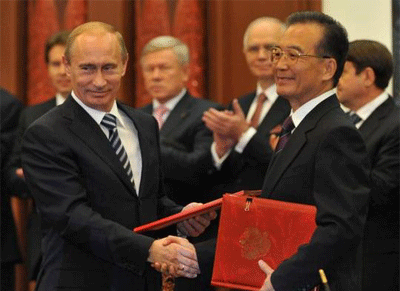
Russia and China united against the US in defeating UN resolution to slap sanctions on Syria.
After going from defeat to defeat on the periphery of world power and not satisfied with running treasury-busting deficits in pursuit of empire building against economically weak countries, Obama has embraced a policy of encirclement and provocations against China, the world’s second largest economy and the US’s most important creditor, and Russia, the European Union’s principle oil and gas provider and the world’s second most powerful nuclear weapons power.
This paper addresses the Obama regime’s highly irrational and world-threatening escalation of imperial militarism. We examine the global military, economic and domestic political context that gives rise to these policies. We then examine the multiple points of conflict and intervention in which Washington is engaged, from Pakistan, Iran, Libya, Venezuela, Cuba and beyond. We will then analyze the rationale for military escalation against Russia and China as part of a new offensive moving beyond the Arab world (Syria, Libya) and in the face of the declining economic position of the EU and the US in the global economy. We will then outline the strategies of a declining empire, nurtured on perpetual wars, facing global economic decline, domestic discredit and a working population reeling from the long-term, large-scale dismantling of its basic social programs.
The Turn from Militarism in the Periphery to Global Military Confrontation
November 2011 is a moment of great historical import: Obama declared two major policy positions, both having tremendous strategic consequences affecting competing world powers.
Obama pronounced a policy of military encirclement of China based on stationing a maritime and aerial armada facing the Chinese coast – an overt policy designed to weaken and disrupt China’s access to raw materials and commercial and financial ties in Asia. Obama’s declaration that Asia is the priority region for US military expansion, base-building and economic alliances was directed against China, challenging Beijing in its own backyard. Obama’s iron fist policy statement, addressed to the Australian Parliament, was crystal clear in defining US imperial goals.
“Our enduring interests in the region [Asia Pacific] demands our enduring presence in this region … The United States is a Pacific power and we are here to stay … As we end today’s wars [i.e. the defeats and retreats from Iraq and Afghanistan]... I have directed my national security team to make our presence and missions in the Asia Pacific a top priority … As a result, reduction in US defense spending will not … come at the expense of the Asia Pacific” (CNN.com, Nov. 16, 2011).
The precise nature of what Obama called our “presence and mission” was underlined by the new military agreement with Australia to dispatch warships, warplanes and 2500 marines to the northern most city of Australia (Darwin) directed at China. Secretary of State Clinton has spent the better part of 2011 making highly provocative overtures to Asian countries that have maritime border conflicts with China.
Clinton has forcibly injected the US into these disputes, encouraging and exacerbating the demands of Vietnam, Philippines, and Brunei in the South China Sea. Even more seriously, Washington is bolstering its military ties and sales with Japan, Taiwan, Singapore and South Korea, as well as increasing the presence of battleships, nuclear submarines and over flights of war planes along China’s coastal waters. In line with the policy of military encirclement and provocation, the Obama-Clinton regime is promoting Asian multi-lateral trade agreements that exclude China and privilege US multi-national corporations, bankers and exporters, dubbed the “Trans-Pacific Partnership”. It currently includes mostly smaller countries, but Obama has hopes of enticing Japan and Canada to join …
Obama’s presence at the APEC meeting of East Asian leader and his visit to Indonesia in November 2011 all revolve around efforts to secure US hegemony. Obama-Clinton hope to counter the relative decline of US economic links in the face of the geometrical growth of trade and investment ties between East Asia and China.
A most recent example of Obama-Clinton’s delusional, but destructive, efforts to deliberately disrupt China’s economic ties in Asia, is taking place in Myanmar (Burma). Clinton’s December 2011 visit to Myanmar was preceded by a decision by the Thein Sein regime to suspend a China Power Investment-funded dam project in the north of the country. According to official confidential documents released by WilkiLeaks the “Burmese NGO’s, which organized and led the campaign against the dam, were heavily funded by the US government”. [1] This and other provocative activity and Clinton’s speeches condemning Chinese “tied aid” pale in comparison with the long-term, large-scale interests which link Myanmar with China. China is Myanmar’s biggest trading partner and investor, including six other dam projects. Chinese companies are building new highways and rail lines across the country, opening southwestern China up for Burmese products and China is constructing oil pipelines and ports. There is a powerful dynamic of mutual economic interests that will not be disturbed by one dispute. [2] Clinton’s critique of China’s billion-dollar investments in Myanmar’s infrastructure is one of the most bizarre in world history, coming in the aftermath of Washington’s brutal eight-year military presence in Iraq which destroyed $500 billion dollars of Iraqi infrastructure, according to Baghdad official estimates. Only a delusional administration could imagine that rhetorical flourishes, a three day visit and the bankrolling of an NGO is an adequate counter-weight to deep economic ties linking Myanmar to China. The same delusional posture underlies the entire repertoire of policies informing the Obama regime’s efforts to displace China’s predominant role in Asia.
While any one policy adopted by the Obama regime does not, in itself, present an immediate threat to peace, the cumulative impact of all these policy pronouncements and the projections of military power add up to an all out comprehensive effort to isolate, intimidate and degrade China’s rise as a regional and global power. Military encirclement and alliances, exclusion of China in proposed regional economic associations, partisan intervention in regional maritime disputes and positioning technologically advanced warplanes, are all aimed to undermine China’s competitiveness and to compensate for US economic inferiority via closed political and economic networks.
Clearly White House military and economic moves and US Congressional anti-China demagogy are aimed at weakening China’s trading position and forcing its business-minded leaders into privileging US banking and business interests over and above their own enterprises. Pushed to its limits, Obama’s prioritizing a big military push could lead to a catastrophic rupture in US-Chinese economic relations. This would result in dire consequences, especially but not exclusively, on the US economy and particularly its financial system. China holds over $1.5 trillion dollars in US debt, mainly Treasury Notes, and each year purchases from $200 to $300 billion in new issues, a vital source in financing the US deficit. If Obama provokes a serious threat to China’s security interests and Beijing is forced to respond, it will not be military but economic retaliation: the sell-off of a few hundred billion dollars in T-notes and the curtailment of new purchases of US debt. The US deficit will skyrocket, its credit ratings will descend to ‘junk’, and the financial system will ‘tremble onto collapse’. Interest rates to attract new buyers of US debt will approach double digits. Chinese exports to the US will suffer and losses will incur due to the devaluation of the T-notes in Chinese hands. China has been diversifying its markets around the world and its huge domestic market could probably absorb most of what China loses abroad in the course of a pull-back from the US market.
While Obama strays across the Pacific to announce his military threats to China and strives to economically isolate China from the rest of Asia, the US economic presence is fast fading in what used to be its “backyard”: Quoting one Financial Times journalist, “China is the only show [in town] for Latin America”- [3] China has displaced the US and the EU as Latin America’s principle trading partner; Beijing has poured billions in new investments and provides low interest loans.
China’s trade with India, Indonesia, Japan, Pakistan and Vietnam is increasing at a far faster rate than that of the US. The US effort to build an imperial-centered security alliance in Asia is based on fragile economic foundations. Even Australia, the anchor and linchpin of the US military thrust in Asia, is heavily dependent on mineral exports to China. Any military interruption would send the Australian economy into a tailspin.
The US economy is in no condition to replace China as a market for Asian or Australian commodity and manufacturing exports. The Asian countries must be acutely aware that there is no future advantage in tying themselves to a declining, highly militarized, empire. Obama and Clinton deceive themselves if they think they can entice Asia into a long-term alliance. The Asian’s are simply using the Obama regime’s friendly overtures as a ‘tactical device’, a negotiating ploy, to leverage better terms in securing maritime and territorial boundaries with China.
Washington is delusional if it believes that it can convince Asia to break long-term large-scale lucrative economic ties to China in order to join an exclusive economic association with such dubious prospects. Any ‘reorientation’ of Asia, from China to the US, would require more than the presence of an American naval and airborne armada pointed at China. It would require the total restructuring of the Asian countries’ economies, class structure and political and military elite. The most powerful economic entrepreneurial groups in Asia have deep and growing ties with China/Hong Kong, especially among the dynamic transnational Chinese business elites in the region. A turn toward Washington entails a massive counter-revolution, which substitutes colonial ‘traders’ (compradors) for established entrepreneurs. A turn to the US would require a dictatorial elite willing to cut strategic trading and investment linkages, displacing millions of workers and professionals. As much as some US-trained Asian military officers , economists and former Wall Street financiers and billionaires might seek to ‘balance’ a US military presence with Chinese economic power, they must realize that ultimately advantage resides in working out an Asian solution.
The age of Asian “comprador capitalists”, willing to sell out national industry and sovereignty in exchange for privileged access to US markets, is ancient history. Whatever the boundless enthusiasm for conspicuous consumerism and Western lifestyles, which Asia and China’s new rich mindlessly celebrate, whatever the embrace of inequalities and savage capitalist exploitation of labor, there is recognition that the past history of US and European dominance precluded the growth and enrichment of an indigenous bourgeoisie and middle class. The speeches and pronouncements of Obama and Clinton reek of nostalgia for a past of neo-colonial overseers and comprador collaborators – a mindless delusion. Their attempts at political realism, in finally recognizing Asia as the economic pivot of the present world order, takes a bizarre turn in imagining that military posturing and projections of armed force will reduce China to a marginal player in the region.
Obama’s Escalation of Confrontation with Russia
The Obama regime has launched a major frontal military thrust on Russia’s borders. The US has moved forward missile sites and Air Force bases in Poland, Rumania, Turkey, Spain, Czech Republic and Bulgaria: Patriot PAC-3 anti-aircraft missile complexes in Poland; advanced radar AN/TPY-2 in Turkey; and several missile (SM-3 IA) loaded warships in Spain are among the prominent weapons encircling Russia, most only minutes away from it strategic heartland. Secondly, the Obama regime has mounted an all-out effort to secure and expand US military bases in Central Asia among former Soviet republics. Thirdly, Washington, via NATO, has launched major economic and military operations against Russia’s major trading partners in North Africa and the Middle East. The NATO war against Libya, which ousted the Gadhafi regime, has paralyzed or nullified multi-billion dollar Russian oil and gas investments, arms sales and substituted a NATO puppet for the former Russia-friendly regime.
The UN-NATO economic sanctions and US-Israeli clandestine terrorist activity aimed at Iran has undermined Russia’s lucrative billion-dollar nuclear trade and joint oil ventures. NATO, including Turkey, backed by the Gulf monarchical dictatorships, has implemented harsh sanctions and funded terrorist assaults on Syria, Russia’s last remaining ally in the region and where it has a sole naval facility (Tartus) on the Mediterranean Sea. Russia’s previous collaboration with NATO in weakening its own economic and security position is a product of the monumental misreading of NATO and especially Obama’s imperial policies. Russian President Medvedev and his Foreign Minister Sergey Lavrov mistakenly assumed (like Gorbachev and Yeltsin before them) that backing US-NATO policies against Russia’s trading partners would result in some sort of “reciprocity”: US dismantling its offensive “missile shield” on its frontiers and support for Russia’s admission into the World Trade Organization. Medvedev, following his liberal pro-western illusions, fell into line and backed US-Israeli sanctions against Iran, believing the tales of a “nuclear weapons programs”. Then Lavrov fell for the NATO line of “no fly zones to protect Libyan civilian lives” and voted in favor, only to feebly “protest”, much too late, that NATO was “exceeding its mandate” by bombing Libya into the Middle Ages and installing a pro-NATO puppet regime of rogues and fundamentalists. Finally when the US aimed a cleaver at Russia’s heartland by pushing ahead with an all-out effort to install missile launch sites 5 minutes by air from Moscow while organizing mass and armed assaults on Syria, did the Medvedev-Lavrov duet awake from its stupor and oppose UN sanctions. Medvedev threatened to abandon the nuclear missile reduction treaty (START) and to place medium-range missiles with 5 minute launch-time from Berlin, Paris and London.
Medvedev-Lavrov’s policy of consolidation and co-operation based on Obama’s rhetoric of “resetting relations” invited aggressive empire building: Each capitulation led to a further aggression. As a result, Russia is surrounded by missiles on its western frontier; it has suffered losses among its major trading partners in the Middle East and faces US bases in southwest and Central Asia.
Belatedly Russian officials have moved to replace the delusional Medvedev for the realist Putin, as next President. This shift to a political realist has predictably evoked a wave of hostility toward Putin in all the Western media. Obama’s aggressive policy to isolate Russia by undermining independent regimes has, however, not affected Russia’s status as a nuclear weapons power. It has only heightened tensions in Europe and perhaps ended any future chance of peaceful nuclear weapons reduction or efforts to secure a UN Security Council consensus on issues of peaceful conflict resolution. Washington, under Obama-Clinton, has turned Russia from a pliant client to a major adversary.
Putin looks to deepening and expanding ties with the East, namely China, in the face of threats from the West. The combination of Russian advanced weapons technology and energy resources and Chinese dynamic manufacturing and industrial growth are more than a match for crisis-ridden EU-USA economies wallowing in stagnation.
Obama’s military confrontation toward Russia will greatly prejudice access to Russian raw materials and definitively foreclose any long-term strategic security agreement, which would be useful in lowering the deficit and reviving the US economy.
Between Realism and Delusion: Obama’s Strategic Realignment
Obama’s recognition that the present and future center of political and economic power is moving inexorably to Asia, was a flash of political realism. After a lost decade of pouring hundreds of billions of dollars in military adventures on the margins and periphery of world politics, Washington has finally discovered that is not where the fate of nations, especially Great Powers, will be decided, except in a negative sense – of bleeding resources over lost causes. Obama’s new realism and priorities apparently are now focused on Southeast and Northeast Asia, where dynamic economies flourish, markets are growing at a double digit rate, investors are ploughing tens of billions in productive activity and trade is expanding at three times the rate of the US and the EU.
But Obama’s ‘New Realism’ is blighted by entirely delusional assumptions, which undermine any serious effort to realign US policy.
In the first place Obama’s effort to ‘enter’ into Asia is via a military build-up and not through a sharpening and upgrading of US economic competitiveness. What does the US produce for the Asian countries that will enhance its market share? Apart from arms, airplanes and agriculture, the US has few competitive industries. The US would have to comprehensively re-orient its economy, upgrade skilled labor, and transfer billions from “security” and militarism to applied innovations. But Obama works within the current military-Zionist-financial complex: He knows no other and is incapable of breaking with it.
Secondly, Obama-Clinton operate under the delusion that the US can exclude China or minimize its role in Asia, a policy that is undercut by the huge and growing investment and presence of all the major US multi-national corporations in China , who use it as an export platform to Asia and the rest of the world.
The US military build-up and policy of intimidation will only force China to downgrade its role as creditor financing the US debt, a policy China can pursue because the US market, while still important, is declining, as China expands its presence in its domestic, Asian, Latin American and European markets.
What once appeared to be New Realism is now revealed to be the recycling of Old Delusions: The notion that the US can return to being the supreme Pacific Power it was after World War Two. The US attempts to return to Pacific dominance under Obama-Clinton with a crippled economy, with the overhang of an over-militarized economy, and with major strategic handicaps: Over the past decade the United States foreign policy has been at the beck and call of Israel’s fifth column (the Israel “lobby”. The entire US political class is devoid of common, practical sense and national purpose. They are immersed in troglodyte debates over “indefinite detentions” and “mass immigrant expulsions”. Worse, all are on the payrolls of private corporations who sell in the US and invest in China.
Why would Obama abjure costly wars in the unprofitable periphery and then promote the same military metaphysics at the dynamic center of the world economic universe? Does Barack Obama and his advisers believe he is the Second Coming of Admiral Commodore Perry, whose 19th century warships and blockades forced Asia open to Western trade? Does he believe that military alliances will be the first stage to a subsequent period of privileged economic entry?
Does Obama believe that his regime can blockade China, as Washington did to Japan in the lead up to World War Two? It’s too late. China is much more central to the world economy, too vital even to the financing of the US debt, too bonded up with the Forbes Five Hundred multi-national corporations. To provoke China, to even fantasize about economic “exclusion” to bring down China, is to pursue policies that will totally disrupt the world economy, first and foremost the US economy!
Conclusion
Obama’s ‘crackpot realism’, his shift from wars in the Muslim world to military confrontation in Asia, has no intrinsic worth and poses extraordinary extrinsic costs. The military methods and economic goals are totally incompatible and beyond the capacity of the US, as it is currently constituted. Washington’s policies will not ‘weaken’ Russia or China, even less intimidate them. Instead it will encourage both to adopt more adversarial positions, making it less likely that they lend a hand to Obama’s sequential wars on behalf of Israel. Already Russia has sent warships to its Syrian port, refused to support an arms embargo against Syria and Iran and (in retrospect) criticized the NATO war against Libya. China and Russia have far too many strategic ties with the world economy to suffer any great losses from a series of US military outposts and “exclusive” alliances. Russia can aim just as many deadly nuclear missiles at the West as the US can mount from its bases in Eastern Europe.
In other words, Obama’s military escalation will not change the nuclear balance of power, but will bring Russia and China into a closer and deeper alliance. Gone are the days of Kissinger-Nixon’s “divide and conquer” strategy pitting US-Chinese trade agreements against Russian arms. Washington has a totally exaggerated significance of the current maritime spats between China and its neighbors. What unites them in economic terms is far more important in the medium and long-run. China’s Asian economic ties will erode any tenuous military links to the US.
Obama’s “crackpot realism”, views the world market through military lenses. Military arrogance toward Asia has led to a rupture with Pakistan, its most compliant client regime in South Asia. NATO deliberately slaughtered 24 Pakistani soldiers and thumbed their nose at the Pakistani generals, while China and Russia condemned the attack and gained influence.
In the end, the military and exclusionary posture to China will fail. Washington will overplay its hand and frighten its business-oriented erstwhile Asian partners, who only want to play-off a US military presence to gain tactical economic advantage. They certainly do not want a new US instigated ‘Cold War’ dividing and weakening the dynamic intra-Asian trade and investment. Obama and his minions will quickly learn that Asia’s current leaders do not have permanent allies - only permanent interests. In the final analysis, China figures prominently in configuring a new Asia-centric world economy. Washington may claim to have a ‘permanent Pacific presence’ but until it demonstrates it can take care of its “basic business at home”, like arranging its own finances and balancing its current account deficits, the US Naval command may end up renting its naval facilities to Asian exporters and shippers, transporting goods for them, and protecting them by pursuing pirates, contrabandists and narco-traffickers. Come to think about it, Obama might reduce the US trade deficit with Asia by renting out the Seventh Fleet to patrol the Straits, instead of wasting US taxpayer money bullying successful Asian economic powers.


 Articles by this author
 Send a message
Russian Federation


Vladimir Putin’s Address to the Federal Assembly

The Silence of the Guilty

Vladimir Putin’s speech at the inauguration of the Zaitsevo Memorial

Russian Duma to address French Parliament
continue


Stay In Touch
Follow us on social networks
Subscribe to weekly newsletter