AfriCom: Control of Africa
By 2013, one quarter of the oil and raw materials consumed by the United States should come from Africa. On the basis of that consideration, a U.S.-Israeli think tank, the Institute for Advanced Strategic & Political Studies (IASPS), recommended the creation of a U.S. military command for Africa: AfriCom. It was inaugurated at the end of the Bush Administration and placed under the command of Afro-American General William E. Ward, former coordinator for security between Israel and the Palestinian Authority.
The announcement of its creation gave rise to a wave of resistance in Africa. No African state was willing to host it and AfriCom ultimately set up base in Germany and Italy.
AfriCom’s build up should crystallize around the U.S. base in Djibouti, where Israeli troops are already stationed, while control of the Gulf of Guinea may constitute another strategic focus. For diplomatic reasons, AfriCom will probably start out as a network of small bases, rather than a display of big installations.
Washington should take measures to show a more conciliatory façade, such as accepting China’s exploitation of Sudan’s oil fields, thereby halting that country’s destabilization.
Simultaneously, France should reduce its military presence, share it with other countries of the European Union, and engage it in the peace-keeping operations of the African Union. Paris still has a contingent of 9’000 men on the ground, stationed in the Ivory Coast, Senegal, Gagon, Central African Republic, Chad and Djibouti.
Washington D.C. (USA) | 22 February 2013February 22, 2013
Dear Mr. Speaker: (Dear Mr. President:)
On February 20, 2013, the last elements of a deployment of approximately 40 additional U.S. military personnel entered Niger with the consent of the Government of Niger. This deployment will provide support for intelligence collection and will also facilitate intelligence sharing with French forces conducting operations in Mali, and with other partners in the region. The total number of U.S. military personnel deployed to Niger (...)
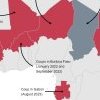
21 February 2013U.S. drone bases are multiplying on the African continent: Niger has agreed to hosting surveillance drones on its soil”; neighboring Burkina Faso already has one; two new drone facilities are opening in Ethiopia and the Seychelles; and UN peacekeepers in Congo want to use U.S. drones. Drones, which have terrorized Somalia from AFRICOM’s base in Djibouti for the past seven years, have become the centerpiece of the modern U.S. version of gunboat diplomacy.
31 January 2013Out of the blue in the last days Mali has suddenly become the focus of world attention. France has been asked to militarily intervene by Mali’s government to drive Jihadist terrorists out of the large parts of the country they claim. What the conflict in Mali really is about is hardly what we read in the mainstream media. It is about vast untapped mineral and energy resources and a de facto re-colonization of French Africa under the banner of human rights. The real background reads like a John LeCarre thriller.
Rome (Italy) | 24 January 2013It is too obvious that Western economic interests in Mali are not enough to explain France’s intervention there. Similarly, it is clear that islamism is not enough to explain vast terrorist action conducted simultaneously at an Algerian gas site. For Manlio Dinucci, this cocktail contains the classic ingredients of the strategy of tension. The target is Algeria, Mali is the rear base for the attack, and the islamists are a pretext for intervention.
21 January 2013As French soldiers pour into Mali in the fight to push back the advancing Islamist militants, questions have been raised as to the motives behind the intervention.
Author William Engdahl told RT the US was using France as a scapegoat to save face.
RT: At a time when France and the rest of the Eurozone are trying to weather the economic crisis, what’s Paris seeking to gain by getting involved in another conflict overseas?
William Engdahl: Well, I think the intervention in Mali is another (...)
Rome (Italy) | 20 August 2012Secretary of State Hillary Clinton and an areopagus of multinational bosses have made a long journey through Africa, from July 31st to August 10th, 2012, during which she endlessly boasted of the altruism and philanthropy of the United States. It was a grotesque masquerade as outlined by Manlio Dinucci, in terms of Washington’s disastrous colonial record and that of its corporations on the black continent.
14 August 2012That China’s rise in Africa amounts to neo-colonialism and is resented by Africans is a notion existing primarily in the minds of Western analysts, as educator and author Brendan P. O’Reilly aptly points out. There are stark differences between Beijing’s and Washington’s foreign policies, and nowhere are these more obvious than in Africa: China’s interests are purely economic, while the U.S. remains obsessed with military dominance. In short, while the U.S. bombs and weaponizes, China is pursuing cooperation based on mutual benefits.
31 July 2012Northern Mali promises to be the graveyard of scores of innocent people if African countries don’t collectively challenge Western influence in the region.
The Republic of Mali is fast becoming the Afghanistan of Africa. The reference is being applied with growing enthusiasm by Western media. The tragic reality is that Mali, with massive size and relatively sparse population - 1,240,000 km² and a population of nearly 15.5 million - was, until a few months ago, paraded as a model of stability (...)
Beijing (China) | 20 July 20121. We, the Ministers of Foreign Affairs and Ministers in charge of economic cooperation of the People’s Republic of China and 50 African countries and the Chairperson of the African Union (AU) Commission, met in Beijing from 19 to 20 July 2012 for the Fifth Ministerial Conference of the Forum on China-Africa Cooperation (FOCAC).
2. We express our thanks to H.E. President Hu Jintao of the People’s Republic of China and H.E. President Jacob Gedleyihlekisa Zuma of the Republic of South Africa, (...)
New York (United States) | 24 June 2012The White House has put in writing its policies for sub-Saharan Africa. The problem is, there’s hardly a word of truth in the document, and not a single mention of AFRICOM, the U.S. military command on the continent. The presidential paper repeats Obama’s 2009 lecture to Africans on “good governance.” He also warned that they avoid the “excuses” of blaming “neocolonialism” and “racism” for their problems. Meanwhile, AFRICOM is “positioning the U.S. to launch coups at will against African civilian, or even military, leaders that fall out of favor with Washington.”
14 June 2012The United States has been expanding its secret intelligence operations across Africa throught a network of small air bases in the continent and under the pretext of fighting terrorism.
The Washington Post reported on Wednesday that the US military has established some small air bases across Africa and trained many army personnel in a bid to keep crucial African regions under surveillance.
The report, obtained from documents and people involved in the US military project, said that the US (...)
Chicago (USA) | 9 April 2012President Obama’s statement on defense strategy announced a stronger U.S. presence in Asia-Pacific, while keeping Africa under the radar. Yet, recent developments clearly suggest that the Black Continent has become the new U.S. military playground of imperial conquest. It is now Mali’s turn to have plunged into turmoil. In this article, written in February 2012 when the latest "Tuareg rebellion" erupted in northern Mali, Rick Rozoff connects the dots between these events and Mali’s pivotal role in Washington’s strategy for Africa, conjecturing that, after Libya, the stage is possibly being set for another U.S. led intervention.
Rome (Italy) | 26 March 2012The Combined Joint Task Force-Horn of Africa is one of two “commands” of AFRICOM, the new Unified Combatant Command of U.S. forces in Africa. Originally conceived by the Israeli-American Institute for Advanced Strategic and Political Studies, AFRICOM is the central command for the new ambitions of empire in Africa. The most recent illustration of this is the creation of the no-fly zone used in the conquest of Libya, allowing the United States to seize the oil resources of that country and the state of Israel to rid itself of its most serious rival on the African continent.
Frankfurt (Germany) | 26 March 2012While few would criticize putting indicted Ugandan war criminal Joseph Kony in prison, the motives and timing of the viral video campaign launched by an NGO with an angelic sounding name are less clear. Invisible Children has blurred the line between charity and politics, advocating direct military action. What is clear to this author is that “Kony2012” is ’manipulative propaganda being used to advance an AFRICOM military presence in the richest mineral region in the world’ before China stakes a claim to it. The battle for Africa has only just begun.
5 December 2011Israel is looking at Africa’s east as an important strategic interest, and trying to step up ties with nations in the region under the name of “controlling the spread of Islamic extremists”.
The Associated Press reports that Israeli Prime Minister Benjamin Netanyahu hosted the leaders of Uganda and Kenya earlier this week. The Kenyan leader (in the photo with Netanyahu) has said that the Zionist entity has promised to provide ‘security assistance’ to his country to help protect its borders. (...)
21 November 2011Divide and conquer stratagems are back with a vengeance throughout the Arab world, fanning the flames of discontent and undermining national sovereignty. The stage is being set for a contrived "clash of civilizations," closely following the 1982 plan of Israeli strategist Oded Yinon, for which any form of peaceful coexistence among the various ethnic and religious groups living in Arab countries spells disaster and must be stamped out. Nazemroaya analyses the process already underway.
8 November 2011Washington increased its drone fleet to 7 000 units in Africa, and opened a new drone base in an airport in Southern Ethiopia.
Along with two other drone bases located in Djibouti (Camp Lemonier) and on the Seychelles Islands, in the Indian Ocean, the new base in Ethiopia increases the mobility of the unmanned planes which are the main war instrument of the Pentagon and the CIA to launch an air attack against Al Shabab, in the Horn of Africa.
Drones currently flying over Somalia are (...)
Rome (Italy) | 29 October 2011Washington is expanding its humanitarian military operations in Africa: here, it’s to curb arms circulation; there, to fight against a criminal gang. Any excuse is good to seize control of the black continent and of its fabulous wealth. But on closer examination, as geographer Manlio Dinucci observes, the U.S. penetration of Africa is patterned after the old European colonialist model.
25 October 2011Libyan leader Colonel Gaddafi overthrew the repressive Libyan monarchy of King Idris in 1969, nationalised the oil and banking industry and with the profits oversaw Africa’s first communication satellite in 2007, free health care and education for the Libyan people. He was working towards the unification of Africa to create a single African trading bloc and a single African currency based on gold and dinar, along with a united African military force.
In the following video, taped before (...)
14 October 2011Back in the UK, after several months spent in Libya covering NATO war crimes and uncovering mainstream media lies, freelance journalist Lizzie Phelan continues to fight for truth and justice on behalf of the Libyan people. Her testimony below is a gripping example of her commitment.
Lizzie Phelan spent her last days in Libya - where she was reporting for PressTV - trapped in the Rixos Hotel, together with Thierry Meyssan, Mahdi Nazemroaya and two other members of the Voltaire Network (...)
6 October 2011Creating terror groups in order to justify a fight against terrorism has become the modus operandi of the US government in Afghanistan and Pakistan, Europe and more recently in Africa. Along with French videographer Julien Teil, Nazemroaya weaves the incredible-but-true scenario of US-sponsored terrorists wanted by Interpol, who have become the chief protagonists in the NATO genocide currently unfolding in Libya.
Tripoli (Libya) | 18 August 2011The United States tried to seize on Monday 1 500 000 000 dollars owned by the Libyan state, but at the last minute South Africa got in its way. The documents emanating from this episode, and unveiled by Voltaire Network, reveal that the members of the NTC and their staff are the direct employees of a US entity.
Tripoli (Libya) | 16 July 2011The division of Libya into three separate countries has been an old imperialist objective of the U.S., Britain, Italy, and France. There have been at least five attempts to divide Libya. The NATO war launched against Libya in 2011 is merely the latest attempt to bring this about. The July 2011 gathering in Istanbul of NATO is really discussing the occupational phase of the war, which will attempt to send foreign troops into Libya to create a buffer zone between Benghazi and Tripoli. The NATO war, however, has backfired. The Libyan people have united to save their country and Tripoli is exploring its strategic options. A new strategic axis may even form between Iran, Algeria, Syria, and Libya that would interface with Venezuela, Russia, China, Sudan, and others to oppose (...)
4 July 2011One of the motives for the war against Libya is to stop the development of the black continent, to enable the setting up of an AfriCom military base in Cyrenaica and to begin the colonial exploitation of Africa for the benefit of the United States. In order to understand this hidden agenda, Voltaire Network interviewed Mohamed Siala, Co-operation Minister and Manager of Libya’s sovereign wealth fund.
Ottawa (Canada) | 16 May 2011The International Criminal Court chief prosecutor has announced that he is seeking the arrest of Colonel Muammar Gaddafi for crimes against humanity, purporting to have evidence of his "widespread and systematic attacks on unarmed Libyan civilians". In the second chapter of his study on the War on Libya, Mahdi Darius Nazemroaya dismantles the double standards and media fabrications that helped to sell the war, and which are now likely to constitute the "evidence" for the ICC charges being brought against Gaddafi.
Beirut (Lebanon) | 29 March 2011After some hesitation over how to respond to the Arab revolutions, the Obama administration has opted for the strong-arm solution as a means to rescue those vassals which can still be salvaged. As in the past, the task of leading the counter-revolution devolved upon Saudi Arabia. Riyad first succeeded in having its Libyan pawns recognized by the international community and later trampled over Bahrain, drowning the popular uprising in blood.
Chicago (USA) | 26 March 2011Had Muammar Gaddafi become too pesky for the likes of Nicolas Sarkozy and his Atlanticist partners, by standing in the way of their agenda for the domination of the Mediterranean sea region? France’s direct role in nurturing the rebellion against the Libyan leader is no longer a secret. In this article, Rick Rozoff offers some additional pointers, and analyzes the Libyan war in the context of the advancing transformation of the Mediterranean into NATO’s mare nostrum.
Chicago (USA) | 21 February 2011Under the banner of NATO and pretending to gear up against an unspecified security threat against Africa, the United States has expanded its presence to every corner of the continent, virtually turning it into a military campground. The only threat facing, not Africa, but the United States is Chinese influence and competition for the same resources. However, it may not prove easy to beat China at a game she already excels at ... without needing to deploy any hardware.