Voltaire Network
From Mossadegh to Ahmadinejad

The CIA and the Iranian experiment

The CIA and the Iranian experiment

The news of alleged election fraud has spread through Tehran like wildfire, pitching ayatollah Rafsanjani’s supporters against ayatollah Khamenei’s in street confrontations. This chaotic situation is secretly stirred by the CIA which has been spreading confusion by flooding Iranians with contradicting SMS messages. Thierry Meyssan recounts this psychological warfare experiment.

Voltaire Network | Beirut (Lebanon)
+
JPEG - 20.7 kb

In March 2000, the Secretary of State Madeleine Albright admitted that the Eisenhower administration organized a regime change in 1953 in Iran and that this historical event explained the current hostility of Iranians towards the United States. Last week, during the speech he addressed to Muslims in Cairo, President Obama officially recognized that « in the midst of the cold war the United States played a role in the toppling of a democratically elected Iranian government » [1].

At the time, Iran was controlled by a puppet monarchy headed by the Shah Mohammad Reza Pahlavi. He had been placed on the throne by the British who forced his father, the pro-Nazi Cossack officer Reza Pahlavi to resign. However, the Shah had to deal with a nationalist Prime Minister, Mohammad Mossadegh. Mossadegh, with the help of ayatollah Abou al-Qassem Kachani, nationalized the oil resources [2]. Furious, the British persuaded the United States that the Iranian dissent needed to be stopped before the country became communist. The CIA then put together Operation Ajax to overthrow Mossadegh with the help of the Shah, and to replace him with Nazi general Fazlollah Zahedi who until then was detained by the British. Zahedi is responsible for having instituted the cruelest terror regime of the time, while the Shah would cover his exactions while parading for Western ‘people’ magazines.

Operation Ajax was lead by archeologist Donald Wilber, historian Kermit Roosevelt (grandson of president Theodore Roosevelt) and general Norman Schwartzkopf Sr. (whose son with the same name lead Operation Desert Storm). This operation remains a textbook example of subversion. The CIA came up with a scenario that gave the impression of a popular revolt when in reality it was a covert operation. The highpoint of the show was a demonstration in Tehran with 8 000 actors paid by the Agency to provide credible pictures to Western media [3].

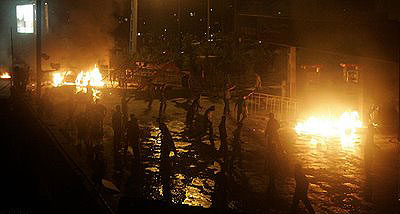
Is History repeating itself? Washington renounced to a military attack on Iran and has dissuaded Israel to take such an initiative. In order to « change the regime », the Obama administration prefers to play the game of covert actions – less dangerous but with a more unpredictable outcome. After the Iranian presidential elections, huge demonstrations in the streets of Tehran are pitching supporters of president Mahmoud Ahmadinejad and supreme leader Ali Khamenei on one side, to supporters of defeated candidate Mir-Hossein Mousavi and former president Akbar Hashemi Rafsanjani on the other. The demonstrations are a sign of a profound division in the Iranian society between a nationalist proletariat and a bourgeoisie upset at being held back from economic globalization [4]. With its covert actions, Washington is trying to weigh on the events to topple the re-elected president.

Once again, Iran is an experimental field for innovative subversive methods. CIA is relying in 2009 on a new weapon: control of cell phones. Since the democratization of mobile phones, Anglo-Saxon secret services have increased their interception capability. While wired phones’ tapping requires the installation of branch circuits – and therefore local agents, tapping of mobile phones can be done remotely using the Echelon network. However, this system cannot intercept Skype mobile phones communications, which explains the success of Skype telephones in conflict areas [5]. The National Security Agency (NSA) therefore lobbied world Internet Service Providers to require their cooperation. Those who accepted have received huge retribution [6].

In countries under their occupation —Iraq, Afghanistan and Pakistan—, the Anglo-Saxons intercept all telephone communication, whether mobile or wired. The goal is not to obtain full transcripts of any given conversation, but to identify « social networks ». In other words, telephones are surveillance bugs which make it possible to know who anyone is in touch with. Firstly, the hope is to identify resistance networks.

Secondly, telephones make it possible to locate identified targets and «neutralize» them. This is why in February 2008, the Afghan rebels ordered various operators to stop their activity daily, from 5PM to 3AM, in order to prevent the Anglo-Saxons to follow their whereabouts. The relay antennas of those that refused to comply where destroyed [7].

On the contrary, with the exception of a telephone exchange which was accidentally hit, Israeli forces made sure not to hit telephone exchanges in Gaza during Operation Cast Lead from December 2008 to January 2009. This is a complete change in strategy. Since the Gulf War, the most prevalent strategy was colonel John A. Warden’s « five circles theory »: the bombing of telephone infrastructures was considered a strategic objective to both confuse populations and to cut communication lines between commanding centers and fighters. Now the opposite applies: telecommunication infrastructures must be protected. During the bombings in Gaza, the operator Jawwal [8] offered additional talk time to its users – officially to help them but de facto serving Israel’s interests. Going one step further, Anglo-Saxons and Israeli secrets services developed psychological warfare methods based on an extensive use of mobile phones. In July 2008, after the exchange of prisoners and remains between Israel and Hezbollah, robots placed tens of thousands of calls to Lebanese mobile phones. A voice speaking in Arabic was warning against participating in any resistance activity and belittled Hezbollah. The Lebanese minister of telecommunications, Jibran Bassil [9], files a complaint to the UN against this blatant violation of the country’s sovereignty [10]. Following the same approach, tens of thousands of Lebanese and Syrians received an automatic phone call in October 2008 to offer them 10 million dollars for any information leading to the location and freeing of Israeli prisoners. People interested in collaborating were invited to call a number in the UK [11].

This method has now been used in Iran to bluff the population, to spread shocking news and to channel the resulting anger.

First, SMS were sent during the night of the counting of the votes, according to which the Guardian Council of the Constitution (equivalent to a constitutional court) had informed Mir-Hossein Mousavi of his victory. After that, the announcing of the official results — the re-election of Mahmoud Ahmadinejad with 64 % of cast votes — seemed like a huge fraud. However, three days earlier, M. Mousavi and his friends were considering a massive victory of M. Ahmadinejad as certain and were trying to explain it by unbalanced campaigns. Indeed the ex president Akbar Hashemi Rafsanjani was detailing his grievances in an open letter. The US polling institutes in Iran were predicting a 20 points lead for M. Ahmadinejad over M. Mousavi  [12]. M. Mousavi victory never seemed possible, even if it is probable that some fraud accentuated the margin between the two candidates.

Secondly, Iranian citizens were selected or volunteered on the Internet to chat on Facebook or to subscribe to Twitter feeds. They received information —true or false— (still via SMS) about the evolution of the political crisis and the ongoing demonstrations. These anonymous news posts were spreading news of gun fights and numerous deaths which to this day have not been confirmed. Because of an unfortunate calendar overlap, Twitter was supposed to suspend its service for a night to allow for some maintenance of its systems. The US State Department intervened to ask them to postpone it [13]. According to the New York Times, these operations contributed to spread defiance in the population [14].
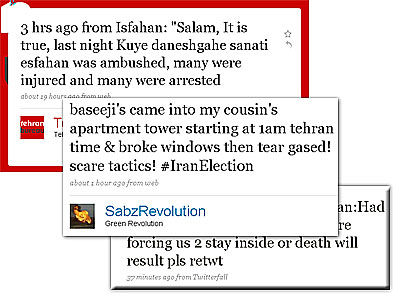
JPEG - 35.8 kb
Messages describing death threats, police bursting into homes, etc. sent by authors who cannot be indentified or located.

Simultaneously, in a new type of effort, the CIA is mobilizing anti-Iranian militants in the United States and in the United Kingdom to increase the chaos. A Practical Guide to revolution in Iran was distributed to them, which contains a number of recommendations, including:
- set Twitter accounts feeds to Tehran time zone;
- centralize messages on the following Twitter accounts @stopAhmadi, #iranelection and #gr88 ;
- official Iranian State websites should not be attacked. « Let the US military take care of it » (sic).
When applied, these recommendations make it impossible to authenticate any Twitter messages. It is impossible to know if they are being sent by witnesses of the demonstrations in Tehran or by CIA agents in Langley, and it is impossible to distinguish real from false ones. The goal is to create more and more confusion and to push Iranians to fight amongst themselves.

Army general staffs everywhere in the world are closely following the events in Tehran. They are trying to evaluate the efficiency of this new subversion method in the Iranian experimental field. Evidently, the destabilization process worked. But it is unclear if the CIA will be able to channel demonstrators to do what the Pentagon has renounced to do, and what they do not want to do themselves : to change the regime and put an end to the Islamic revolution.

English version by J.C.

[1] « Obama Speech In Cairo », Voltaire Network, 6 June 2009.

[2] « BP-Amoco, coalition pétrolière anglo-saxonne », Arthur Lepic, Voltaire Network, June 10 2004.

[3] On the 1953 coup, the reference work is All the Shah’s Men : An American Coup and the Roots of Middle East Terror, by Stephen Kinzer, John Wiley & Sons éd (2003), 272 pp.

[4] « La société iranienne paralysée », Thierry Meyssan, Voltaire Network, 5 février 2004.

[5] « Taliban using Skype phones to dodge MI6 », Glen Owen, Mail Online, September 13 2008.

[6] « NSA offering ’billions’ for Skype eavesdrop solution », Lewis Page, The Register, February 12 2009.

[7] « Taliban Threatens Cell Towers », Noah Shachtman, Wired, February 25 2008.

[8] Jawwal belongs to PalTel, Palestinian billionaire Munib Al-Masri’s company.

[9] Jibran Bassil is one of the main leaders of the ‘Courant patriotique libre’, the nationalist party of Michel Aoun.

[10] « Freed Lebanese say they will keep fighting Israel », Associated Press, July 17 2008.

[11] The author of this article witnessed these phone calls. Also see « Strange Israeli phone calls alarm Syrians. Israeli intelligence services accused of making phone calls to Syrians in bid to recruit agents », Syria News Briefing, December 4 2008.

[12] Quoted in « Ahmadinejad won. Get over it », Flynt Leverett and Hillary Mann Leverett, Politico, June 15 2009.

[13] « U.S. State Department speaks to Twitter over Iran », Reuters, June 16 2009.

[14] « Social Networks Spread Defiance Online », Brad Stone and Noam Cohen, The New York Times, June 15 2009.

<span lang='fr'>Thierry Meyssan</span>

Thierry Meyssan French intellectual, founder and chairman of Voltaire Network and the Axis for Peace Conference. His columns specializing in international relations feature in daily newspapers and weekly magazines in Arabic, Spanish and Russian. His last two books published in English : 9/11 the Big Lie and Pentagate.

 
Covert Action
Although the principle of state sovereignty lies at the heart of international law, the super powers have not refrained from corrupting governments, destabilising societies, eliminating their leaders and even overthrowing regimes by means of covert action. While this form of interference is relatively inexpensive when weighed against the potential gains, it inevitably undermines trust among nations.
The Anglo-Saxons have become the masters of the game. As joint signatories to a 1948 secret military pact (UK-USA + Canada, Australia, New Zealand), they fashioned espionage and covert action tools to serve their common project: the Cold War. They were rivaling in this field against the Soviet Union, over which they had already attained undeniable superiority. Both Maoist China and post-colonial France also resorted to analogous means with a view to securing zones of interest, mainly in Africa.
The landscape changed completely after the demise of the USSR. China stopped financing armed revolutionary groups all around and concentrated on pragmatic intelligence efforts to sustain economic cooperation development. France withdrew from its private reserve in Africa to leave room for the European Union. Having outlived the Yeltsin abyss, Russian intelligence set about restructuring at the national level and in their historical area of influence (newly independent ex-Soviet states) by mobilizing against external intrusions rather than interfering in the affairs of other countries.
As of 1995, the Anglo-Saxons invested massively in their secret services, whose budget tripled over a 15-year period. In addition, they have drawn the Israeli services into their structure either as full members or as subcontractors. In 2009, the Anglo-Saxon services (except Israel) operate on an employment level of 250,000 men and a budget exceeding 100 billion dollars (i.e. 15 times higher than Russia’s, virtually their main competitor). In effect, espionage and covert action have become the essential tools of forced globalisation.
+

Article licensed under Creative Commons

The articles on Voltaire Network may be freely reproduced provided the source is cited, their integrity is respected and they are not used for commercial purposes (license CC BY-NC-ND).

Support Voltaire Network

You visit this website to seek quality analysis that enables you to forge your own understanding of today’s world. In order to continue our work, we need you to support our efforts.
Help us by making a contribution.

How to participate in Voltaire Network?

The members of our team are all volunteers.
- Authors : diplomats, economists, geographers, historians, journalists, military servicemen, philosophers, sociologists. You can send us your article proposals.
- Professional-level mother-tongue translators: you can help us by translating our articles.

International edition
français
English
Español
italiano
Português
عربي
Deutsch
 
85 <span lang='fr'>articles cette semaine dans toutes les langues</span>
"In Lybia now the truth is coming out"
New York Times interview with Lizzie Phelan
"In Lybia now the truth is coming out"
by Lizzie Phelan, Voltaire Network, 4 February 2012
 
Europe in the US "rotation"
The art of war
Europe in the US "rotation"
by Manlio Dinucci , Voltaire Network, 3 February 2012
 
Páginas Libres
Espionaje chileno no se amedrenta ni ante catástrofes
por Guillermo Olivera Díaz, Socios, 3 de febrero de 2012
 
Señal de Alerta
¡Big brother is watching you!
por Herbert Mujica Rojas, Socios, 3 de febrero de 2012
 
Draft resolution dealing with Syria (by Morrocco) Draft resolution dealing with Syria (by Morrocco)
Voltaire Network, 3 February 2012
 
François Hollande verhandelt mit dem Emir des Qatar François Hollande verhandelt mit dem Emir des Qatar
Voltaire Netzwerk, 3. Februar 2012
 
L'OTAN se heurte à la Russie et à la Chine
« Revue de presse Syrie » #42
L’OTAN se heurte à la Russie et à la Chine
Partenaires, 2 février 2012
 
Letra abierta para el deshonorable Ban Ki-Moon
Corrupción en la cumbre
Letra abierta para el deshonorable Ban Ki-Moon
por Hassan Hamade, Red Voltaire, 2 de febrero de 2012
 
Die Europäer, erste Opfer der Sanktionen gegen Iran Die Europäer, erste Opfer der Sanktionen gegen Iran
Voltaire Netzwerk, 2. Februar 2012
 
NATO runs up against Russia and China
« SYRIA PRESS REVIEW » #42
NATO runs up against Russia and China
Partners, 2 February 2012
 
Señal de Alerta
TC-Urviola: ¿gato de despensero?
por Herbert Mujica Rojas, Socios, 1ro de febrero de 2012
 
U.N. Security Council discusses the situation in Lybia U.N. Security Council discusses the situation in Lybia
Voltaire Network, 1 February 2012
 
Páginas Libres
TC prevarica y esconde torpemente a prevaricador
por Guillermo Olivera Díaz, Socios, 31 de enero de 2012
 
La fuite imaginaire de la famille el-Assad
« Revue de presse Syrie » #40
La fuite imaginaire de la famille el-Assad
Partenaires, 31 janvier 2012
 
Conseil national syrien et 14-Mars libanais : même cause, même combat
« Tendances de l’Orient »
Conseil national syrien et 14-Mars libanais : même cause, même combat
par Pierre Khalaf, Partenaires, 31 janvier 2012
 
Europeans first victims of sanctions against Iran Europeans first victims of sanctions against Iran
Voltaire Network, 31 January 2012
 
François Hollande négocie avec l'émir de Qatar François Hollande négocie avec l’émir de Qatar
Réseau Voltaire, 31 janvier 2012
 
Páginas Libres
Prevarica juez constitucional que antes fue abogado de BCP
Socios, 31 de enero de 2012
 
The imaginary flight of the Assad family
« SYRIA PRESS REVIEW » #40
The imaginary flight of the Assad family
Partners, 31 January 2012
 
Impotence, hypocrisy and Western division over Iran
« Orient Tendencies »
Impotence, hypocrisy and Western division over Iran
by Wassim Raad, Partners, 31 January 2012
 
La fuga imaginaria de la familia al-Assad
« Revista de prensa sobre Siria » #40
La fuga imaginaria de la familia al-Assad
Socios, 31 de enero de 2012
 
Press sees rebels at Damascus gates
« SYRIA PRESS REVIEW » #39
Press sees rebels at Damascus gates
Partners, 30 January 2012
 
La presse voit des rebelles aux portes de Damas
« Revue de presse Syrie » #39
La presse voit des rebelles aux portes de Damas
Partenaires, 30 janvier 2012
 
Páginas Libres
Integración suramericana prosigue imparable camino
Socios, 30 de enero de 2012
 
What Is Really Going On In Syria: Insider Update What Is Really Going On In Syria: Insider Update
by Boris Dolgov, Voltaire Network, 30 January 2012
 
254. Rattachement de la Suisse à la toile d'araignée mondiale
« Horizons et débats », 12e année, n° 4, 30 janvier 2012
Rattachement de la Suisse à la toile d’araignée mondiale
Partenaires, 30 janvier 2012
 
Offener Brief an den unehrlichen Ban Ki-Moon
Korruption am Gipfel
Offener Brief an den unehrlichen Ban Ki-Moon
von Hassan Hamade, Voltaire Netzwerk, 30. Januar 2012
 
La prensa inventa rebeldes a las puertas de Damasco
« Revista de prensa sobre Siria » #39
La prensa inventa rebeldes a las puertas de Damasco
Socios, 30 de enero de 2012
 
سورية
الأيام الصعبة
بقلم نضال الخضري, Partners, 30 كانون الثاني (يناير) 2012
 
 Die Presse sieht die Rebellen vor den Toren von Damaskus
« Presseschau Syrien » #39
Die Presse sieht die Rebellen vor den Toren von Damaskus
Partner, 30. Januar 2012
 
الداخلية السورية لن تتساهل مع المسلحين
موسكو تريد الإطلاع على تقرير المراقبين
بقلم سورية الغد, Partners, 30 كانون الثاني (يناير) 2012
 
سورية
((طبخة دولية))..
بقلم سورية الغد, Partners, 30 كانون الثاني (يناير) 2012
 
Señal de Alerta
¡Ojo con Licitación en Poder Judicial!
por Herbert Mujica Rojas, Socios, 29 de enero de 2012
 
Le CCG et la Turquie se tournent vers l'OTAN
« Revue de presse Syrie » #38
Le CCG et la Turquie se tournent vers l’OTAN
Partenaires, 29 janvier 2012
 
 Der GCC und die Türkei wenden sich an die NATO
« Presseschau Syrien » #38
Der GCC und die Türkei wenden sich an die NATO
Partner, 29. Januar 2012
 
The GCC and Turkey turn to NATO
« SYRIA PRESS REVIEW » #38
The GCC and Turkey turn to NATO
Partners, 29 January 2012
 
El CCG y Turquía recurren a la OTAN
« Revista de prensa sobre Siria » #38
El CCG y Turquía recurren a la OTAN
Socios, 29 de enero de 2012
 
موسكو تلوح بالفيتو مجدداً
تصاعد موجة العنف واعتداء على السفارة السورية في القاهرة
بقلم سورية الغد, Partners, 28 كانون الثاني (يناير) 2012
 
الحرب الافتراضية
شاشات الدم
Partners, 28 كانون الثاني (يناير) 2012
 
المواجهة السورية
روسيا من جديد...
بقلم مازن بلال, Partners, 28 كانون الثاني (يناير) 2012
 
بعد الجمعة
عبوة ناسفة.. لذاكرتي
بقلم نضال الخضري, Partners, 28 كانون الثاني (يناير) 2012
 
The Geopolitical Stakes in Nigeria: The Curious Role of the IMF
Part 1
The Geopolitical Stakes in Nigeria: The Curious Role of the IMF
by F. William Engdahl, Voltaire Network, 28 January 2012
 
The "Syrian revolution" no longer fires Western imagination
« SYRIA PRESS REVIEW » #37
The "Syrian revolution" no longer fires Western imagination
Partners, 27 January 2012
 
An Open Letter to the dishonorable Ban Ki-moon
Corruption at the Top
An Open Letter to the dishonorable Ban Ki-moon
by Hassan Hamade, Voltaire Network, 27 January 2012
 
La “révolution syrienne” ne fait plus rêver les Occidentaux
« Revue de presse Syrie » #37
La “révolution syrienne” ne fait plus rêver les Occidentaux
Partenaires, 27 janvier 2012
 
Russia and China in the Balance of the Middle East: Syria and other countries Russia and China in the Balance of the Middle East: Syria and other countries
by Imad Fawzi Shueibi, Voltaire Network, 27 January 2012
 
Ver discurso de los presidentes Chávez y Ahmadinejad en Caracas
La agencia de noticias francesa AFP deforma palabras de Hugo Chávez para fabricar teoría conspiracionista
Ver discurso de los presidentes Chávez y Ahmadinejad en Caracas
Red Voltaire, 27 de enero de 2012
 
I moderni tagliatori di teste
L’arte della guerra
I moderni tagliatori di teste
di Manlio Dinucci , Rete Voltaire, 27 gennaio 2012
 
Irão : o assassinato de Ahmadi Roshan suscita 1000 vocações Irão : o assassinato de Ahmadi Roshan suscita 1000 vocações
Rede Voltaire, 27 de Janeiro de 2012
 
Páginas Libres
Santos y Pol Pot versus yacimientos mineros que aniquilan
por Guillermo Olivera Díaz, Socios, 27 de enero de 2012
 
Los occidentales dejan de soñar con la “revolución siria”
« Revista de prensa sobre Siria » #37
Los occidentales dejan de soñar con la “revolución siria”
Socios, 27 de enero de 2012
 
 Die “ syrische Revolution ” begeistert den Westen nicht mehr
« Presseschau Syrien » #37
Die “ syrische Revolution ” begeistert den Westen nicht mehr
Partner, 27. Januar 2012
 
الشهود الزور ..كما في لبنان كذلك في الشام الشهود الزور ..كما في لبنان كذلك في الشام
بقلم عيسى الأيوبي, Shabakat Voltaire, 27 كانون الثاني (يناير) 2012
 
Señal de Alerta
Limpieza y licitaciones en el Poder Judicial
por Herbert Mujica Rojas, Socios, 26 de enero de 2012
 
L'armée syrienne libère Douma et Hama
« Revue de presse Syrie » #36
L’armée syrienne libère Douma et Hama
Partenaires, 26 janvier 2012
 
Die syrische Armee befreit Duma und Hama
« Presseschau Syrien » #36
Die syrische Armee befreit Duma und Hama
Partner, 26. Januar 2012
 
El «Proyecto Juicio Final» y los eventos profundos: el asesinato de JFK, el Watergate, el Irangate y el 11 de septiembre
Historia del Estado profundo en EE.UU. (Primera parte)
El «Proyecto Juicio Final» y los eventos profundos: el asesinato de JFK, el Watergate, el Irangate y el 11 de septiembre
por Peter Dale Scott, Red Voltaire, 26 de enero de 2012
 
رغم فشلها المركزي يعود للمزادات..
المصارف متوقفة عن التمويل
بقلم سورية الغد, Partners, 26 كانون الثاني (يناير) 2012
 
الارهاب يطال الجميغ
اغتيال كاهن في حماه ورئيس فرع الهلال الأحمر في إدلب
Partners, 26 كانون الثاني (يناير) 2012
 
المعركة القادمة
روسيا والصياغة السورية
بقلم سورية الغد, Partners, 26 كانون الثاني (يناير) 2012
 
الحل الثقافي...
ديمقراطية المماليك
بقلم نضال الخضري, Partners, 26 كانون الثاني (يناير) 2012
 
El ejército sirio libera Duma y Hama
« Revista de prensa sobre Siria » #36
El ejército sirio libera Duma y Hama
Socios, 26 de enero de 2012
 
Syrian army liberates Douma and Hama
« SYRIA PRESS REVIEW » #36
Syrian army liberates Douma and Hama
Partners, 26 January 2012